How to Hire the Right Social Media Manager for Your Business
Key Takeaways
Hiring the right social media manager starts with goals. A brand awareness role requires different skills from a lead generation, community management, or content production role.
A strong social media manager does more than post. They plan content, protect brand voice, manage engagement, read analytics, and keep campaigns moving.
Cost is more than salary. Recruiting, tools, training, benefits, management time, and creative support all affect the true cost of hiring.
One person may not cover every skill. Growing businesses often need strategy, design, copywriting, reporting, and customer response support working together.
Smart VAs is a strong fit when execution is the bottleneck. The managed model helps businesses get consistent social media support without building a full internal department first.

ARE YOU STILL TRYING TO DO IT ALL?
Discover the SMART way to delegate without losing control—and finally free up your time.
If your posts are inconsistent, your inbox is ignored, and your social media feels more reactive than strategic, it may be time to hire a social media manager. But hiring the right person is not just about finding someone who knows Instagram, TikTok, LinkedIn, or Facebook.

The right hire should protect your brand voice, understand your audience, plan content with intention, respond with care, and help you understand what is actually working. That is where many growing businesses get stuck. They do not just need more posts. They need a better system for showing up online.
In this guide, I will walk you through what a social media manager does, how much hiring can cost in 2026, which skills matter most, what interview questions to ask, and when a Managed Specialist Team may be a better fit than one overloaded hire.
What Does a Social Media Manager Actually Do?
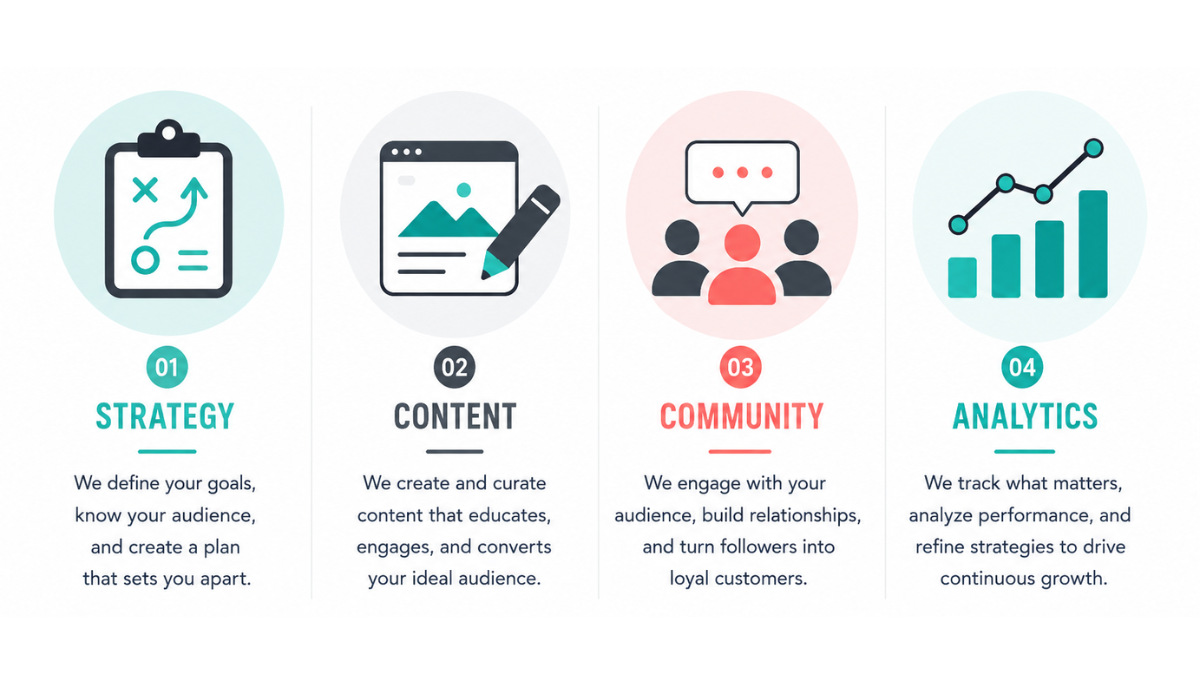
A social media manager plans, creates, schedules, monitors, and improves content across social platforms. The role is not just posting; it includes strategy, audience understanding, brand voice, community response, analytics, and campaign coordination.
I see this confusion often. A business owner says they need someone to "handle social media," but the actual work includes several different responsibilities. If you underestimate the scope, you can hire someone who is good at posting but not equipped to manage the full channel.
A social media manager may be responsible for:
Creating a monthly or weekly content calendar
Writing captions that match the brand voice
Coordinating graphics, reels, short videos, or visual assets
Scheduling posts across platforms
Monitoring comments, messages, tags, and mentions
Responding to basic customer questions or routing them to the right person
Tracking engagement, reach, clicks, leads, and campaign performance
Watching platform trends without chasing every trend blindly
Helping campaigns connect with launches, offers, events, or seasonal priorities
If your posts are inconsistent, your inbox is ignored, and your social media feels more reactive than strategic, it may be time to hire a social media manager. But hiring the right person is not just about finding someone who knows Instagram, TikTok, LinkedIn, or Facebook.
The right hire should protect your brand voice, understand your audience, plan content with intention, respond with care, and help you understand what is actually working. That is where many growing businesses get stuck. They do not just need more posts. They need a better system for showing up online.
In this guide, I will walk you through what a social media manager does, how much hiring can cost in 2026, which skills matter most, what interview questions to ask, and when a Managed Specialist Team may be a better fit than one overloaded hire.
What Does a Social Media Manager Actually Do?
A social media manager plans, creates, schedules, monitors, and improves content across social platforms. The role is not just posting; it includes strategy, audience understanding, brand voice, community response, analytics, and campaign coordination.
I see this confusion often. A business owner says they need someone to "handle social media," but the actual work includes several different responsibilities. If you underestimate the scope, you can hire someone who is good at posting but not equipped to manage the full channel.
A social media manager may be responsible for:
Creating a monthly or weekly content calendar
Writing captions that match the brand voice
Coordinating graphics, reels, short videos, or visual assets
Scheduling posts across platforms
Monitoring comments, messages, tags, and mentions
Responding to basic customer questions or routing them to the right person
Tracking engagement, reach, clicks, leads, and campaign performance
Watching platform trends without chasing every trend blindly
Helping campaigns connect with launches, offers, events, or seasonal priorities
This is why hiring a social media expert requires more than reviewing a portfolio. You need to know whether the person can think strategically, communicate clearly, and keep your brand consistent under real business pressure.
Why Should You Define Your Goals Before You Start Hiring?
You should define your goals first because different social media goals require different skills. A person who is strong at community building may not be the right fit for lead generation, paid campaigns, content systems, or executive brand visibility.
Before you write a job description or book an interview, decide what problem social media needs to solve for your business. Without that clarity, you risk hiring for activity instead of outcomes.
“The first question I would ask is not “Who can post for us?” It is “What do we need social media to do for the business right now?””
Common goals include:
Brand awareness: You need consistent storytelling, strong visuals, and regular visibility.
Lead generation: You need clear calls to action, landing page alignment, and campaign tracking.
Community engagement: You need thoughtful replies, inbox management, and relationship-building.
Recruiting or employer branding: You need culture content, employee stories, and professional positioning.
Client education: You need content that answers questions, handles objections, and builds trust.
Launch support: You need campaign planning, asset coordination, reminders, and timely reporting.
Once the goal is clear, the job description becomes easier. The interview also becomes more useful because you are asking about the actual results you need, not just general social media experience.
How Much Does It Cost to Hire a Social Media Manager in 2026?
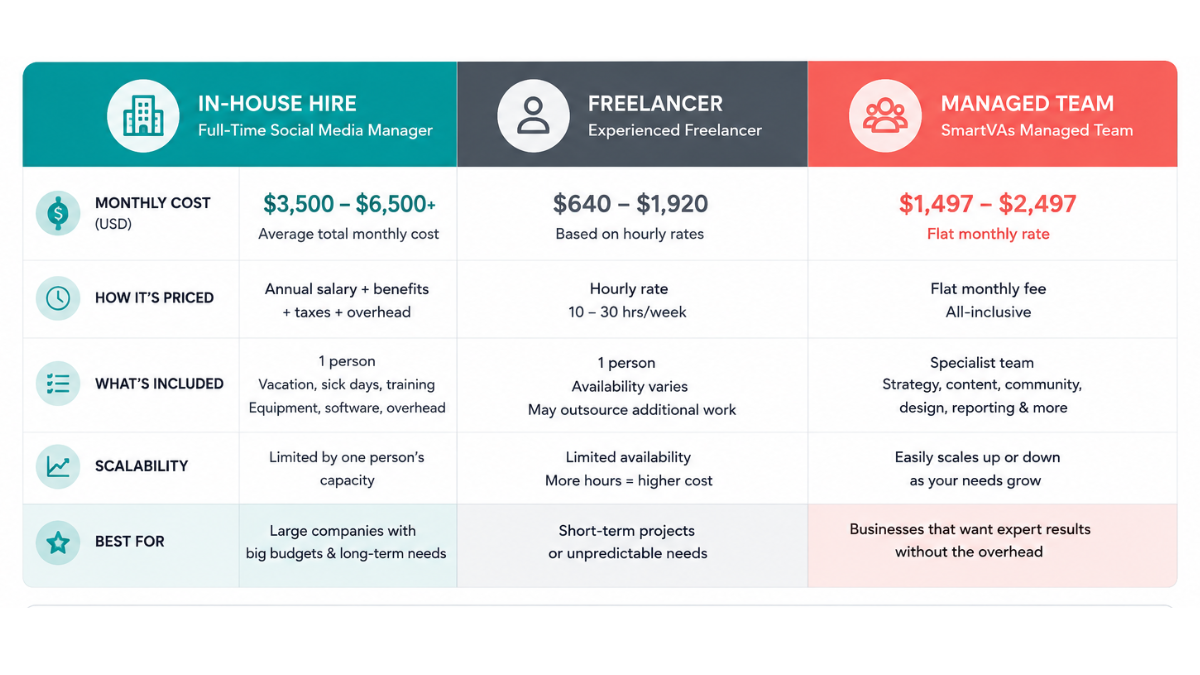
The cost depends on experience, location, scope, and hiring model. As a benchmark, Indeed lists the average U.S. social media manager salary at $64,959 per year, based on 3.1k salaries from job postings in the past 36 months, updated August 2, 2026.
For broader marketing leadership context, the U.S. Bureau of Labor Statistics reports that marketing managers earned a median annual wage of $161,030 in May 2024, while advertising and promotions managers earned $126,960. BLS also projects 6% employment growth for advertising, promotions, and marketing managers from 2024 to 2034.
Those numbers are useful, but they are not the whole cost. A business also has to consider recruiting time, onboarding, software, benefits, training, content tools, creative support, and management time.
| Cost Area | Internal Hire | Managed Specialist Team |
|---|---|---|
| Salary or Support Cost | Fixed payroll commitment | Flexible support based on workload |
| Benefits and Payroll Costs | Often added to employer overhead | Not carried as internal payroll overhead |
| Recruiting | Time-consuming screening and interviews | Specialists are already sourced and vetted |
| Training | Handled internally | Supported through existing processes and role experience |
| Creative Support | May require separate design, writing, or video help | Can coordinate with other specialists when needed |
| Management Time | Business owner or marketing leader supervises directly | Supported by a Client Success Partner and clear workflow |
| Scalability | Requires another hire when workload grows | Support can adjust as needs change |
This does not mean an internal hire is wrong. It means the budget conversation should include the real operating cost, not just one salary number.
Should You Hire In-House, a Specialized Remote Professional, or a Managed Specialist Team?
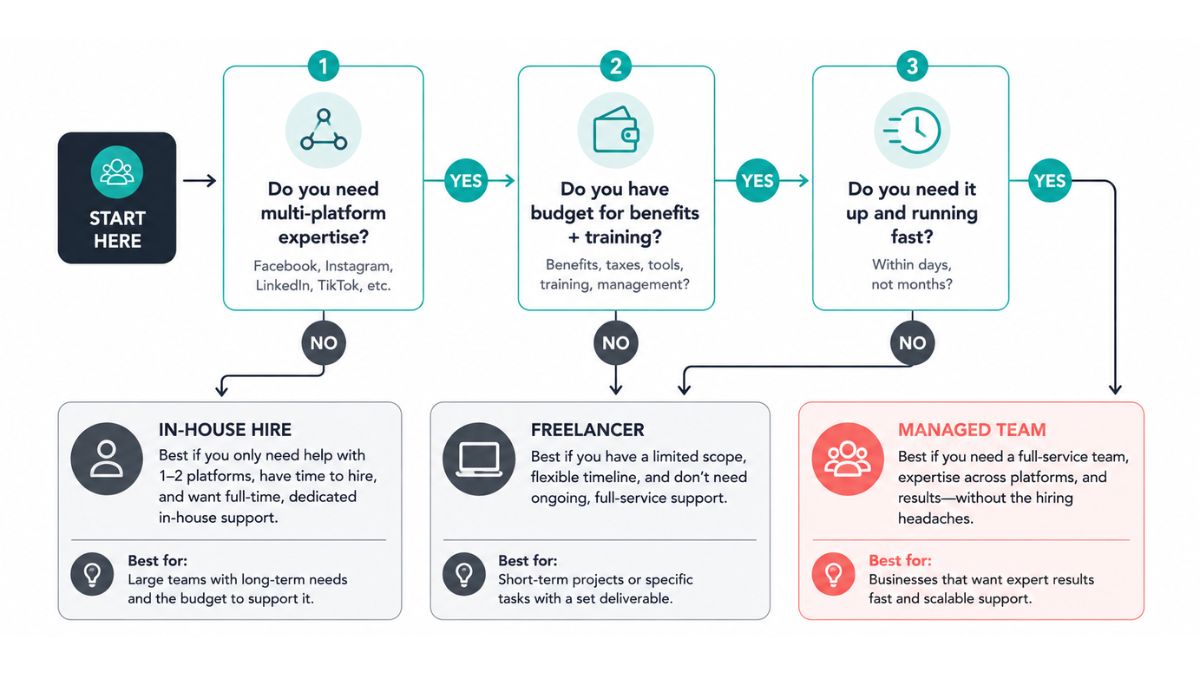
The best hiring model depends on workload, budget, skill needs, and how much management capacity you have. In-house support gives you proximity, a Specialized Remote Professional can help with focused tasks, and a Managed Specialist Team works best when consistency and scale matter.
Here is the practical difference:
| Hiring Model | Best For | What to Watch For |
|---|---|---|
| In-House Employee | Businesses with steady daily workload, internal management capacity, and long-term budget | Higher fixed cost, recruiting time, and limited skill breadth |
| Specialized Remote Professional | Focused support for a defined channel, project, or part-time workload | More direct management and backup planning may be needed |
| Managed Specialist Team | Growing businesses that need consistent posting, reporting, creative coordination, and scalable support | Works best when goals, brand voice, and approvals are clear |
At Smart VAs, our social media management specialist support is designed for business owners who need more than a content poster. A great specialist plans, writes, schedules, responds, analyzes, and adjusts so your content has a business purpose.
This is where many business owners feel relief. They realize they do not have to choose between doing everything alone and building a full internal department before they are ready.
What Skills and Qualifications Should You Look For?
Look for a mix of platform knowledge, communication skills, creative judgment, and analytics literacy. A strong social media manager should be able to create content, read performance data, protect brand voice, and respond to public interactions with good judgment.
The best person for the role understands that social media is both creative and operational. They need to be comfortable with ideas, deadlines, customer tone, and numbers.
Important skills include:
Platform knowledge: They understand how content behaves differently on Instagram, Facebook, LinkedIn, TikTok, Pinterest, or YouTube.
Content planning: They can map themes, campaigns, offers, and audience needs into a workable calendar.
Copywriting: They can write captions that sound like your brand and invite action without sounding forced.
Visual judgment: They can guide or coordinate images, reels, graphics, and templates.
Analytics literacy: They can explain what the numbers mean and what should change next.
Community care: They can respond to comments, messages, and negative feedback calmly.
Adaptability: They can adjust when platform behavior, audience response, or business priorities shift.
If your social media plan requires polished graphics, a graphic design specialist may also be needed so the manager is not forced to become designer, strategist, writer, and analyst at the same time.
Where Can You Find Qualified Social Media Manager Candidates?
You can find candidates through referrals, job boards, professional communities, industry groups, internal promotions, or a managed support partner. The right source depends on how much time you have to recruit, vet, train, and manage the person yourself.
If you are hiring internally, job boards can help you reach a wider candidate pool. Referrals can also work well because they come with some trust built in. The challenge is that you still have to screen for quality, review portfolios, check communication style, and confirm they can handle the actual workload.
If you are working with a managed partner, the screening burden is lighter because the team already has a vetting and matching process. That does not remove your role from the decision, but it can save time and reduce hiring friction.
Good places to look include:
Referrals from other business owners in your industry
Marketing and social media communities
LinkedIn posts and professional networks
Job boards with clear role descriptions and salary ranges
Existing team members who understand your brand and want to grow into the role
A Managed Specialist Team that can match the role to your workload and goals
How Do You Write a Job Description That Attracts the Right Candidates?
A good job description is specific about goals, platforms, responsibilities, tools, reporting, and success metrics. Vague job posts attract vague candidates, while clear expectations help the right person see whether they can truly support the business.
Start with the business outcome. Are you trying to build visibility, generate leads, improve engagement, support launches, or create a more consistent content system? Then describe the work needed to support that outcome.
Your job description should include:
A short role summary tied to business goals
Platforms the person will manage
Posting cadence and content volume expectations
Content creation, scheduling, community response, and reporting duties
Tools used for scheduling, analytics, design, communication, and approvals
Required skills versus preferred skills
Examples of brand voice or industry experience that would be helpful
Reporting cadence and how performance will be reviewed
Avoid asking for everything unless you are truly hiring for a multi-role marketing position. If you expect one person to manage strategy, write content, design graphics, edit video, answer messages, analyze data, and run ads, be clear about that scope and budget accordingly.
What Should You Ask During the Interview Process?
The best interview questions test judgment, not just experience. Ask how the candidate plans content, responds to feedback, reads analytics, protects brand voice, handles negative comments, and adjusts strategy when the numbers are not moving.
A polished portfolio is helpful, but it does not tell the full story. You also need to understand how the person thinks when a campaign underperforms, a customer complains publicly, or leadership changes direction mid-month.
Use questions like:
How would you build a 30-day content calendar for our business?
Which metrics would you track weekly, and why?
How do you adjust content when engagement drops?
How would you respond to a negative comment from a customer?
How do you learn a new brand voice?
What does a strong caption need besides a good hook?
How do you decide whether a trend is worth using?
Can you show an example where social content supported a business goal?
How do you communicate delays, blockers, or unclear requests?
You can also give a small practical exercise. Ask them to review a current post, explain what they would improve, and describe how they would measure the result. That shows whether they can connect creativity with strategy.
What Are the Biggest Red Flags When Hiring a Social Media Manager?
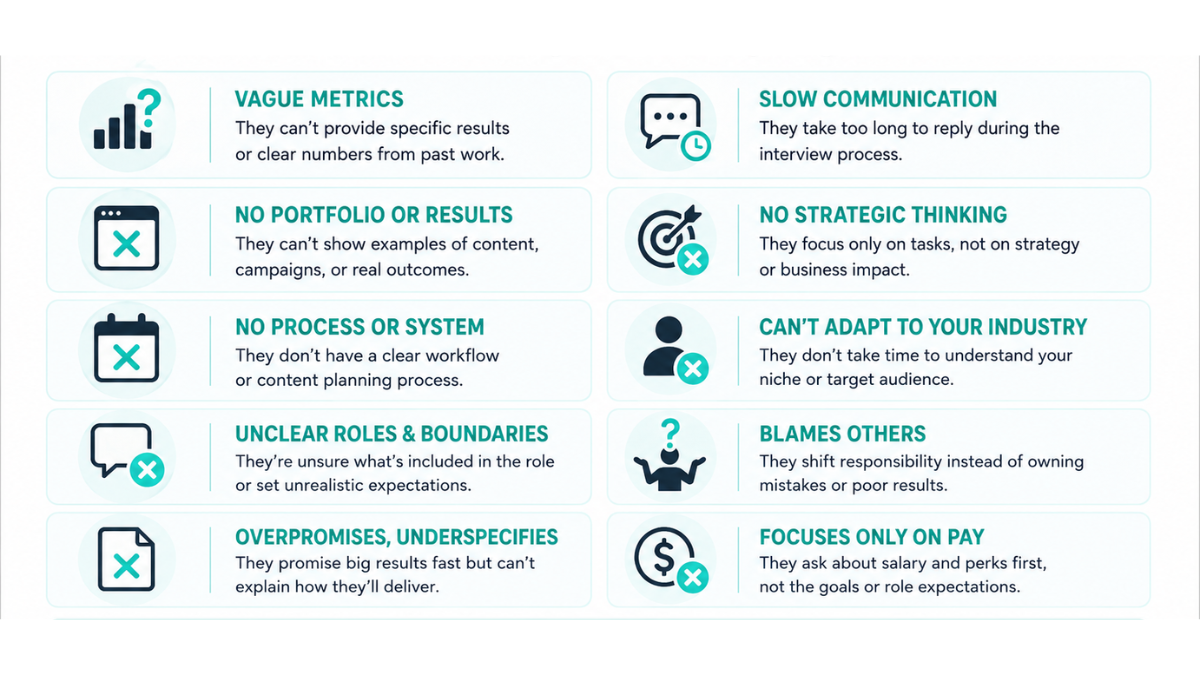
The biggest red flags are vague results, weak communication, no analytics comfort, generic strategy answers, and no clear process for learning your brand. Social media is public-facing, so poor judgment can affect trust quickly.
A candidate does not need to know everything. But they should be able to explain how they think, how they plan, and how they improve work over time.
Watch for these warning signs:
They talk only about followers and likes, not business goals.
They cannot explain what they would measure or why.
They use the same strategy for every business.
They do not ask about your audience, offers, or brand voice.
They have no clear process for approvals or feedback.
They avoid discussing missed deadlines or difficult situations.
They cannot show examples of content planning, not just final posts.
They promise fast growth without understanding your market.
They ignore comments, inbox response, or customer experience.
A strong hire should make you feel more confident, not more confused. They should bring clarity to the work and make the next steps easier to understand.
How Do You Onboard a New Social Media Manager for a Smooth Start?
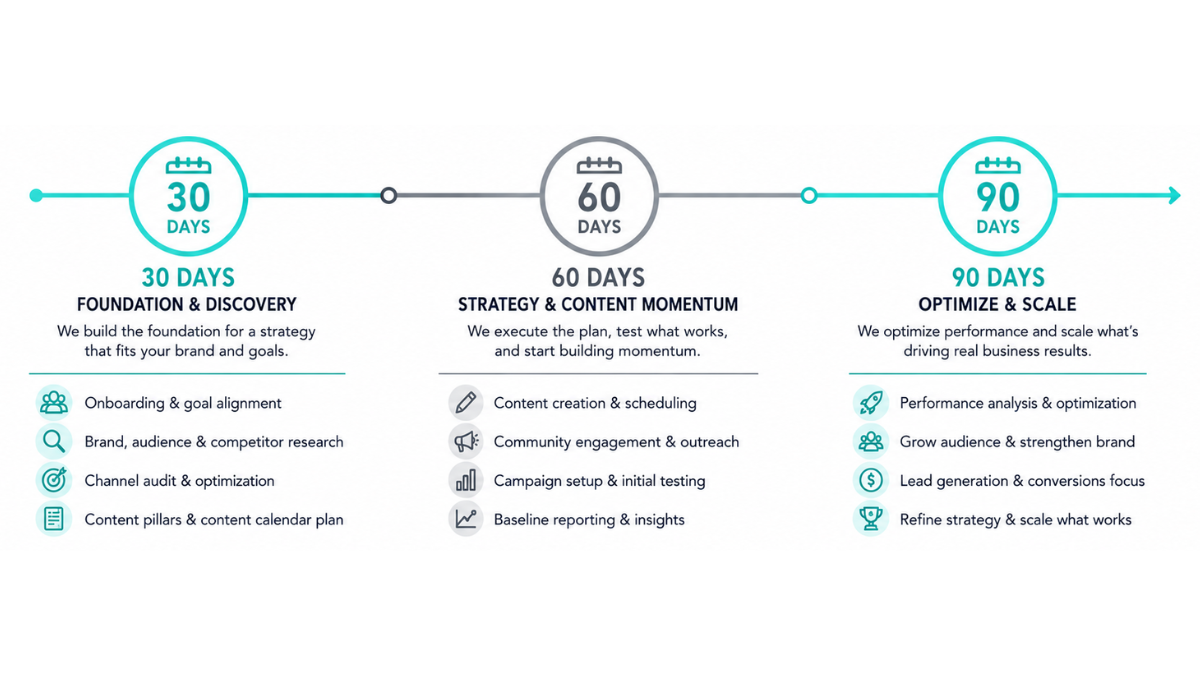
A smooth onboarding process gives the social media manager brand context, safe account access, clear expectations, and early feedback. Without onboarding, even a skilled person can miss the mark because they are guessing how your brand should sound and operate.
I recommend starting with a 30-60-90 day plan. The first month should focus on learning, organizing, and stabilizing. The second month should improve consistency. The third month should refine performance based on data.
Give the new hire or team access to:
Brand guidelines and voice notes
Audience personas or customer profiles
Approved content examples
Offer descriptions and current sales priorities
Platform logins through secure access management
Content templates, brand assets, and image libraries
Approval workflow and turnaround expectations
Reporting format and meeting cadence
If comments and messages are part of the role, define what they can answer directly and what should be escalated. A strong social presence depends on both content and customer experience, which is why some businesses also benefit from a
A customer service specialist can support response standards when comments, direct messages, reviews, and customer questions become too much for one social media manager to manage alone.
How Can Client Experience Prove What the Right Support Model Looks Like?
Client experience matters because hiring advice should not stay theoretical. When a business owner sees how another company used support to protect time, consistency, and quality, the hiring decision becomes easier to understand.
I see this clearly in Cindy Ko's Smart VAs case study. Cindy Ko, founder of Cindy Ko Photography and Boudoir by Cindy Ko, was managing a luxury photography business while juggling client experience, content, administrative work, SEO, and social media management. Smart VAs supported her with a team structure that helped her spend more time on high-value client work and growth.
That is the part I want business owners to pay attention to. Cindy did not only need another pair of hands. She needed a support model that could handle different parts of the business without asking one person to be expert at everything.
For a growing business, social media often connects to content, customer questions, SEO, website updates, and brand visibility. The right support model should reflect that reality.
How Can a Managed Specialist Team Make This Hire Easier?
A Managed Specialist Team makes hiring easier by reducing the time spent sourcing, vetting, training, and replacing support. Instead of relying on one person to cover every social media, design, copy, and reporting need, you get a more structured support system.
This is the middle path many growing businesses need. Hiring in-house can be slow and costly. Managing separate independent contractors can create inconsistent communication. A Managed Specialist Team gives you support that is more coordinated and easier to scale.
Smart VAs gives growing businesses access to a fully managed team of specialists who can support social media, content, creative coordination, customer response, and broader business operations without the owner carrying every moving piece alone.
The goal is not just to fill a role. The goal is to help you reclaim focus, protect your brand, and create a system that keeps working even when your schedule is full.
Delegation is not just a task - it is a strategy. When your social media needs consistency, accountability, and support beyond one person, Smart VAs can help you build the right structure.
Ready to find the right support model for your business? Book a discovery call with Smart VAs.
Related Reading From Smart VAs
These related guides can help business owners compare social media support models and understand what consistent execution looks like:
Smart Virtual Assistant
👍🤵
Smart Virtual Assistant 👍🤵
What if you could reclaim 40 hours
this month?
Find out inside this free guide.
Frequently Asked Questions
-
In 2026, Indeed lists the average U.S. social media manager salary at $64,959 per year, but total cost depends on experience, location, scope, tools, and hiring model. Business owners should also account for recruiting, onboarding, software, creative support, benefits, and management time.
-
A small business should hire based on workload and goals. Part-time support may work for light scheduling and basic engagement. Full-time support may make sense when social media affects launches, lead generation, community response, reporting, and daily brand visibility across several platforms.
-
A social media manager often owns strategy, planning, publishing, community engagement, and reporting. A social media specialist may focus on a narrower area, such as content creation, platform growth, analytics, or community response. In growing businesses, both types of support may be useful.
-
Ask how they would build a content calendar, learn your brand voice, respond to negative comments, measure success, and adjust when engagement drops. Also ask for examples of content that supported a business goal, not just examples that looked visually polished.
-
Costs vary depending on whether you hire a freelancer, full-time employee, or agency. We offer scalable solutions that allow businesses to access a skilled team at a structured monthly rate, making it easier to plan and manage expenses.
About the Author:
Kristy Yoder, Founder

Kristy Yoder is the Founder of Smart VAs, a virtual assistant agency that helps entrepreneurs grow through reliable administrative and digital marketing support. With extensive experience building and managing remote teams, she specializes in delegation, operational efficiency, and scalable business growth.
Passionate about helping business owners reclaim their time, Kristy leads Smart VAs in connecting entrepreneurs with skilled virtual professionals who provide dependable support and contribute to long-term success.