Key Takeaways
DIY bookkeeping can work when a business is simple, but growth adds transactions, accounts, payment methods, documents, and reporting needs that make inconsistency harder to hide.
The clearest warning signs are recurring backlogs, unreliable reports, cash surprises, rushed month-end work, and bookkeeping that keeps getting postponed.
A better process can solve some problems before a business needs more headcount, especially through clear document routines, reconciliation schedules, and sensible automation.
A bookkeeping specialist can take over repeatable execution such as transaction categorization, reconciliations, document organization, and routine cleanup, while owners and accountants keep the decisions that require their judgment.
The goal is not to remove the owner from the numbers. It is to make the records reliable enough that the owner can actually use them.

DELEGATE SMART. SCALE FAST.
The step-by-step guide to reclaim your time and grow with confidence.
DIY bookkeeping can make sense when a business is small and the financial activity is simple. I see the problem start when the same owner who is selling, serving clients, managing the team, and making decisions is also trying to keep every receipt, transaction, invoice, and reconciliation in order. In my bookkeeping work at Smart VAs, one of the first patterns I notice is that the books do not suddenly become difficult overnight. They become harder little by little as the business adds more activity.
One of the most common issues I see is mixed personal and business spending. A business owner pays for a business expense with a personal card, uses the business account for something personal, or simply stops keeping the separation consistent. When that happens on top of growing transaction volume, missing documents, and delayed reconciliations, the books become much harder to trust.
The right time to reconsider DIY bookkeeping is not based on one revenue number. I would look at whether the process is still keeping your records accurate, organized, and current without pulling too much time away from running the business. These are the seven signs I would pay attention to.
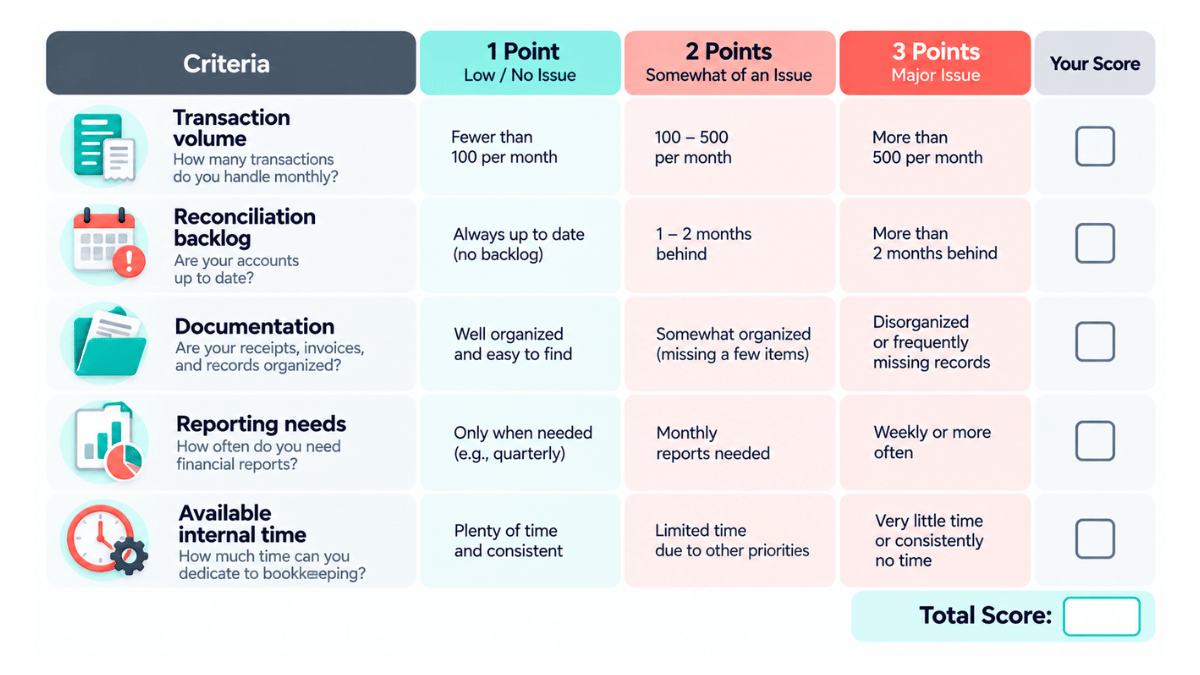
Why DIY Bookkeeping Can Become Difficult as Your Business Grows
A process that worked when you had one bank account and a small number of monthly transactions can become fragile as the business grows. More sales can mean more deposits, more payment platforms, more vendors, more customer invoices, more credit cards, and more supporting documents to match. Every new source of activity creates another place where something can be missed or recorded incorrectly.
Growth also makes it harder for me to get consistent information from a client because the owner is busier too. That is why I do not automatically assume the answer is to hire more people. Sometimes the first fix is a better workflow. I look at recurring transactions that can use rules, how documents are collected, who answers bookkeeping questions, and whether I can get secure read-only access to the information I need instead of asking the owner to download the same files every month.
The IRS recordkeeping guidance makes the same basic point from a compliance perspective: business records should clearly support income, expenses, financial statements, and tax-return items. I think about it operationally too. If the records are not current enough to explain what happened in the business, the process needs attention.
1. Your Books Are Always Behind Schedule
This is one of the clearest signs I see. I have taken over books that were months behind, and sometimes even years behind, because there was no dedicated person keeping the process moving. Transactions were miscategorized, accounts had not been reconciled, and some expenses were missing completely.
When I handle cleanup and catch-up work, I use a checklist instead of trying to fix random items as I notice them. I review the transactions, check the account classifications, reconcile bank and credit-card accounts, look for missing or unusual items, and work through the corrections until I am confident the records are complete enough for review.
The important part is what happens after the cleanup. If the business goes straight back to the same inconsistent routine, the backlog will return. I want a weekly or monthly process that keeps the books from becoming a tax-season emergency again. If you are already comparing whether to keep catching up yourself or use outsourced bookkeeping support, recurring backlog is one of the strongest signals to evaluate.
What I would check
How many transactions are still uncategorized?
When were the bank and credit-card accounts last reconciled?
Are monthly reports ready when the business actually needs them?
Is the backlog a one-time event, or does it happen every month?
2. You Spend More Time on Bookkeeping Than Running Your Business
The bookkeeping work that consumes an owner is not always the complicated part. A lot of time disappears into repetitive questions, downloading statements, finding receipts, matching supporting documents, and correcting the same types of transactions again and again.
My goal is to reduce how often I need the owner to stop what they are doing just to feed the bookkeeping process. For repetitive transactions, I can set up rules where appropriate. When access is approved and secure, read-only bank access can let me pull information directly instead of asking the client to download statements every month. Tools such as HubDoc or Dext can help organize supporting documents, while Double can centralize bookkeeping questions instead of scattering them across messaging apps.
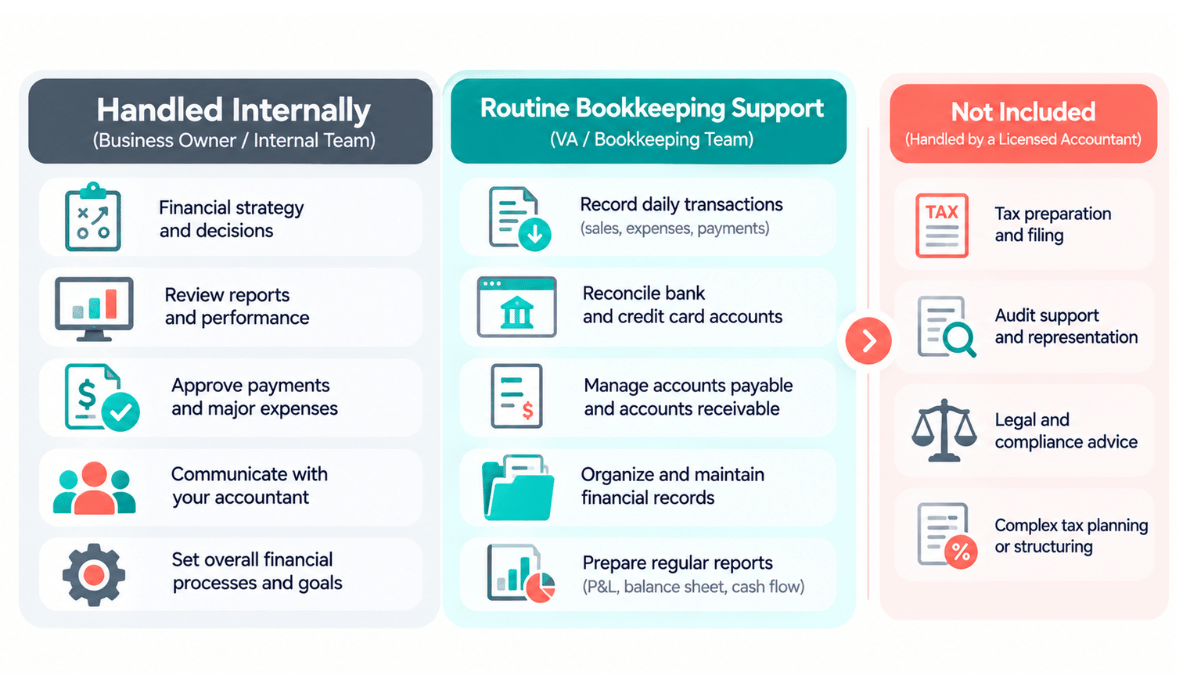
If an owner wants to delegate, I usually start with routine work that does not require business-owner or accountant approval: transaction categorization, bank and credit-card reconciliation, document organization, and recurring cleanup. A clear delegation process matters here because good bookkeeping support still needs defined responsibilities, access rules, and a reliable way to resolve questions.
If the real bottleneck is broader file organization rather than the accounting entries themselves, an administrative support specialist can help organize documents and recurring admin workflows while the bookkeeping specialist remains responsible for the financial records within scope.
3. You Cannot Rely on Your Financial Reports
When I take over a new client, I never assume the existing records are correct just because there is already data in the accounting system. I compare the accounts against bank and credit-card statements and look for balances or reports that do not make sense.
Reconciliation is where I catch many problems. If a report looks unusual, I go back to the individual transactions and supporting documents. I also ask the client a specific question rather than making an assumption about what the transaction was for. Once I understand the issue, I make the correction and note the pattern so similar transactions are easier to handle correctly in the future.
For a growing business, the reports should be useful enough to review spending, profitability, liabilities, and the overall position. The U.S. Small Business Administration's guidance on managing business finances also emphasizes maintaining proper bookkeeping and using financial statements such as the balance sheet to understand business finances. That is why I see clean records as a decision-making tool, not just a tax-preparation task.
4. Cash Flow Problems Keep Catching You by Surprise
I often see confusion around cash because the bank balance is being treated as the full picture. A business owner may think more cash is available than there really is because bills have not been recorded yet. On the other side, unpaid invoices may be sitting open, but the owner does not have a clear view of which customers still owe money.
During cleanup, I review outstanding invoices against bank activity and make sure bills and expenses are recorded properly. Once those records are updated, the owner can see accounts receivable, upcoming expenses, and available cash more clearly instead of relying only on the number they see in the bank account.
Bookkeeping does not replace cash-flow forecasting or financial planning, but it gives those decisions a cleaner starting point. If the underlying records are incomplete, even a good forecast begins with the wrong information.
5. Your Business Has More Accounts, Transactions, or Financial Workflows to Manage
A growing business simply creates more things to track. Clients may open additional bank or credit-card accounts, accept payments through multiple platforms, work with more vendors, or add new customers and services. That means more transactions to categorize, more accounts to reconcile, and more supporting documents to collect.
This is where I start looking for repeatability. For lower-volume businesses, I may review transactions weekly. For higher-volume clients, I may need to review every two or three days. I also use tools such as Google Sheets, Google Drive, Excel, and PDF readers to organize and extract information efficiently when the source documents come in different formats.
The goal is not to add software for the sake of it. It is to reduce manual steps without losing the review points that keep the books accurate. When the business is scaling in several areas at once, the same idea applies beyond bookkeeping: a support structure that can scale with the workload is more sustainable than relying on the owner to connect every process manually.
6. Month-End Close and Tax Preparation Become a Last-Minute Scramble
One of the biggest month-end problems I run into is incomplete supporting documentation. A payment may not clearly trace back to the right customer. A paid bill may be matched to the wrong vendor. A transaction may need the owner to explain what it was for before I can classify it correctly.
There will always be transactions that require the owner's input. The difference between a calm month-end and a last-minute scramble is whether there is a consistent way to get those answers. I want a routine for unresolved questions, document requests, reconciliation, review, and final reporting instead of saving every uncertainty until the deadline.
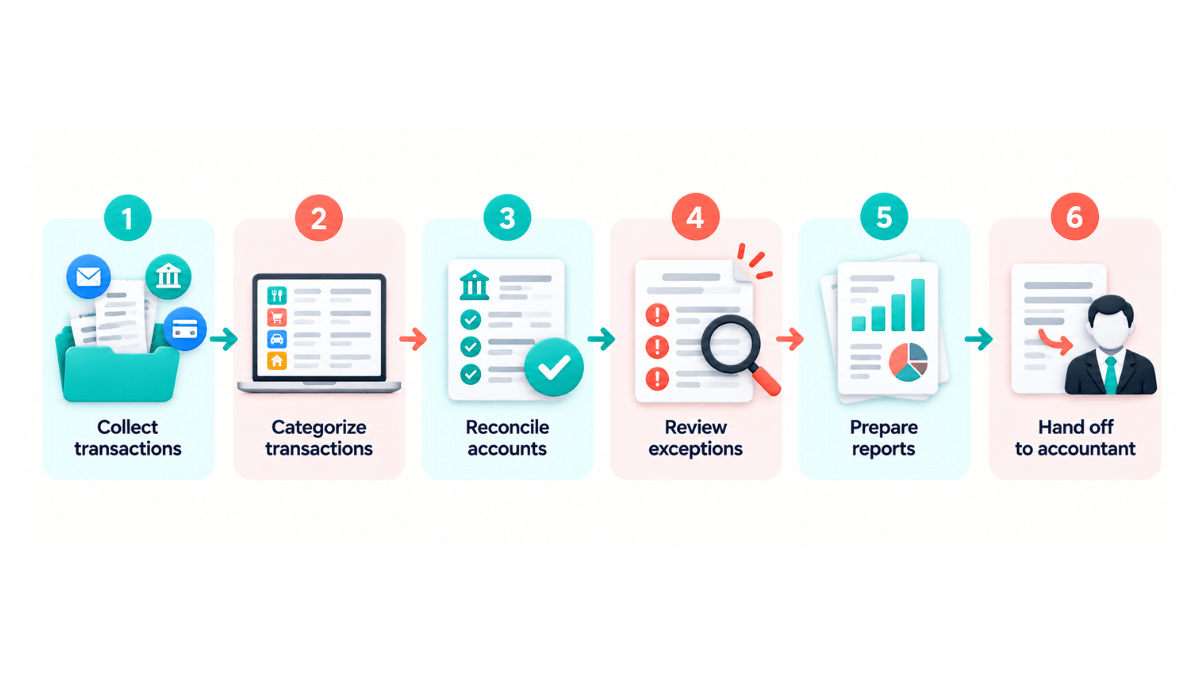
My normal close routine
1. Review recurring transactions and apply appropriate rules for repeatable items.
2. Review transactions on the schedule that fits the client's volume.
3. Match supporting receipts, invoices, and bills.
4. Check uncategorized items, duplicates, unusual balances, and anything that does not make sense.
5. Reconcile the relevant accounts and resolve open questions.
6. Finalize month-end reports and submit them for client review.
A bookkeeping specialist can organize the records that an accountant or tax professional needs, but I would still keep tax advice, filing decisions, audits, and regulated accounting work with the appropriately qualified professional.
7. You Are Growing, but Your Bookkeeping Process Has Not Kept Up
For me, this is the bigger pattern behind all the other signs. The owner may still be using the same process they used when the business was much smaller, even though there are now more transactions, accounts, people, vendors, payment channels, and reporting requests.
A scalable bookkeeping process should not depend on the owner remembering to send documents at the end of the month. I want clear responsibilities, a reliable document flow, regular reconciliation, a consistent place for questions, predictable reporting, and the right access for each person involved.
That is also when the support model matters. If the business only needs a small amount of occasional help, a freelancer may be enough. If the workload is recurring and the owner wants more structure around communication and continuity, the comparison between managed and freelance virtual support becomes more relevant.
A Real Example: Clean Books Can Reveal Costs You Stopped Noticing
One client example that stayed with me was not about a complicated accounting issue. While reviewing the books, I pulled together the recurring subscriptions charging the client's credit card. The client was able to identify subscriptions the business was no longer using and cancel them.
That is a simple example of why I care about clean, current records. The benefit was not just that the transactions were categorized. The client could see where money was going and use that information to make a better business decision.
I see the same value in the way Christina Golden describes using Smart VAs for bookkeeping alongside administrative and document support. Bookkeeping rarely lives in isolation. It works best when the surrounding process for information, documents, and follow-up is organized too.
Smart Virtual Assistants
👍🤵
Smart Virtual Assistants 👍🤵
What Should You Do If Your Business Has Outgrown DIY Bookkeeping?
I would not tell every owner to outsource immediately. I would first ask what is actually failing. If the books are basically accurate but the monthly routine is inconsistent, a better schedule, clearer responsibilities, and improved document collection may be enough. If the workload is now too large or the owner keeps postponing it, dedicated support becomes more practical.
Option 1: Improve the process you already have
Set a fixed bookkeeping schedule, separate personal and business activity, create one place for supporting documents, define who answers questions, and decide when reconciliations and reports should be completed.
Option 2: Hire in-house
A dedicated employee can make sense when the workload is high enough to justify ongoing internal capacity and the business wants direct day-to-day supervision.
Option 3: Work with a virtual bookkeeping assistant
A bookkeeping virtual assistant can support defined, repeatable work such as categorization, reconciliation, document organization, accounts payable or receivable tracking, routine cleanup, and report preparation, depending on scope and qualifications.
Whichever option you choose, I would keep the owner and accountant involved in the decisions that require business judgment, tax expertise, or formal accounting responsibility. The specialist should make the process more reliable, not blur who is responsible for what.
How to Get Started With Bookkeeping Support
1. List the tasks that are already falling behind, including overdue reconciliations, missing documents, or recurring cleanup work.
2. Document your current workflow: software, accounts, storage, responsibilities, and approval points.
3. Separate routine bookkeeping execution from work that still requires the owner, accountant, or tax professional.
4. Create a clear monthly cadence for transaction review, documents, reconciliations, questions, reports, and approval.
5. Review the result after a few cycles. The books should be more current, the month-end process should be more predictable, and the owner should have better visibility into what is happening.
If bookkeeping is becoming the task you keep pushing to the next weekend, that is the point where I would stop asking, “Can I still do this myself?” and start asking, “Is this still the best use of my time, and can I trust the numbers when I need them?”
The goal of support is not to disconnect you from your finances. It is to give you a process that keeps the records current enough to make them useful. If that is the gap in your business, Smart VAs can help you build a more consistent bookkeeping workflow around the tasks that are appropriate to delegate.
What if you could reclaim 40 hours this month?
Find out inside this free guide.
Frequently Asked Questions
-
Recurring backlogs, unreliable reports, increasing transaction complexity, cash surprises, and too much owner time spent catching up are common warning signs. I would pay most attention to whether the problem repeats month after month rather than judging the business by one unusually busy period.
-
Consider support when routine bookkeeping regularly falls behind, reconciliations are inconsistent, or the owner no longer has enough time to keep the records current. Before hiring, define which repeatable tasks can be delegated and which decisions still need the owner or accountant.
-
Depending on scope and qualifications, a bookkeeping virtual assistant may support transaction categorization, bank and credit-card reconciliation, document organization, accounts payable and receivable tracking, routine cleanup, and report preparation. Tax advice, audits, and regulated accounting work should stay with the appropriate professional.
-
Sometimes, but not always. Compare the actual workload, service fee, internal management time, availability requirements, and total employment cost before deciding. I would choose the model that keeps the books reliable without creating unnecessary overhead or another process the owner has to manage closely.
-
Often yes, but compatibility depends on the provider's experience, the software you use, and the access required. Confirm the platform, permissions, document workflow, and review process before work begins so the bookkeeping setup does not become more complicated.
-
Bookkeeping focuses on recording, organizing, reconciling, and maintaining financial transactions and supporting records. Accountants may provide broader accounting judgments, tax services, analysis, and other professional work depending on their qualifications. The two roles often work together, but they are not interchangeable.
-
A bookkeeping specialist can help organize transactions, reconciliations, receipts, invoices, and supporting records so an accountant or tax professional has cleaner information to review. That does not automatically mean the assistant provides tax advice or files the return.
-
It depends on transaction volume, complexity, deadlines, reporting needs, and how often the books need attention. Some small businesses only need a structured recurring workflow, while businesses with higher activity may need more frequent support.
-
Use role-appropriate access, strong authentication, secure document sharing, and clear procedures for granting and removing access. Give specialists only the permissions required for their work, and keep ownership and approval authority with the business where appropriate.
-
Prepare a list of recurring tasks, the software and accounts involved, current records, storage locations, existing procedures, and the approvals that still belong to you or your accountant. The clearer the workflow is at the start, the easier it is to delegate safely.
Rashien | Bookkeeping, Smart VAs

Rashien is a Bookkeeping Assistant at Smart VAs, responsible for maintaining accurate financial records, keeping books balanced, and preparing reports. She is knowledgeable in QuickBooks Online and proficient in spreadsheets. She also handles data entry, bank, credit card, and loan account reconciliations, along with other bookkeeping and administrative tasks.