Is It Time to Use Outsourced Bookkeeping Services? A Business Owner's Guide
Key Takeaways
Outsourcing bookkeeping is usually worth considering when DIY books cost more in time, stress, or mistakes than the service would cost in fees.
The biggest signs are delayed reports, messy reconciliations, unclear cash flow, mixed expenses, and tax-season panic.
It may not be time yet if your transaction volume is low, your records are clean, and you are intentionally learning your numbers.
The best partner gives you accurate books, clear reporting, secure access practices, and a consistent communication rhythm.
Smart VAs is positioned for owners who want bookkeeping support inside a managed structure, not another person to chase.

ARE YOU STILL TRYING TO DO IT ALL?
Discover the SMART way to delegate without losing control—and finally free up your time.
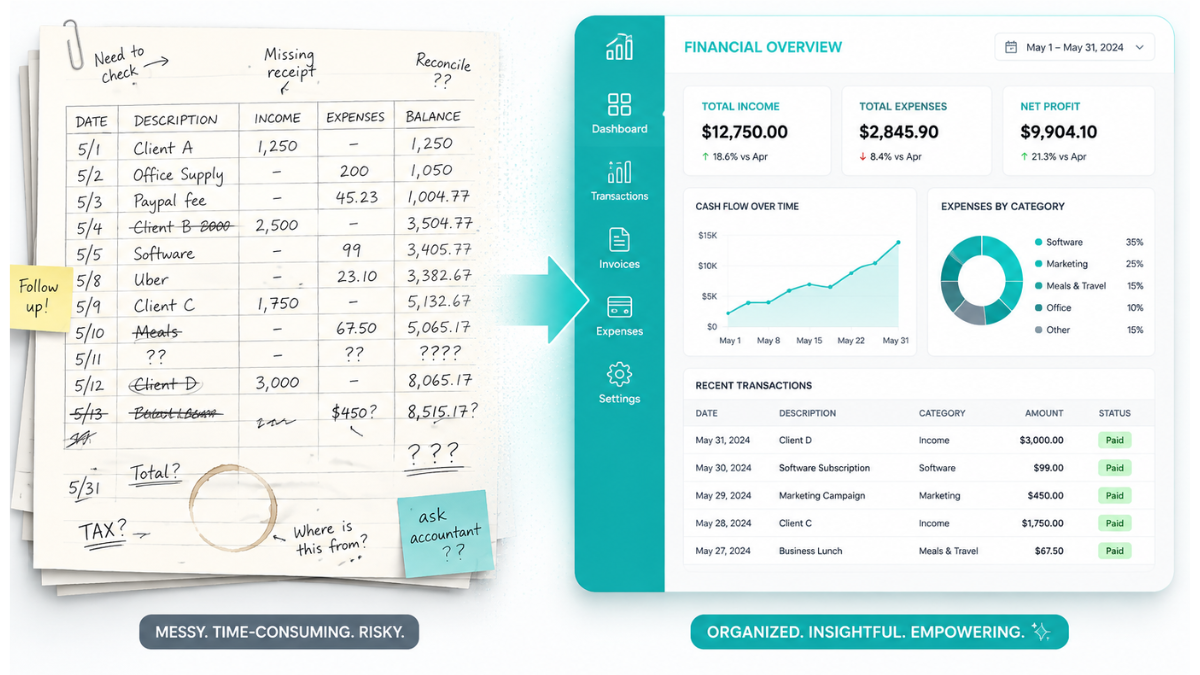
Outsourced bookkeeping services are worth considering when your books are behind, your reports feel unreliable, or financial tasks are taking time away from growth. The decision is not about reaching a certain business size. It is about whether doing the work yourself is costing more in time, accuracy, or peace of mind than getting structured help.
I have seen this decision point show up quietly for many business owners. At first, bookkeeping feels manageable. Then the receipts pile up, bank feeds stop matching, invoices fall through the cracks, and tax season becomes a scramble instead of a review.
This guide walks through what outsourced bookkeeping actually includes, how to know when it is time, when it may be too early, what you gain, what you give up, and how to choose a partner you can trust.
What Does Outsourced Bookkeeping Actually Include?
Outsourced bookkeeping includes the recurring financial tasks that keep your records clean, current, and ready for decisions. It may cover transaction categorization, reconciliations, invoicing, accounts payable and receivable, payroll support, financial reporting, and cash-flow tracking, depending on what your business needs.
In simple terms, bookkeeping is the system that shows what money came in, what went out, and where the business stands. The IRS says small business owners should use a recordkeeping system that clearly shows income and expenses, which is exactly why clean books matter beyond tax season. IRS recordkeeping guidance
Some owners delegate everything. Others keep strategic review in-house and hand off the time-consuming pieces, such as:
Bank and credit card reconciliation
Transaction categorization
Invoice preparation and payment tracking
Accounts payable and receivable support
Financial report preparation
Receipt and document organization
QuickBooks or accounting software cleanup
Monthly summaries for a CPA or tax preparer
The goal is not to remove you from your numbers. The goal is to stop making financial clarity depend on whether you had a spare Sunday to catch up. If you are still clarifying what a bookkeeping support specialist can do, start with the recurring tasks that drain the most time or create the most errors. For bookkeeping-specific help, Smart VAs can help owners maintain clear, real-time bookkeeping and QuickBooks support without turning financial cleanup into another task they have to chase.
Why Does Bookkeeping Matter Before It Becomes a Problem?
Bookkeeping matters because every growth decision depends on clean financial information. If your income, expenses, receivables, and cash flow are unclear, you end up guessing instead of deciding. Good bookkeeping gives you the confidence to hire, invest, price, plan, and prepare for taxes.
Many owners only think about bookkeeping when a deadline is near. By then, the books are already telling an old story. The better approach is to keep them updated while the business is moving.
Clean books can help you answer questions like:
Which services are actually profitable?
Which clients or projects create the most financial strain?
Can the business afford a new hire, tool, or campaign?
Are receivables being collected on time?
Is cash flow strong enough for the next quarter?
The IRS also notes that electronic records must provide complete, accurate, accessible data if business records are maintained digitally. That is another reason bookkeeping should be treated as an operating system, not a once-a-year cleanup. IRS electronic record guidance
For many growing businesses, financial clarity also depends on cleaner client records, invoice follow-ups, and payment notes. That is where customer relationship management support can connect the numbers to the relationship side of the business.
What Are the Practical Signs It Is Time to Outsource Your Bookkeeping?

It is time to consider outsourcing when bookkeeping errors, delays, or complexity start affecting business decisions. If reconciliations are late, reports are confusing, accounts are multiplying, or you are unsure whether your numbers are accurate, the business has likely outgrown casual bookkeeping habits.
The practical signs usually show up before a crisis. They look like small delays at first, but they create bigger problems when they keep repeating.
Your bank and credit card reconciliations are regularly behind.
You have multiple revenue streams, payment processors, or business accounts.
You are unsure whether expenses are categorized correctly.
Invoices, bills, or receipts are scattered across too many places.
Your reports are delayed, incomplete, or hard to understand.
You avoid reviewing cash flow because the numbers do not feel reliable.
Your CPA keeps asking for cleaner documents before tax deadlines.
When these problems show up, the issue is not always that you need more software. Often, you need a person and a process responsible for keeping the financial system clean. If receipts, files, and recurring operational tasks are scattered, an administrative support specialist can also help organize the work around the books.
What Are the Emotional Signs You Have Outgrown DIY Bookkeeping?
You may have outgrown DIY bookkeeping when the emotional weight of the work becomes a pattern. If you dread opening your accounting software, delay financial review, mix personal and business spending, or feel anxious every tax season, the problem is no longer only technical.
This is the part many guides skip. Bookkeeping overwhelm is not only about spreadsheets. It is also about the mental load of knowing your finances matter, while also knowing you are not giving them enough attention.
Common emotional signs include:
You feel embarrassed by how far behind the books are.
You keep telling yourself you will catch up next weekend.
You avoid looking at reports because you do not trust them.
You feel nervous when your accountant asks for documents.
You know money is coming in, but you still feel unclear about profit.
You spend more energy worrying about the books than actually reviewing them.
Those feelings are valid signals. They often appear before the business reaches a major financial mess. The earlier you respond, the easier the cleanup usually is.
Are There Signs It Is Not Time to Outsource Yet?

Yes. It may not be time to outsource if your transaction volume is very low, your records are simple, and you are intentionally learning how money moves through the business. Outsourcing should solve a real bottleneck, not add complexity before the business needs it.
I do not believe every owner should outsource bookkeeping immediately. There is value in understanding your numbers early. The key is knowing when learning turns into avoidance or when saving money starts costing time and accuracy.
You may not need outside help yet if:
You are pre-revenue or have very few monthly transactions.
Your books are simple and updated regularly.
You understand your reports and review them consistently.
You have a clear system for receipts, invoices, and categorization.
You are still learning the financial basics on purpose, not because you are stuck.
This is a tradeoff decision. The right time is when the books need more consistency than you can realistically give them.
DIY Software, an In-House Hire, or Outsourced Bookkeeping: What Is the Difference?
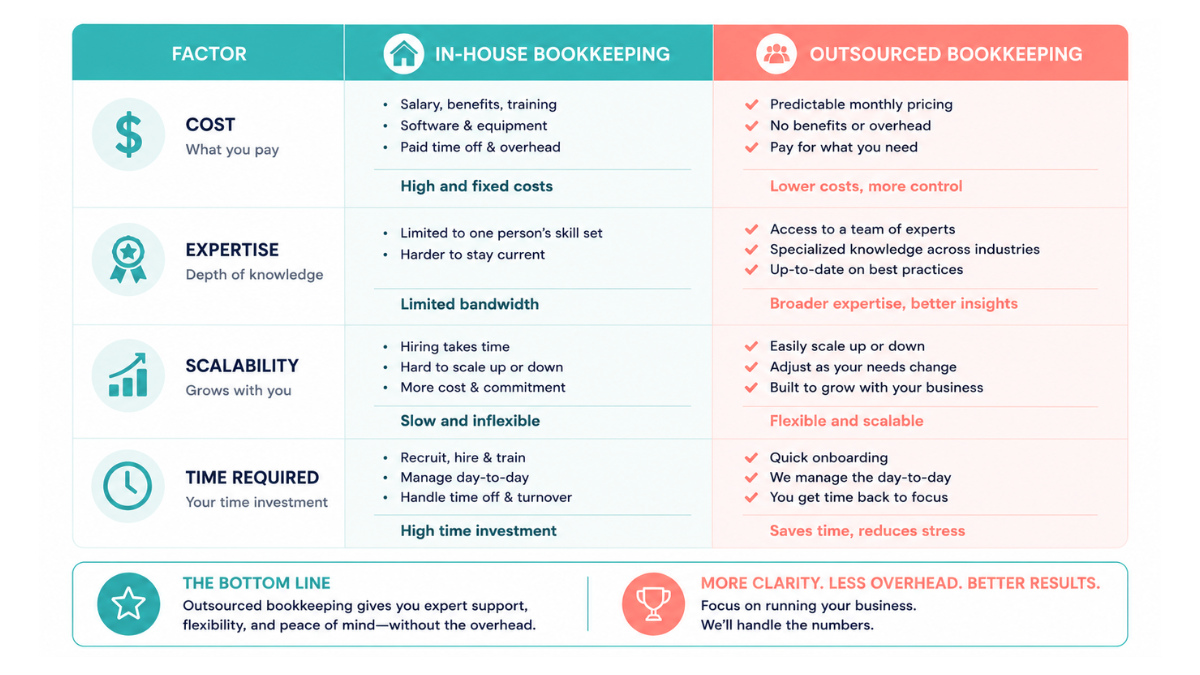
DIY software works when the business is simple and the owner has time to maintain it. An in-house hire can make sense for complex daily financial operations. Outsourced bookkeeping fits owners who need professional consistency without building a full internal finance function.
The best choice depends on transaction volume, complexity, budget, and how much financial work you want to manage directly. If your bookkeeping needs are part of a broader delegation problem, managed remote assistant services for scaling can also help you think beyond one isolated task. Here is the practical difference:
How Much Do Outsourced Bookkeeping Services Cost?
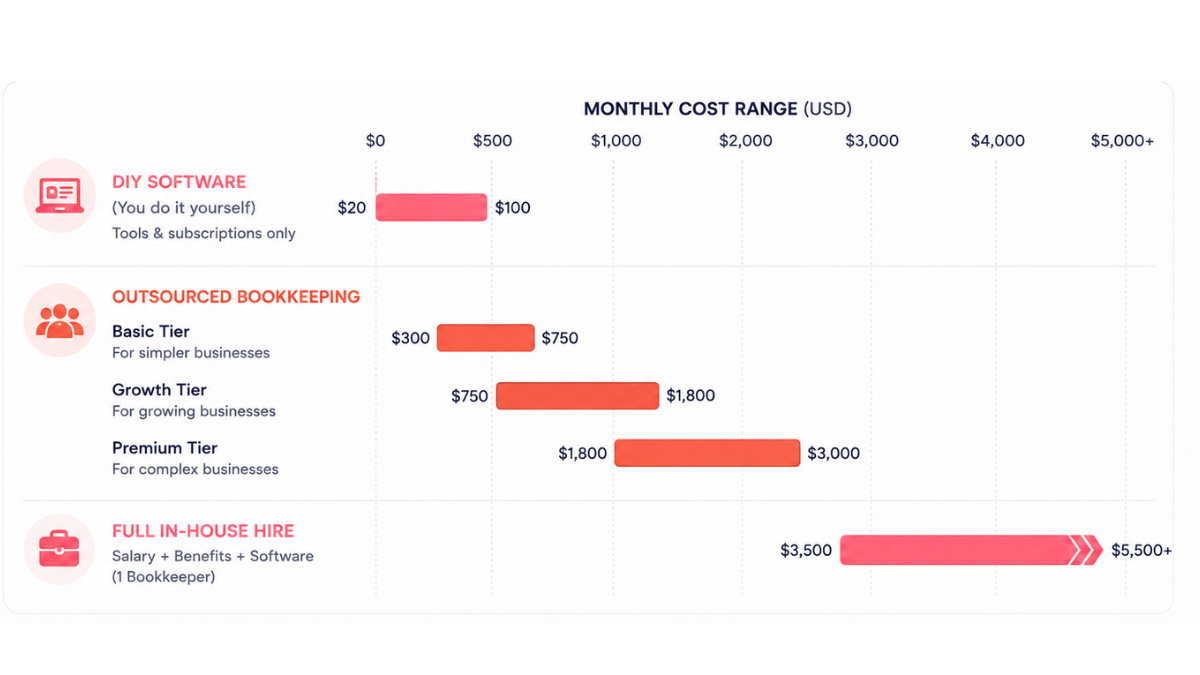
Outsourced bookkeeping cost depends on transaction volume, account complexity, reporting needs, payroll support, cleanup work, and how often the books must be updated. A simple monthly account will cost far less than support for multiple revenue streams, platforms, locations, or reporting requirements. I avoid giving one flat price because bookkeeping needs vary too much. A business with one bank account and a few monthly expenses is not the same as a company with payroll, multiple payment processors, recurring invoices, and tax-prep cleanup.To understand the real comparison, look beyond the service fee. Hiring internally can also include salary, benefits, training, software seats, equipment, and management time. The U.S. Bureau of Labor Statistics reported a May 2024 median annual wage of $49,210 for bookkeeping, accounting, and auditing clerks. BLS wage dataCost usually increases when you need: More frequent reconciliation and reporting Catch-up or cleanup bookkeeping Payroll support or contractor payment tracking Accounts payable and receivable workflows Multiple business entities or locations Budgeting or cash-flow summaries Coordination with your accountant or CPA
What Are the Real Benefits and Drawbacks of Outsourcing Bookkeeping?
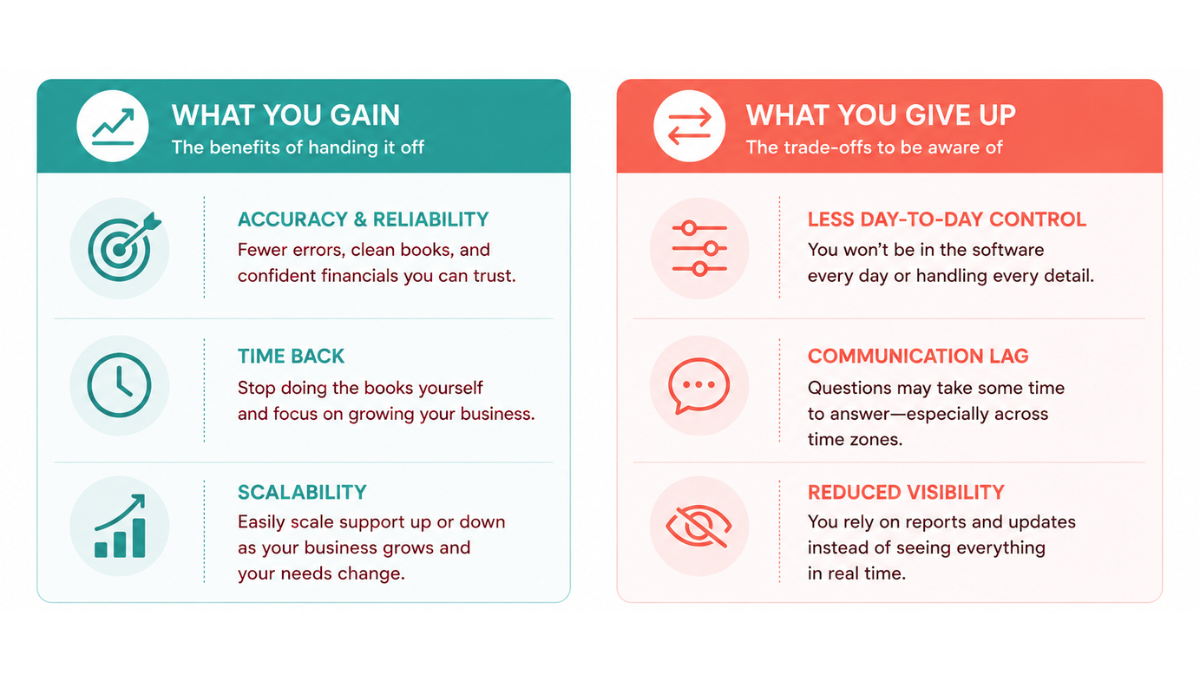
The main benefits are cleaner books, more time, better reporting, and less tax-season stress. The real drawbacks are less day-to-day control, data security concerns, possible communication delays, and reduced visibility if the process is not structured well from the start. A trustworthy guide should be honest about both sides. Outsourcing can be a strong move, but only when the relationship is managed properly.
Data security deserves special attention. The FTC Safeguards Rule requires covered financial institutions to have measures that keep customer information secure and to ensure service providers safeguard information in their care. Even if your business is not covered by that rule, the principle still matters: financial access should never be casual. FTC Safeguards Rule
What Should You Look for When Choosing a Bookkeeping Partner?
The right bookkeeping partner should understand your business model, your accounting software, your reporting needs, and your communication style. They should also be clear about scope, pricing, security, review cadence, and what happens when your business becomes more complex.
Do not choose based only on price. Choose based on fit, process, and reliability. A lower fee will not help if you still have to chase reports, explain the same issue repeatedly, or clean up preventable errors. Bring your own questions to ask a bookkeeper before hiring them so you can compare providers clearly.
The right fit can also depend on your industry. Accounting firms may need bookkeeping support for accounting firms, while firms with recurring client work may need support for accountants and financial workflows as volume grows.
Ask questions like:
Which accounting platforms do you support?
How often will my books be updated?
What reports will I receive each month?
Who reviews the work before I see it?
How do you protect financial access and passwords?
What tasks are included, and what costs extra?
Can support expand if transaction volume grows?
How will you coordinate with my CPA or tax preparer?
What Mistakes Do Business Owners Make When Outsourcing Bookkeeping?
The biggest mistakes are outsourcing without a clear scope, giving access before security is planned, assuming every provider offers strategic insight, and failing to review reports regularly. Outsourcing helps most when the owner stays informed while the specialist handles execution.
The goal is not to disappear from your finances. The goal is to stop being the person manually holding every financial detail together.
Unclear expectations: The owner says “handle my books,” but no one defines what that includes.
Software mismatch: The provider does not know the tools the business already uses.
No review rhythm: Reports are created, but the owner never reviews them.
Poor access control: Passwords are shared casually instead of through secure systems.
Wrong expectations: The business expects CFO-level advice from basic bookkeeping support.
A good bookkeeping process should make your finances easier to understand, not more distant.
Should You Outsource Bookkeeping Yourself or Work With a Specialist Team?
If bookkeeping is simple and occasional, a single independent provider may be enough. If your business needs recurring support, clean reporting, task continuity, and less owner management, a specialist team is usually a stronger fit because the work is supported by process, oversight, and structure.
At Smart VAs, I see bookkeeping as part of a bigger operating system. Clean books connect to client payments, CRM records, administrative workflows, reporting, and the decisions owners make every week.
That is why a fully managed team of specialists can be valuable for growing businesses. You are not only looking for someone to categorize transactions. You are looking for support that fits into the way your business actually runs.
We see the value of that structure in client feedback, too. Danielle Mulvey shared that Smart VAs supports her with administrative tasks, bookkeeping, and video/document editing. She also described appreciating the structure, flexibility, and expert support under one roof.
For me, that matters because bookkeeping support should not create another person for the owner to chase. It should reduce the mental load and make the business easier to run.
Delegation is not just a task — it is a STRATEGY. If your books are taking more time, stress, or focus than they should, book a discovery call with Smart VAs and let us help you build the right support structure.
What Mistakes Do Business Owners Make When Outsourcing Bookkeeping?
The biggest mistakes are outsourcing without a clear scope, giving access before security is planned, assuming every provider offers strategic insight, and failing to review reports regularly. Outsourcing helps most when the owner stays informed while the specialist handles execution. The goal is not to disappear from your finances. The goal is to stop being the person manually holding every financial detail together. Unclear expectations: The owner says “handle my books,” but no one defines what that includes. Software mismatch: The provider does not know the tools the business already uses. No review rhythm: Reports are created, but the owner never reviews them. Poor access control: Passwords are shared casually instead of through secure systems. Wrong expectations: The business expects CFO-level advice from basic bookkeeping support. A good bookkeeping process should make your finances easier to understand, not more distant.
Should You Outsource Bookkeeping Yourself or Work With a Specialist Team?
If bookkeeping is simple and occasional, a single independent provider may be enough. If your business needs recurring support, clean reporting, task continuity, and less owner management, a specialist team is usually a stronger fit because the work is supported by process, oversight, and structure. At Smart VAs, I see bookkeeping as part of a bigger operating system. Clean books connect to client payments, CRM records, administrative workflows, reporting, and the decisions owners make every week. That is why a fully managed team of specialists can be valuable for growing businesses. You are not only looking for someone to categorize transactions. You are looking for support that fits into the way your business actually runs. We see the value of that structure in client feedback, too. Danielle Mulvey shared that Smart VAs supports her with administrative tasks, bookkeeping, and video/document editing. She also described appreciating the structure, flexibility, and expert support under one roof. For me, that matters because bookkeeping support should not create another person for the owner to chase. It should reduce the mental load and make the business easier to run. Delegation is not just a task — it is a STRATEGY. If your books are taking more time, stress, or focus than they should, book a discovery call with Smart VAs and let us help you build the right support structure.
Smart Virtual Assistant
👍🤵
Smart Virtual Assistant 👍🤵
What if you could reclaim 40 hours this month?
Find out inside this free guide.
Frequently Asked Questions
-
It may be time to outsource when your books are consistently behind, reports are unreliable, tax season feels chaotic, or financial tasks pull you away from revenue-generating work. The clearest sign is when handling the books yourself costs more in time, stress, or mistakes than getting structured support would cost.
-
Monthly cost depends on transaction volume, account complexity, software setup, reporting needs, cleanup work, and whether you need payroll or accounts receivable support. Avoid choosing only by price. A useful bookkeeping partner should provide clean records, clear communication, and reports you can understand.
-
You can outsource transaction categorization, reconciliations, invoicing support, accounts payable, accounts receivable, reporting, document organization, and QuickBooks cleanup. Many owners keep strategic financial decisions, final approvals, and cash-flow planning internal while assigning recurring bookkeeping execution to a specialist.
-
It can be, especially for businesses that do not need full-time finance support. In-house hiring may include salary, benefits, training, software, and management time. Outsourced bookkeeping can be more flexible because support can match the actual workload and grow as the business becomes more complex.
-
Look for software experience, clear scope, secure access practices, reporting cadence, pricing transparency, and the ability to coordinate with your CPA or tax preparer. Also ask how work is reviewed, how questions are handled, and whether support can expand as your business grows.
-
It depends on complexity. If your transaction volume is low and your books are simple, you may be able to manage them yourself for now. Outsourcing becomes more valuable when the work creates stress, delays, errors, or takes time away from clients, sales, or leadership.
About the Author:
Kristy Yoder, Founder

Kristy Yoder is the Founder of Smart VAs, a virtual assistant agency that helps entrepreneurs grow through reliable administrative and digital marketing support. With extensive experience building and managing remote teams, she specializes in delegation, operational efficiency, and scalable business growth.
Passionate about helping business owners reclaim their time, Kristy leads Smart VAs in connecting entrepreneurs with skilled virtual professionals who provide dependable support and contribute to long-term success.