Key Takeaways
White-label SEO usually breaks down because of process gaps, not because outsourcing itself is the problem.
The agency should keep ownership of the client relationship, business priorities, strategy decisions, and final approvals while the specialist owns agreed execution and documentation.
Quality control needs a definition of done, manual verification, and clear review checkpoints instead of relying only on automated SEO tools.
Useful reporting explains what changed, why it matters, what remains blocked, and what should happen next. Numbers alone are not enough.
Agencies scale SEO more safely when they delegate repeatable execution while keeping strategy, client communication, security, and high-impact approvals under agency oversight.

DELEGATE SMART. SCALE FAST.
The step-by-step guide to reclaim your time and grow with confidence.
When an agency sells SEO, the client expects one thing: reliable delivery. The problem starts when the work behind the scenes does not feel reliable at all. Deadlines slip, briefs are interpreted differently, reports arrive without enough context, or the agency has to recheck every deliverable before it can confidently send anything to the client.
I have worked across keyword research, competitor analysis, technical audits, on-page optimization, site structure, internal linking, content planning, backlink analysis, and reporting. I have also managed multiple client websites and worked directly with agencies and teams. From that experience, I do not see white label SEO services as the problem by themselves. The real problems are usually unclear ownership, weak quality control, poor communication, and a delivery process that was never defined properly.
White-label SEO simply means an outside specialist or provider completes agreed SEO work that the agency delivers under its own brand. It can work very well, but only when both sides know what they own, what good work looks like, how questions are handled, and how performance is reviewed. In this article, I will walk through the seven failure points I see most often and the practical fixes I use to keep SEO delivery organized.
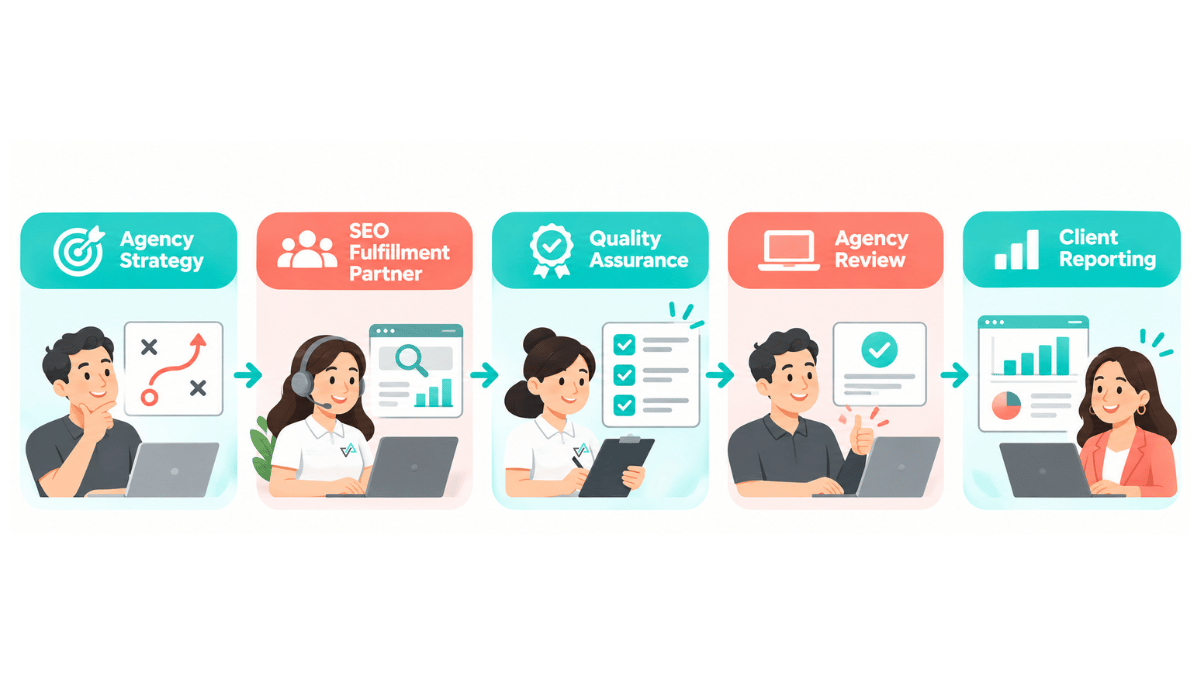
What Are White-Label SEO Services, and How Should They Work?
In a healthy white-label setup, I do not expect the agency to disappear after handing over a task. The agency should still own the client relationship, business goals, overall strategy, budget, campaign priorities, and final approvals. My role as the SEO specialist is to take responsibility for the execution we agreed on and to explain what I find clearly enough that the agency can make informed decisions.
Depending on the scope, that execution can include keyword research, competitor analysis, technical SEO audits, on-page optimization, internal linking, content briefs, backlink analysis, local SEO tasks, reporting preparation, and implementation support. The exact mix should always be defined before work begins.
I also think the relationship works best when some responsibilities are shared. Scope, timelines, reporting standards, escalation rules, and review checkpoints should be agreed together. That keeps the specialist from working in a vacuum and keeps the agency from finding out about problems only when the client asks.
1. Inconsistent Quality Makes Agencies Recheck Every Deliverable
One of the fastest ways to lose the benefit of outsourcing is to receive work that still needs a full second audit. I have taken over websites where SEO had already been done, but the work was based on the wrong assumptions. Keywords were chosen mainly for search volume, important technical issues were missed, and pages were optimized without enough attention to what the page was actually supposed to do.
When I inherit work like that, I start fresh. I review the business, target audience, current keyword targeting, indexed pages, Search Console data, technical issues, and on-page problems. Then I prioritize corrections based on likely impact instead of trying to fix every warning at once.
This is also why I separate technical problems from content and intent problems. A page can fail because it cannot be crawled or indexed correctly, or because it is technically accessible but does not satisfy the searcher. I use that distinction throughout my audits, and it is the same practical difference explained in our technical SEO vs on-page SEO guide.
How I Check SEO Work Before It Goes Back to the Agency
I use a different quality check depending on the deliverable. For keyword research, I verify search intent, relevance, search volume, keyword difficulty, and whether the keyword maps to the right landing page. For technical audits, I verify issues manually instead of trusting an automated crawl report by itself. For on-page work, I review titles, descriptions, headings, internal links, keyword placement, and content relevance.
The last step is simple but important: I cross-check the finished work against the original requirements. I want the handoff to be actionable and properly documented, not just a spreadsheet full of issues that leaves the agency wondering what to do next.
Define what "complete" means for each deliverable.
Provide examples of acceptable audits, keyword maps, briefs, and reports.
Use a checklist for accuracy, relevance, completeness, and presentation.
Review early deliverables closely before expanding the workload.
Track why work gets sent back and update the process when the same issue repeats.
2. Communication Gaps Create Delays and Client Friction
I have seen projects slow down simply because the brief did not explain the priority, deadline, client context, or expected output. When I am managing several SEO projects at once, those gaps become expensive because one unclear task can hold up content, web changes, reporting, or a client update.
My rule is to clarify before I proceed rather than make assumptions. I also share progress updates, call out dependencies, and raise questions as soon as I see a blocker. That is much better than completing the wrong work quickly.
A managed SEO structure can make this easier because communication, priorities, and execution are treated as one workflow instead of disconnected tasks. That is the same reason I like the operating model described in our article on managed SEO services: the agency keeps strategic control while the execution layer has clear ownership.
What I Need Before Starting an SEO Project
A clear description of the business, services, target audience, and target locations.
The main objectives and current SEO priorities.
Website, Google Analytics 4, Google Search Console, and CMS access where implementation is required.
Existing SEO performance, competitor sites, and any keywords already being targeted.
Expected deliverables, deadlines, reporting format, and approval process.
The earlier I have that context, the easier it is to build a realistic SEO action plan and avoid wasting agency review time later.
3. Unclear Scope Leads to Missed Expectations and Rework
SEO projects change. An audit can uncover issues nobody knew existed, a client can request a new landing page, or a migration can suddenly create technical work that was not part of the original plan. I do not think the answer is to reject every new request. The answer is to make the change visible.
When an additional request comes in, I first assess what it involves, how much time it may take, what it depends on, and whether it belongs in the current scope. If it is urgent, I discuss priorities with the agency. Sometimes the right move is to add hours or resources. Other times, we pause a lower-priority task so the team is not pretending everything can happen at once.
This is one of the practical reasons agencies need to define what they truly want to outsource in their SEO execution instead of using broad phrases such as 'complete SEO' without deliverable details.
What I Want Written Into the Scope
Deliverables and quantities.
Required data, tools, and access.
Due dates and dependencies.
Review rounds and approval ownership.
What is included, excluded, or treated as additional work.
The handoff format and documentation standard.
How urgent requests affect the existing task plan.
4. Poor Reporting Leaves the Agency Without a Clear Client Story
I do not think an SEO report should be a stack of screenshots. When I prepare reporting, I want the agency to understand both the work completed and the progress achieved. Depending on the campaign, I may look at organic clicks, impressions, keyword visibility, organic traffic, leads or conversions, backlink progress, and technical site health.
More importantly, I explain what changed, why it matters, what still needs attention, and what I recommend next. That context is what helps an agency have a useful conversation with the client instead of reading numbers from a dashboard.
A Reporting Structure I Find Useful
| Reporting layer | What I include |
|---|---|
| Work completed | Tasks finished, pages updated, audits completed, fixes implemented, and deliverables produced. |
| Performance | Relevant organic clicks, impressions, traffic, conversions/leads, keyword visibility, or technical health based on the campaign goal. |
| Context | Seasonality, tracking changes, implementation delays, algorithm changes, or other supported factors that affect interpretation. |
| Open issues | Dependencies, unresolved technical problems, approvals, and items that need another team member. |
| Next steps | The highest-priority work for the next reporting period and why it matters. |
I also separate activity from outcome. If I optimized a page, I report that as completed work. If rankings or leads later change, I evaluate the data before claiming the optimization caused the result. That distinction protects the agency from overclaiming and gives the client a more honest view of SEO progress.
5. Unrealistic Client Expectations Put the Agency in a Difficult Position
I have worked with clients who expected rankings or leads to improve almost immediately after new content, backlinks, or website changes. I understand why. SEO can look simple from the outside: make a change, wait for Google, expect the graph to move. In reality, competition, website authority, technical health, content quality, search intent, and Google's evaluation of changes all affect the outcome.
I set expectations around milestones instead of guaranteed positions. That approach also matches Google's own SEO guidance, which makes clear that there is no secret that automatically ranks a site first and that changes can take time to show an effect.
The milestones I prefer are things I can actually control or measure: resolving technical blockers, improving important landing pages, aligning pages to relevant search intent, strengthening internal links, publishing approved content, and monitoring whether organic visibility and conversions move in the right direction.
A clear SEO strategy helps here because the agency can explain why work is being prioritized instead of treating every ranking fluctuation as an emergency.
6. Scaling Delivery Exposes Capacity and Specialist Skill Gaps
As an agency adds clients, the difficulty is not only the number of tasks. It is maintaining project-specific knowledge and quality across different industries, locations, websites, and priorities. Keyword research, technical audits, content planning, implementation, reporting, and performance monitoring all need dedicated time. Without clear task distribution, important issues sit in the backlog while senior people spend too much time correcting routine work.
I keep separate project documentation for keyword research, audits, website changes, reports, and ongoing activities. I also organize tasks by priority, deadline, and effort. That makes it easier to see what is blocked and prevents one client from disappearing inside a busy task board.
A good real-world example of this kind of agency capacity is Gabe Gibitz of Blue Guru Marketing. As his digital marketing agency grew, his Smart VAs support expanded from project-based help into a wider team that included an SEO lead and project managers. What stands out to me is that recurring SEO execution had clear ownership instead of remaining another bottleneck on the agency owner's desk.
In my own past SEO projects, I have seen organic traffic increase by 130% on one project and by more than 150% on another. I do not use those results as a promise for the next site. What they reinforced for me is that consistent research, relevant keyword targeting, site optimization, backlink opportunities, and regular performance analysis matter more than completing a high volume of disconnected SEO tasks.
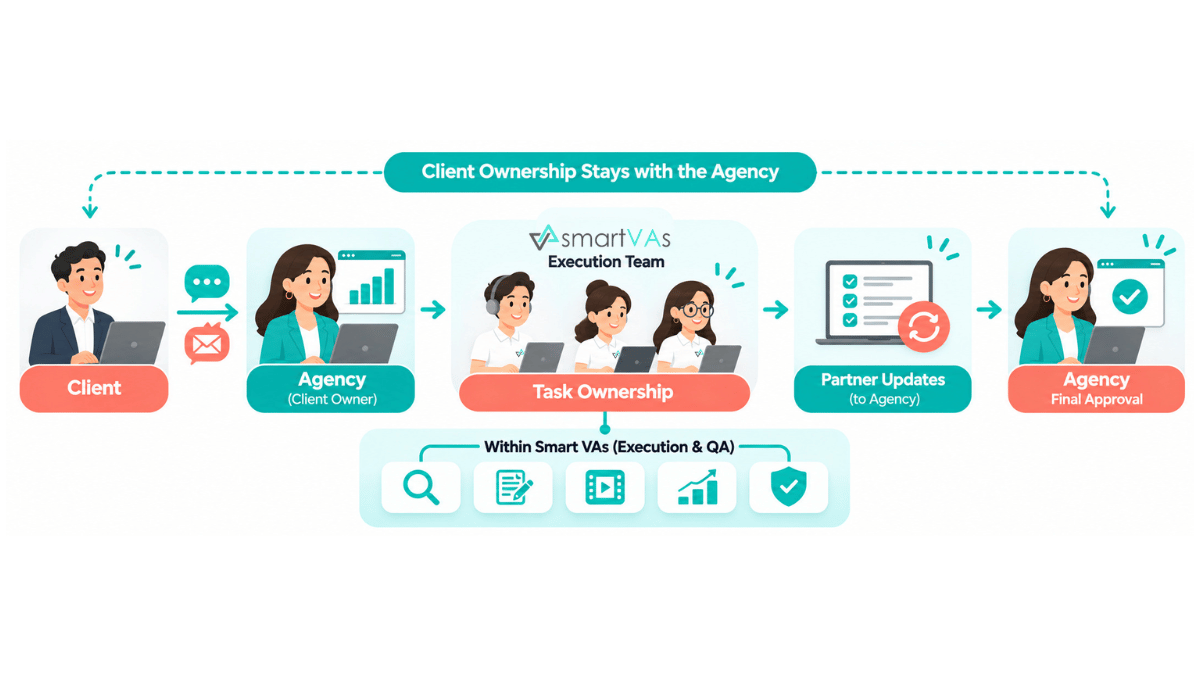
How I Add Capacity Without Giving Up Agency Oversight
Map recurring execution tasks that can be delegated safely.
Separate technical, content, research, local, reporting, and implementation responsibilities.
Document SOPs and review checkpoints.
Start with a defined pilot or limited scope.
Keep client priorities, major approvals, and final client communication with the agency.
7. Confidentiality and Access Controls Are Not Clearly Defined
White-label work often requires access to Search Console, Analytics, the CMS, reporting files, and sometimes client documentation. I prefer to decide who actually needs each system before anyone is added. Sharing one admin password with everyone is not a process.
For Search Console specifically, Google's user and permission controls allow owners to assign different access levels. I use that same principle across SEO tools: give the person the level of access required for the task, and remove or update access when the engagement or responsibility changes.
I also keep each client's files and documentation separate, record important website changes, and avoid unnecessary credential sharing. The agency should decide whether a provider may contact the end client, what branding can appear in reports, how confidential information is handled, and how access is removed when the work ends.
How to Choose or Reset a White-Label SEO Partnership
If an agency already has a partner but keeps seeing rework, delays, or unclear reporting, I would not immediately assume the answer is to replace them. First, I would audit the operating model. Many relationships improve once the agency defines the brief, quality standard, communication rhythm, reporting format, and approval path more clearly.
If you are choosing a new partner, I would not choose based only on price. I would look at actual SEO experience, technical knowledge, previous work, communication habits, documentation, and the ability to explain why a recommendation matters.
Questions I Would Ask Before Starting
Which SEO deliverables and specialties are actually included?
How are audits and recommendations quality-checked?
What does a normal brief, status update, and final handoff look like?
Who handles urgent questions, blockers, and missed deadlines?
What access will the specialist need, and at what permission level?
How will reports be prepared and branded?
Can the specialist show redacted work samples or explain a real workflow?
What happens when the workload or scope changes?
I also recommend starting with a smaller pilot. A pilot tells you more than a sales call because you can evaluate the quality of the research, technical thinking, communication, turnaround, and documentation before expanding the workload.
Smart Virtual Assistants
👍🤵
Smart Virtual Assistants 👍🤵
How an SEO Specialist Can Support Agency Delivery
For agencies, the strongest use of an outside SEO specialist is usually not 'take the whole client and disappear.' I prefer a clear division: the agency retains the client relationship and business direction, while I own the execution that falls inside the agreed SEO scope.
Tasks I can support include keyword research, competitor analysis, technical audits, on-page optimization, internal linking, content briefs, backlink analysis, local SEO activities where appropriate, SEO content quality checks, and reporting preparation. I can also identify technical issues and document what needs to be fixed so the right web specialist can implement or review the change.
When an SEO issue crosses into website implementation, having access to website design support can be useful because the SEO recommendation and the web change can be coordinated instead of treated as unrelated tasks.
At Smart VAs, that managed-team structure is useful when agency work touches SEO, websites, content, reporting, and other recurring execution. The SEO specialist can stay responsible for the search work while the Client Success Partner helps keep communication, priorities, and workload organized.
The agency should still review strategy, major changes, client-facing recommendations, security, and campaign outcomes. White-label support should extend the agency's capability, not remove the agency's responsibility.
A Practical White-Label SEO Workflow I Recommend
Confirm the client goal, target audience, priority services, target locations, current performance, and agency expectations.
Define deliverables, scope limits, access, deadlines, reporting format, review rounds, and escalation rules.
Complete a baseline audit and prioritize work by impact, dependency, and client value.
Execute agreed SEO tasks with project-specific documentation and manual quality checks.
Share progress updates early, especially when a blocker, delay, or scope issue appears.
Report completed work separately from observed performance changes, then agree on the next priority.
This is the kind of structure I want before increasing volume. The more clients an agency adds, the more valuable documented expectations become because the team cannot rely on memory and informal messages to protect quality.
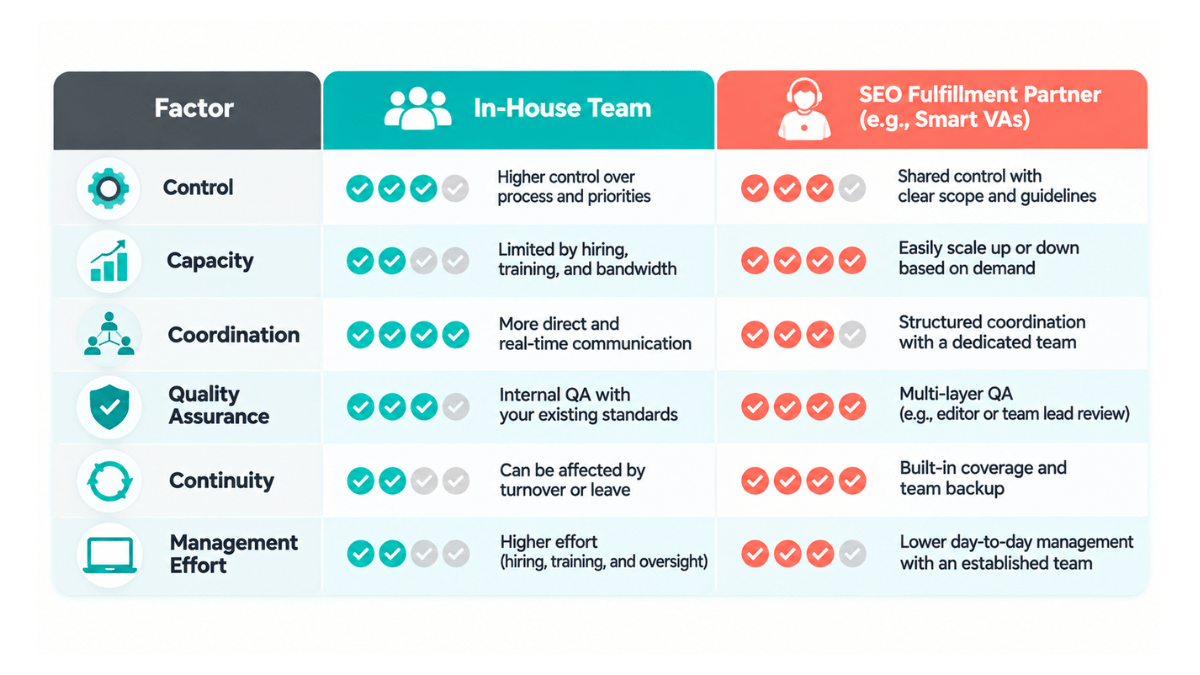
Conclusion: Fix the Delivery Model Before Blaming Outsourcing
White-label SEO can give an agency more delivery capacity, but capacity only helps when the work is dependable. If quality varies, communication is slow, scope is unclear, reporting is weak, or client access is unmanaged, the agency ends up carrying the risk while still doing much of the review work itself.
My advice is to make the operating model visible. Define what the agency owns. Define what the specialist owns. Document the brief, quality standard, deadlines, access, reporting, and escalation process. Then start small, review the work, and expand only when the delivery is consistent.
If your agency needs reliable SEO execution support without handing over your client strategy or approvals, the goal should be a specialist relationship that gives you more capacity while keeping the agency in control of the work that matters most.
What if you could reclaim 40 hours this month?
Find out inside this free guide.
Frequently Asked Questions
-
White-label SEO services are agreed SEO tasks completed by an outside specialist or provider under another agency's brand. The agency normally keeps the client relationship, while the provider handles defined execution. The exact scope, branding, reporting, approvals, and client-contact rules should be agreed before work starts.
-
The most common problems are inconsistent quality, unclear briefs, communication gaps, vague scope, weak reporting, unrealistic expectations, limited specialist capacity, and poorly defined access controls. In my experience, most of these problems improve when responsibilities and review steps are documented instead of assumed.
-
Use a clear brief, a definition of done, sample deliverables, manual review checkpoints, and a repeatable QA checklist. I also recommend tracking why work gets revised. If the same correction appears repeatedly, the process or briefing standard should be updated.
-
The terms can overlap, but the operating model can differ. What matters is the agreement: who owns the client relationship, who performs the work, whether the provider is visible to the end client, how reporting is branded, and how responsibilities are divided.
-
Agencies can outsource execution such as keyword research, technical audits, on-page optimization, internal linking, content briefs, backlink analysis, local SEO support, reporting preparation, and selected implementation tasks. The specialist's actual skills and permissions should determine the final scope.
-
I would look at real SEO experience, technical understanding, work samples, communication, QA, reporting, access practices, capacity, and scope clarity. I would also start with a small pilot so the agency can evaluate how the partner actually works before increasing volume.
-
That depends on the agreement. Agencies should define branding, confidentiality, reporting, client-contact boundaries, and escalation exceptions before work starts. Do not assume a provider will remain invisible or that direct client communication is automatically allowed.
-
Yes, when the role is defined around suitable technical execution and documentation. A technical SEO VA can help identify issues, monitor Search Console, review crawl and indexation problems, document fixes, and support implementation. Complex development or high-risk changes may still need specialist developer review.
-
The report should distinguish completed activity from measured results. I want to see the work finished, relevant visibility and conversion metrics, technical health where appropriate, blockers, context, and next steps. A useful report explains the story behind the numbers instead of presenting screenshots without interpretation.
-
No. The right comparison includes cost, workload, specialist skill, management time, quality control, flexibility, and rework. A cheaper provider can become expensive if the agency has to redo or heavily review every deliverable.
Amit Sharma | SEO Specialist, Smart VAs

Amit Sharma is an SEO Specialist at Smart VAs, responsible for improving website rankings, increasing organic traffic, and strengthening online visibility. He has over 7 years of experience in SEO and is skilled in keyword research, technical SEO, on-page optimization, website audits, and developing effective strategies to help businesses grow their online presence.