Managed Remote Assistant Services for Scaling: Why Generalist VAs Fail to Grow Your Business
Key Takeaways
A single generalist VA can help at first, but one person eventually becomes a ceiling when the business needs admin, design, web, video, CRM, and client support at the same time.
The real bottleneck is not always the assistant. It is the structure around the assistant: no backup, no specialist support, and no management layer.
Managed Remote Assistant Services for Scaling give business owners one primary point of contact, specialist support behind the scenes, Client Success Partner oversight, and backup coverage.
A managed team model reduces founder micromanagement because tasks are routed to the right person instead of forced onto one overloaded freelancer.
Scaling safely is not about buying more hours. It is about building a support system that can grow without breaking.

ARE YOU STILL TRYING TO DO IT ALL?
Discover the SMART way to delegate without losing control—and finally free up your time.
Hiring help is a big milestone.
As a founder, I never want business owners to skip over that. If you are finally at the point where you can bring someone in to support your operations, that means you have built real momentum. You have clients. You have tasks worth delegating. You have growth to protect.
But this is also where I see a lot of business owners walk straight into the same trap.
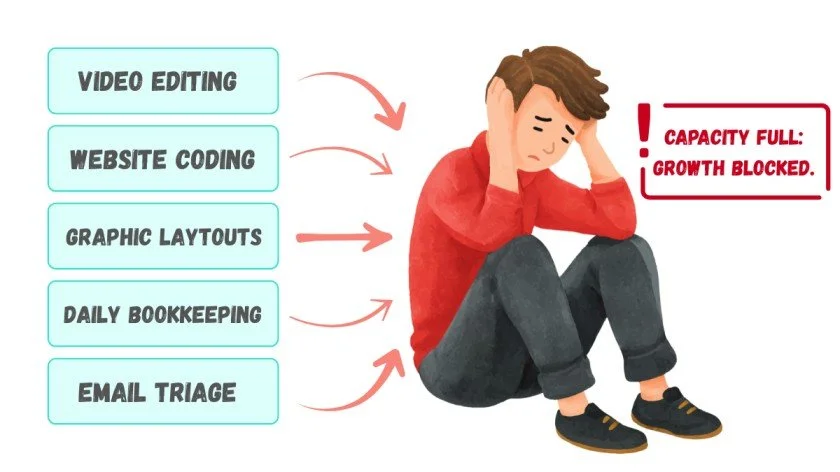
They hire one assistant and quietly expect that person to become an admin, designer, web updater, bookkeeper, scheduler, inbox manager, video editor, CRM cleaner, customer service rep, and project coordinator.
At first, it feels efficient.
One person. One payment. One place to send tasks.
Then the cracks start showing.
The inbox gets handled, but the website updates sit untouched. The social graphics get done, but the CRM is still messy. The assistant is great with scheduling, but not confident editing video. The owner is still answering questions all day, checking work, rewriting instructions, and deciding what this one person should prioritize next.
That is not true delegation. That is a new version of founder overload.
I built Smart VAs because I saw this problem from both sides. I started as a virtual assistant myself, so I know how unfair it is to put ten different specialties on one person and expect excellent work in every area. I also know how frustrating it is for business owners who think they finally hired support, only to realize they are still the person holding everything together.
The issue is rarely that the assistant is lazy or incapable. The issue is that the business has outgrown the single-assistant model.
That is where Managed Remote Assistant Services for Scaling become the smarter structure. Instead of putting the weight of your business on one generalist, you build a managed support system with a primary assistant, specialized team support, a Client Success Partner, and backup coverage.
Because once your business starts growing, you do not just need a helper.
You need a system.
Related Article: How Do Administrative Assistants Manage Calendars and Appointments?
Introduction: The Ceiling of the Single Assistant Model

Every growing business eventually hits an operational wall.
At first, the owner does everything. Then the owner hires a freelancer or a general VA. For a while, that helps. The inbox is lighter. The calendar is cleaner. Someone else can handle the routine work.
But then the business keeps growing.
More clients come in. More platforms need attention. More content needs to go out. More leads need follow-up. More internal systems need maintenance. Suddenly, the assistant who was hired to reduce pressure becomes another person the owner has to manage.
That is the ceiling of the single assistant model.
A Time Etc survey of entrepreneurs found that business owners spend an average of 36% of their workweek on administrative tasks. Asana research also reports that knowledge workers spend 60% of their time on "work about work," including chasing updates, switching tools, searching for information, and managing shifting priorities.
That is exactly what I see in real client conversations.
A business owner does not usually come to us saying, "I need ten more people." They say something more honest:
"I hired help, but I still feel like everything comes back to me."
That sentence tells me the problem is not just capacity. It is structure.
"You cannot build a multi-million dollar company on the shoulders of one overloaded generalist. Scaling requires a system, not just a helper."
The moment your business needs different kinds of work done at the same time, one assistant cannot be the whole solution anymore.
Why One Generalist Freelancer Becomes a Growth Bottleneck
I am not against generalist VAs.
A strong general VA can be a wonderful first hire. They can organize your inbox, manage your calendar, update spreadsheets, prepare documents, and keep the daily admin from swallowing your week.
But there is a difference between using a generalist well and expecting one person to carry an entire growing operation.
Here is where the model usually breaks.
1. The Mastery Limit
Someone can be excellent at inbox management and still not be the right person to edit a sales video.
Someone can be organized and reliable but not trained in SEO, website updates, bookkeeping, paid ads, custom graphics, or CRM automation.
That does not make them bad at their job. It makes them human.
The problem starts when a business owner forces every task through the same person because that person is already there.
I have seen owners hand one assistant a task list that includes:
Rescheduling calls
Updating the CRM
Designing social media graphics
Editing podcast clips
Uploading blog posts
Formatting lead magnets
Following up with prospects
Checking invoices
Fixing website pages
That is not a role. That is a pile-up.
When one person is asked to do five different specialties, the business pays for it through slower turnaround, more revisions, and lower-quality work. I say this with empathy because I have been to the VA on the other side of that kind of list. One person can be resourceful, but resourceful is not the same as specialized.
2. The Management Burden
The second issue is management.
When you hire one independent freelancer, you are usually responsible for everything around that person:
Writing every process
Training them on every tool
Checking the work
Managing deadlines
Reassigning tasks when they are unavailable
Finding a replacement if they quit
Rebuilding the relationship if the fit is wrong
That creates a hidden cost.
You may pay less per hour, but you spend more of your own time managing the relationship. And owner time is not cheap.
This is why I care so much about management structure. Gallup has found that managers account for at least 70% of the variance in employee engagement across business units. That reinforces something I see every day: people do better work when they are supported, managed, and given clear expectations.
Most founders do not have extra time to become full-time managers of independent contractors. They need support that already comes with management built in.
Related Article: 15 Interview Questions When Hiring for an Admin Assistant: Your Comprehensive Guide
3. The Time Limit
A single person has a hard capacity limit.
Even if your VA is wonderful, they still only have so many hours in a week.
Once those hours are filled with inboxes, scheduling, data entry, and recurring admin, there is no room left for higher-value projects like:
Building a better lead tracking system
Repurposing long-form content
Updating landing pages
Preparing sales assets
Organizing client onboarding
Creating reports
Improving client communication workflows
That is the generalist freelancer bottleneck.
The assistant is busy. The owner is still busy. The business is still waiting.
Why Growth-Minded Brands Choose Managed Remote Assistant Services for Scaling

Growth-minded brands choose Managed Remote Assistant Services for Scaling because they understand something important:
The goal is not to hire the cheapest help.
The goal is to remove the founder bottleneck without creating a new one.
At Smart VAs, I built our model around a managed team structure because I knew business owners needed more than a task-taker. They needed one reliable point of contact, specialist support behind the scenes, and a management layer that kept work moving without forcing the founder to micromanage every detail.
That is why our clients do not just get a lone assistant and a list of hours. They get a core assistant, access to experienced specialists, backup protection, and a Client Success Partner who helps oversee communication, progress, and deadlines.
That matters because scaling is not just about getting tasks done.
It is about keeping tasks moving without the owner constantly stepping in.
Here is how I think about the managed team model.
Step 1: The Core Assistant: Your Dedicated Point of Contact
You still need one person who knows you well.
That is your core assistant.
This person learns your brand voice, your preferences, your schedule, your clients, your tools, and the way you like work handled. They become your day-to-day point of contact so you are not managing a scattered group of random freelancers.
You can send assignments, updates, reminders, and priorities to one familiar person.
The difference is that this person is not left alone to figure out every specialty by themselves. They are supported by the team behind them.
Step 2: The Client Success Partner: Expert Oversight Without Micromanagement
This is the layer many business owners do not realize they need until they have gone without it.
At Smart VAs, our Client Success Partner helps oversee the work, check progress, guide communication, and make sure deadlines do not disappear inside someone’s inbox.
That means you are not the only person watching the task list.
You are not constantly asking, "Did this get done?"
You are not chasing updates across email, Slack, Google Docs, and project management tools.
The Client Success Partner helps keep the support system accountable so you can stay focused on sales, clients, partnerships, and strategy.
Step 3: Specialized VA Matching: Experienced Team Support
This is where the managed model becomes more powerful than the single-assistant model.
When a task requires a specific skill, your core assistant does not have to pretend to be an expert in everything.
Instead, the work can be routed to the right person inside our team network.
For example:
A website update can go to a website design specialist.
A social graphic can go to a graphic design specialist.
A short-form video can go to a video editing specialist.
A blog upload can go to a content or website support specialist.
A CRM cleanup can go to someone comfortable with systems and data.
This is the difference between assigning work to whoever is available and assigning work to someone who actually owns that skill set.
I want our clients to stop asking one assistant to be everything. That is not scalable for the business, and it is not sustainable for the assistant.
Step 4: Backup Protection: Continuous Operational Health

One of the biggest risks of hiring one freelancer is downtime.
If they get sick, take a vacation, lose the internet, become unavailable, or move on suddenly, your operations can stall immediately.
That is not a small issue when the person is handling your inbox, follow-ups, calendar, client requests, reports, or recurring content.
A managed model gives you backup coverage.
At Smart VAs, we build our support structure so a trained backup assistant can step in when the primary assistant is unavailable. That protects the business from stopping just because one person is out.
This is one of the reasons I prefer managed support for scaling companies. The goal is not just delegation. The goal is continuity.
Managed Team Model: How Tasks Flow
| Step | What Happens |
|---|---|
| Step 1: Core Assistant | Your dedicated point of contact learns your business and organizes the daily workflow. |
| Step 2: Client Success Partner | Your support system is guided, checked, and kept on track without you micromanaging. |
| Step 3: Specialized VA Matching | Design, website, video, CRM, admin, and content tasks are assigned to the right specialists based on the work required. |
| Step 4: Backup Protection | A trained backup assistant helps prevent downtime when your primary assistant is unavailable, ensuring business continuity. |
The Math of Scaling Safely: Cost vs. Capabilities
When business owners compare a freelancer to a managed assistant service, they often look only at the hourly rate.
That is the wrong comparison.
The better question is:
"What would it cost to build this same support structure myself?"
If you hired in-house, you might need:
An administrative assistant
A graphic designer
A web developer or web designer
A project manager
A video editor
A social media assistant
A CRM or operations support person
Even if you hired only a few of those roles, the cost adds up quickly.
The U.S. Bureau of Labor Statistics lists the May 2024 median annual wage for secretaries and administrative assistants at $47,460. It also reports median annual wages of $61,300 for graphic designers and $100,750 for project management specialists. BLS also projects demand for web developers and digital designers to grow from 2024 to 2034. Those numbers do not include benefits, recruiting, onboarding, software, hardware, or the founder’s management time.
That is why I do not look at managed support as "VA hours."
I look at it as shared access to capabilities.
With a managed assistant model, you are not trying to carry the cost of multiple full-time salaries just to access different skills. You are building a flexible remote staffing solution that can expand or adjust based on the business’s actual workload.
Cost vs. Capability Comparison
| Capabilities Needed | Hiring Individual In-Office Staff | Managed Assistant Services with Smart VAs |
|---|---|---|
| Skill Access | Pay separate salaries for admin, design, web, project coordination, and other roles. | Get a primary assistant plus access to specialized, experienced VAs. |
| Management Cost | You spend hours tracking, training, checking, and guiding each person. | Oversight is included through a Client Success Partner. |
| Workspace Costs | Hardware, software licenses, office space, payroll setup, and employee overhead add up. | Remote support reduces office overhead and keeps the structure flexible. |
| Continuity | If one employee is out, the work may pause unless you have internal backup. | Backup coverage helps protect task continuity. |
| Flexibility | You may be locked into full-time roles even when workload fluctuates. | Support can be adjusted around changing business needs. |
| Founder Time | You still manage the team directly. | You delegate into a managed system, not a loose group of freelancers. |
The cheapest option is not always the lowest-risk option.
A single freelancer may cost less upfront, but if the owner has to manage every task, solve every gap, and rebuild from scratch every time someone leaves, the hidden cost becomes expensive fast.
Choosing Managed Remote Assistant Services for Scaling with Smart VAs
If you are scaling, you do not need another person to chase.
You need a support structure that makes your business easier to run.
That is what I created Smart VAs to provide.
I started as a freelance virtual assistant and digital marketer before becoming a founder, so I know the difference between simply completing tasks and building support that actually helps a business grow. I have seen what happens when business owners hire one person, overload them, and then wonder why nothing feels lighter.
At Smart VAs, we do not just sell hours.
We provide scalable infrastructure.
That means you can have a core assistant who understands your business, a Client Success Partner who helps manage workflow, and access to experienced specialists when the work requires more than general admin. Our hiring standards prioritize skilled assistants with education, professional communication, and at least three years of relevant experience, because scaling businesses need support they can trust.
One of my favorite examples is Gabe Gibitz of Blue Guru Marketing.
Before working with Smart VAs, Gabe was stretched thin across web development, SEO, client communication, and project management. He did not just need a few tasks taken off his plate. He needed a support structure that could grow with the business.
Our work with Gabe started with 40 hours of project-based help in October 2021. As trust grew and the business needed more capacity, that support expanded into a 400-500-hour-per-month operation with a dedicated Smart VAs team helping with technical project management, social media, and operations.
That is what scaling looks like when support is built as a system.
It starts small.
Then, as the business grows, the support structure grows with it.
Gabe’s story is not just about outsourcing. It is about moving from "I have to do everything myself" to "I have a team that keeps the business moving."
That is the shift managed remote assistant services are designed to create.
Smart Vas Features Checklist
A Whole Managed Team
You get your core assistant, plus access to experienced VAs specializing in admin support, graphic design, website updates, content support, video editing, CRM, and more.
Independent Thinkers
Our VAs are trained to solve problems, organize work, and reduce founder dependence instead of asking for every tiny next step.
Client Success Partner Oversight
Your support is backed by a management layer that monitors communication, quality, progress, and deadlines.
Always Active Support
Backup coverage helps protect your business from downtime whenever your primary assistant is unavailable.
Flexible Remote Staffing
Scale your support up or down based on workload instead of hiring multiple full-time employees before you're ready.
Commercially Focused Delegation
The goal isn't simply to clear tasks—it's to free founders to focus on sales, partnerships, strategy, client relationships, and business growth.
When a Single VA Is Still Enough
To be fair, not every business needs managed assistant services right away.
A single VA may be enough if:
You only need simple admin support.
Your workload is predictable.
You have clear SOPs already written.
You do not need design, web, video, CRM, or marketing support.
You have time to train and manage the person yourself.
It would not hurt the business if work paused for a few days.
But if your assistant is already overloaded, your task list keeps expanding, or you are still the person connecting every dot, the model has probably reached its limit.
That is when the question changes.
It is no longer, "Do I need a VA?"
It becomes, "Do I need a team structure that can scale with me?"
Signs You Have Outgrown the Generalist VA Model
I would consider managed support if three or more of these are true:
Your VA is doing admin, design, web, and client support all at once.
You are constantly rewriting or rechecking work.
Projects pause when your assistant is unavailable.
You still manage most deadlines yourself.
You have more tasks than one person can realistically complete.
Your assistant is good, but the workload now requires more specialized skills.
You avoid delegating because explaining the task feels exhausting.
You are still working nights or weekends to "catch up."
Growth projects keep getting delayed by recurring admin work.
You feel nervous about what would happen if your current assistant left.
When I hear those signs, I know the business does not just need more help.
It needs a stronger operating structure.
Final Thoughts: Scaling Requires Structure, Not Heroics
A generalist VA can be a great starting point.
But if your business is growing, one person cannot be your entire support system forever.
That is not fair to the assistant, and it is not safe for the business.
Scaling requires depth. It requires backup. It requires specialized skills. It requires someone besides the owner watching the workflow. It requires a system that keeps moving when life happens.
That is the real value of Managed Remote Assistant Services for Scaling.
You stop depending on one overloaded person.
You stop being the backup plan for every unfinished task.
You start building the kind of support structure that lets you lead the business instead of holding it together.
Smart Virtual Assistant
👍🤵
Smart Virtual Assistant 👍🤵
What if you could reclaim 40 hours this month?
Find out inside this free guide.
Frequently Asked Questions
-
Managed Remote Assistant Services for Scaling are remote support services designed for growing businesses that need more than one generalist assistant. Instead of relying on a single VA, the business gets a managed support structure that may include a core assistant, specialized VAs, Client Success Partner oversight, and backup coverage.
-
One generalist VA becomes a bottleneck because one person cannot realistically master admin, design, web updates, video editing, bookkeeping, CRM management, client support, and project coordination at the same time. As the business grows, the task volume and skill requirements usually outgrow what one person can handle well.
-
A freelancer usually works independently, which means the business owner handles training, task management, quality control, and backup planning. A fully managed virtual assistant agency provides a more structured system with vetted talent, management support, task oversight, and replacement or backup options when needed.
-
A Client Success Partner helps oversee communication, deadlines, progress, and task flow. This reduces the amount of micromanagement required from the business owner and gives the assistant team clearer support and accountability.
-
They may cost more than hiring one independent freelancer, but the comparison should include management time, downtime risk, specialist access, quality control, and replacement costs. For scaling businesses, managed services can be more cost-effective than hiring multiple in-house employees or managing several freelancers separately.
-
A business should consider switching when the current VA is overloaded, projects are delayed, the owner is still managing too many details, specialized tasks are piling up, or the business would experience downtime if the assistant became unavailable.
About the Author:
Kristy Yoder, Founder and CEO of Smart VAs

Kristy Yoder is the Founder of Smart VAs, a virtual assistant agency that helps entrepreneurs grow through reliable administrative and digital marketing support. With extensive experience building and managing remote teams, she specializes in delegation, operational efficiency, and scalable business growth.