Managed Virtual Assistant vs Freelance Virtual Assistant: Which Is Right for Your Business?
Key Takeaways
A freelance virtual assistant can be a good fit for short-term projects, occasional help, or businesses that have time to manage contractors directly.
Managed virtual assistant services are built for ongoing support, quality control, backup coverage, documentation, and scalable operations.
The cheapest hourly rate is not always the lowest total cost once recruiting, onboarding, replacement, management time, and business continuity are considered.
Growing businesses often outgrow freelancers when one person becomes a bottleneck or when managing multiple freelancers turns the founder into a project manager.
Smart VAs is best suited for businesses that need a managed team model, not just a single assistant working alone.

ARE YOU STILL TRYING TO DO IT ALL?
Discover the SMART way to delegate without losing control—and finally free up your time.
Hiring help should make a business feel lighter. But I have seen many founders hire a virtual assistant and still feel like everything depends on them.
Sometimes the issue is not the assistant. It is the support model.
A freelance virtual assistant can be an excellent choice for the right business. Many freelancers are talented, responsible, and affordable. If you need a defined project done, or you have the time to manage someone directly, freelancing can work very well.
But as a business grows, the needs usually change. The work becomes more recurring. The tasks spread across admin, marketing, CRM, website updates, client support, reporting, and operations. That is when one independent assistant can become too fragile of a system.
I built Smart VAs because I saw this gap from both sides. Before I became a founder, I worked as a freelance virtual assistant and digital marketer. I know the value a good freelancer can bring. I also know what happens when a business starts depending on one person for everything without backup, documentation, oversight, or a wider team behind them.
This guide breaks down managed virtual assistant vs freelance virtual assistant support in a practical way, so you can decide which model fits your stage of business growth.
For context, flexible work is already a major part of the modern talent market: Upwork reported that 28% of U.S. knowledge workers were freelancing or working independently in 2024. At the same time, the U.S. Bureau of Labor Statistics reported that secretaries and administrative assistants had a median annual wage of $47,460 in May 2024 before benefits, recruiting, training, and management time are considered. Sources: Upwork Future Workforce Index and U.S. Bureau of Labor Statistics.
The Short Answer: Managed Virtual Assistant vs Freelance Virtual Assistant

Choose a freelancer if you need occasional help, have a limited budget, and are comfortable managing the relationship yourself.
Choose managed virtual assistant services if you need ongoing support, consistent delivery, backup coverage, quality control, and the ability to scale without rebuilding your support system every few months.
The real question is not only “Which option is cheaper?” It is “Which option can support the business without creating more work for the founder?”
What Is a Freelance Virtual Assistant?
A freelance virtual assistant is an independent contractor who provides remote support directly to a business owner or team. They may charge by the hour, by project, or through a monthly retainer. The client usually manages the relationship, assigns the tasks, reviews the work, and decides whether to continue the engagement.
Freelance VAs can help with many tasks, including inbox management, scheduling, research, data entry, customer service, social media scheduling, document formatting, and other admin or marketing support tasks.
This model works best when the work is clear, the scope is limited, and the business owner has enough time to onboard, train, guide, and review the assistant. It can be a smart starting point for solopreneurs or early-stage businesses that need help but are not ready for a managed support structure.
| How the Freelancer Model Usually Works |
|---|
| Business owner assigns the task. |
| Freelancer completes the task. |
| Business owner reviews the output. |
| Business owner manages changes, communication, and next steps. |
What Is a Managed Virtual Assistant?
A managed virtual assistant service gives the business a more structured remote support system. Instead of hiring one independent person and managing everything alone, the business works with a provider that helps with matching, onboarding, oversight, documentation, backup planning, and performance support.
At Smart VAs, this is the difference between hiring “one more person” and building an actual support system. Our model is designed around a fully managed virtual assistant team for scaling businesses, with a Client Success Partner, trained assistants, documented workflows, quality reviews, specialist support, and backup coverage when needed.
That matters because growing businesses usually do not need only one type of help. They may need admin support today, CRM cleanup next week, website support next month, and marketing execution as the business expands. A managed model makes that easier to organize without turning the founder into the full-time project manager.
| Managed Support Flow |
|---|
| Business owner shares goals and tasks. |
| Client Success Partner helps organize communication and priorities. |
| Managed VA team executes the work. |
| Documentation, quality support, and backup coverage protect continuity. |
Managed Virtual Assistant vs Freelance Virtual Assistant: Side-by-Side Comparison
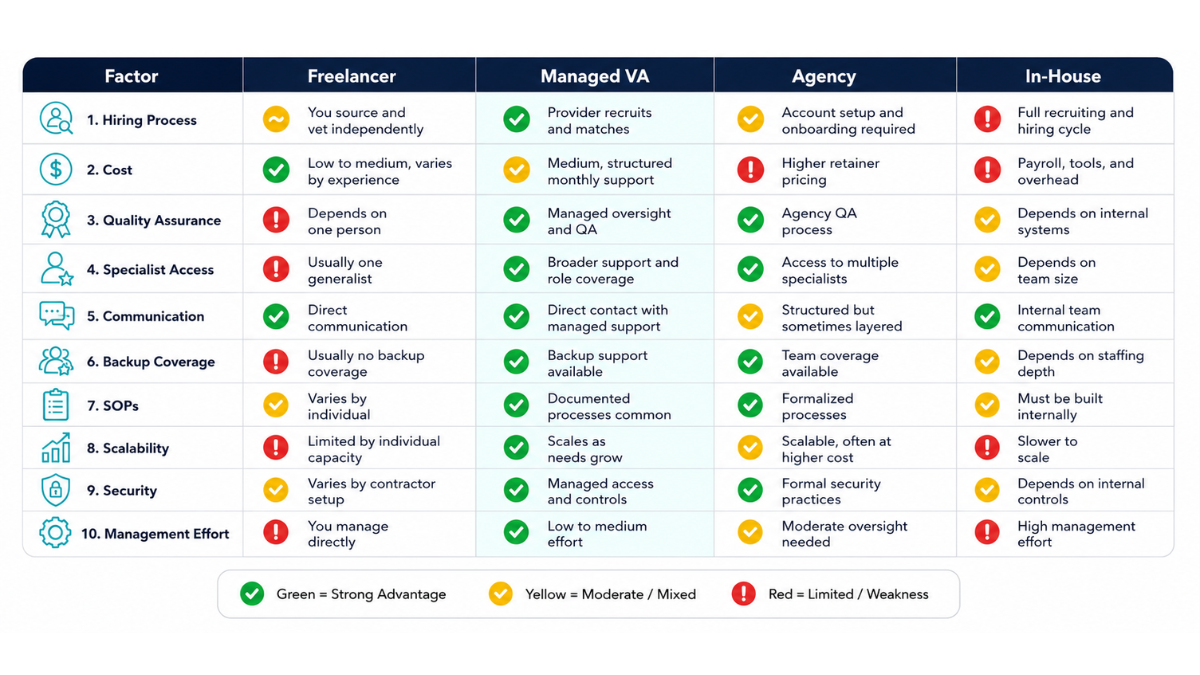
Here is the simple way I explain the difference to founders. A freelancer is often a person you manage. A managed VA service is a support structure you plug into.
Managed Virtual Assistant vs Freelance Virtual Assistant: The True Cost Comparison
A freelancer can look cheaper because the hourly rate is usually lower. That matters, especially for businesses with limited budgets. But hourly rate is not the whole cost.
The real cost includes recruiting, onboarding, training, corrections, communication, replacement, and the founder’s time. If the founder has to spend five hours a week managing the assistant, that cost should be included in the decision.
This is why a managed VA may cost more per hour but still create better long-term value for a growing business.
| Cost Area | Freelancer | Managed VA |
|---|---|---|
| Hourly Cost | Usually lower. | Usually higher than low-cost freelancers, but includes more support structure. |
| Recruiting | Client handles sourcing and screening. | Provider handles talent sourcing and matching. |
| Onboarding | Client creates the process. | Support includes onboarding and workflow setup. |
| Training | Client trains directly. | Training and role guidance are supported by the managed system. |
| Replacement | Client starts over if the freelancer leaves. | Provider can help replace or adjust support. |
| Quality Control | Client checks everything. | Quality support is built into the model. |
| Management Time | Higher owner involvement. | Lower owner involvement. |
| Specialist Access | Limited to one person unless you hire more freelancers. | Access to a wider support team. |
| SOP Documentation | Often missing unless the client creates it. | Documentation can be part of the managed workflow. |
| Business Continuity | Riskier if one person is unavailable. | Stronger with backup coverage. |
| Long-Term ROI | Good for simple or short-term work. | Stronger for recurring support and scaling operations. |
What Happens When Your Virtual Assistant Is Unavailable?
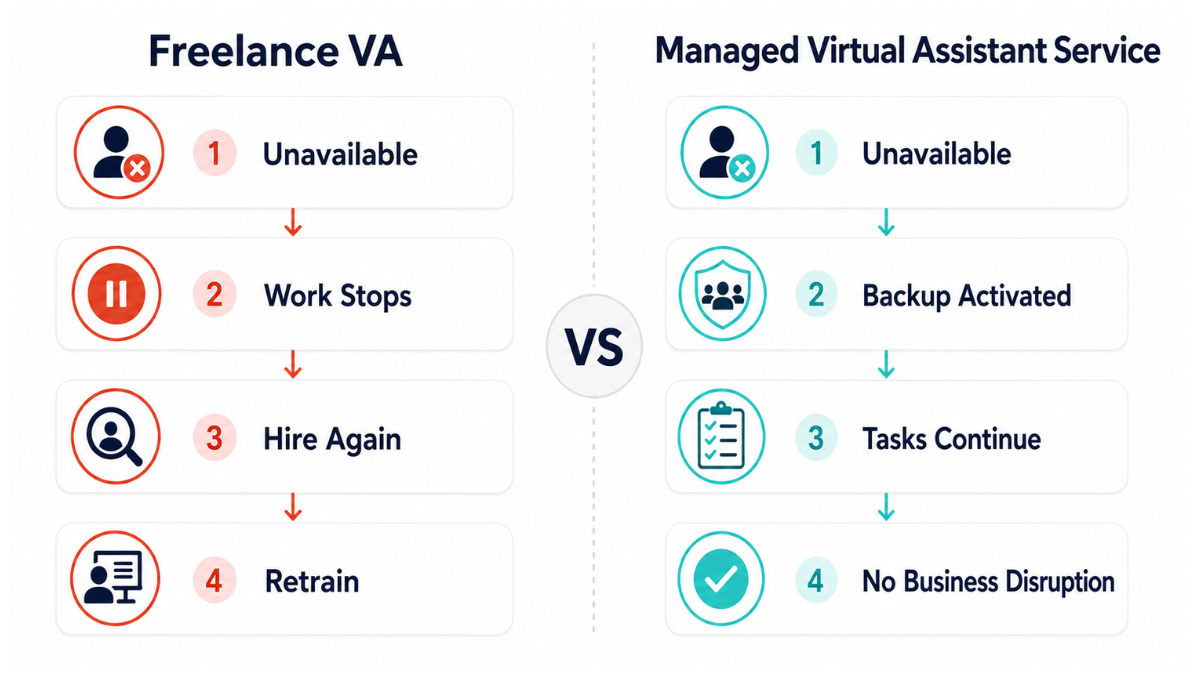
This is one of the most practical questions a business owner can ask, and it is often ignored until there is a problem.
If a freelance virtual assistant gets sick, takes a vacation, loses internet access, or suddenly becomes unavailable, the work may stop. If they are the only person who knows your inbox, client follow-up process, reporting routine, or CRM workflow, you may have to pause operations while you find and train someone new.
With managed virtual assistant services, the goal is to reduce that single-person risk. Documented processes, a Client Success Partner, and trained backup support help protect account continuity so work does not depend entirely on one person being available every day.
Why Growing Businesses Eventually Outgrow Freelancers
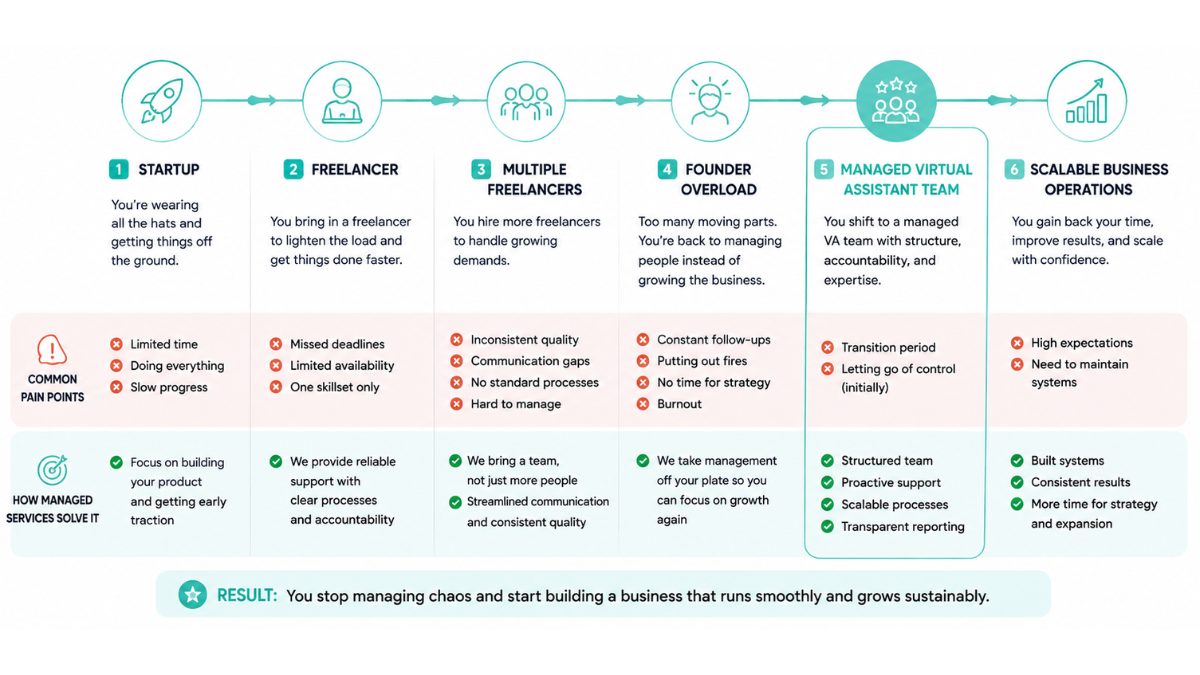
Freelancers are not the problem. A lack of structure is the problem.
A business can start with one freelancer and do very well. Then the work grows. The founder hires another freelancer for design, another for admin, another for content, another for web updates, and another for CRM tasks. Suddenly, the founder is not just leading the business. They are managing a scattered support team.
That is when the hidden cost shows up. The founder becomes the project manager. Communication happens in too many places. Documentation is inconsistent. Quality depends on who is available. If one person leaves, the workflow breaks. If two people need to collaborate, the owner becomes the bridge.
That is the moment many businesses need systems instead of disconnected individuals.
What This Looks Like in a Real Smart VAs Client Story
One example I often think about is Gabe Gibitz, founder of Blue Guru Marketing. Before working with us, Gabe was stretched thin across SEO, web development, client communication, and project management. He did not just need a few tasks removed from his plate. He needed support that could grow with the business.
Our work with Gabe started with project-based help and grew into a much larger managed support structure. That is the point I want business owners to see. The value was not only that tasks were completed. The value was that Gabe had a support model that could expand as the business needed more capacity.
You can see more client examples on the Smart VAs case studies page: Smart VAs case studies.
Which Option Fits Your Stage of Business Growth?
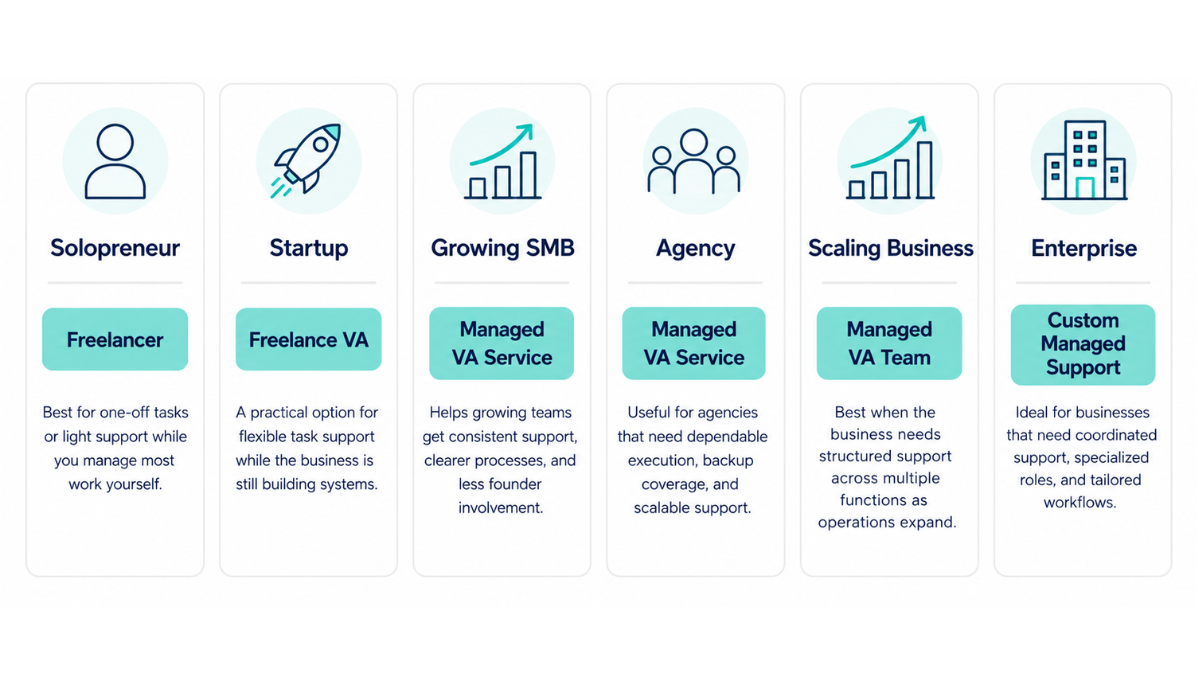
The best choice depends on your current stage, not what sounds most impressive. A solopreneur with a few admin tasks may not need the same support model as a growing agency or multi-location business.
When Is a Freelance Virtual Assistant the Better Choice?
A freelance virtual assistant can be the better choice when your needs are clear, simple, and limited. I would consider a freelancer if you need one-off work, occasional support, a short-term project, or a highly specialized task that does not require long-term coordination.
Freelancers can also be a good fit for startups that are still testing what kind of help they need. If you enjoy managing contractors, writing instructions, checking work, and building your own processes, the freelance model may give you enough flexibility at a lower starting cost.
When Are Managed Virtual Assistant Services the Better Choice?
Managed virtual assistant services are usually the better choice when the work is recurring, the business is growing, and the founder does not want to spend more time managing people than leading the company.
This model fits businesses that need support across multiple functions: administrative support, marketing support, customer service, CRM management, website support, content support, graphic design, and operations support. It is especially helpful for agencies, healthcare businesses, legal teams, accounting firms, SaaS companies, real estate businesses, marketing teams, and founders who want to reduce operational workload without building a full in-house team.
If the phrase “I need help managing the help” feels familiar, managed support is probably worth considering.
Common Myths About Managed Virtual Assistant Services
| Myth | Reality |
|---|---|
| Managed services are only for enterprise companies. | Growing SMBs often benefit the most because they need structure without the cost of a large in-house team. |
| Freelancers are always cheaper. | The hourly rate may be lower, but management time, replacement, quality control, and downtime still cost the business. |
| Managed means losing control. | The business still controls strategy, priorities, approvals, brand voice, and ownership of accounts. |
| Managed virtual assistants are less flexible. | A managed team can often scale faster because support does not depend on one person's availability or skill set. |
Should You Hire a Freelancer or a Managed Virtual Assistant?
Use this quick checklist. If you answer yes to most of these, managed virtual assistant services are probably the better fit.
☐ Do you need recurring support every week?
☐ Are you growing quickly?
☐ Do you need more than one skill set?
☐ Do you want to avoid managing multiple freelancers?
☐ Would your business be affected if your assistant became unavailable?
☐ Do you need consistent quality and documentation?
☐ Do you want support that can scale as your workload grows?
If you only need occasional help or a small one-time project, a freelancer may be enough. If you need reliable execution that supports long-term growth, a managed VA model is usually the safer choice.
How Smart VAs Delivers Managed Virtual Assistant Support
At Smart VAs, we are not trying to replace the value of a great freelancer. We are solving a different problem: the operational challenge of scaling support without creating more work for the founder.
Our process is designed to help you move from scattered delegation to structured support:
| Step | Stage | What Happens |
|---|---|---|
| Step 1 | Discovery Call | We talk through your goals, workload, and biggest bottlenecks. |
| Step 2 | Role Matching | We help match your needs with the right support mix. |
| Step 3 | Onboarding | We help set up expectations, tools, communication, and priorities. |
| Step 4 | Task Documentation | We turn recurring work into clearer processes. |
| Step 5 | Dedicated Support | You work with your assistant or team on day-to-day execution. |
| Step 6 | Performance Reviews | We review communication, task delivery, and fit. |
| Step 7 | Scale Anytime | Support can expand as your workload grows. |
Smart VAs can support areas such as administrative support, marketing support, customer service, CRM management, website support, content support, graphic design, and operations support.
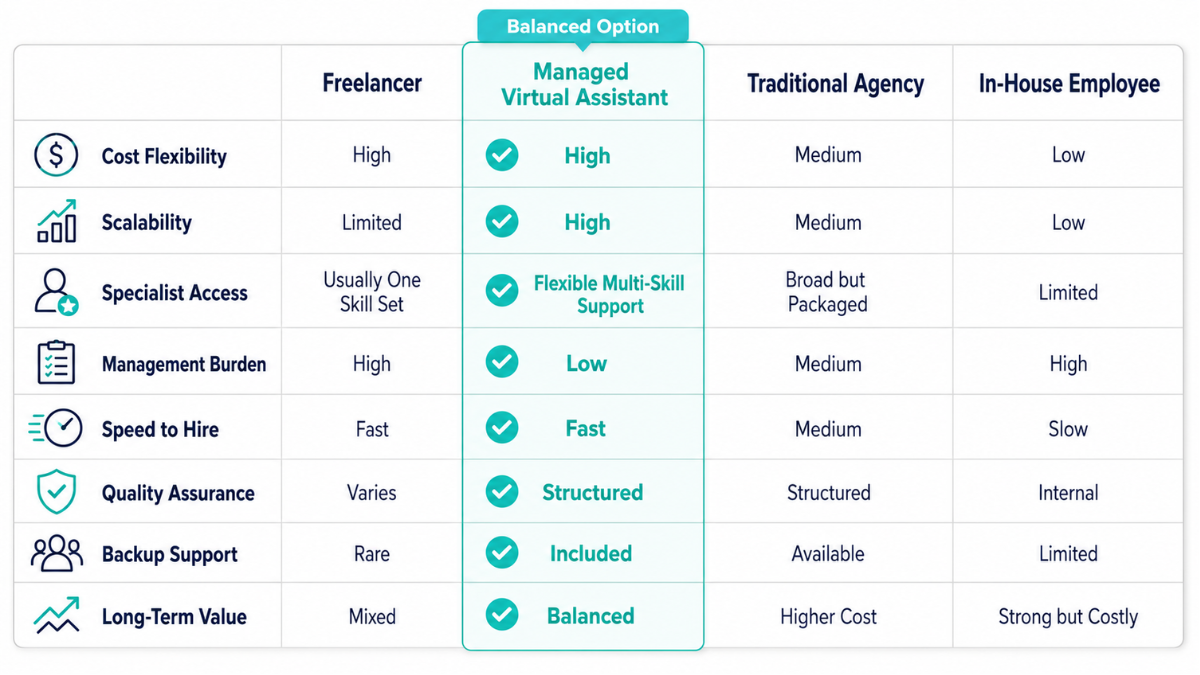
Which Support Model Is Right for Your Business?
Most businesses are not choosing between only two options. They are usually deciding between a freelancer, a managed VA, an agency, or an in-house employee. This comparison can help clarify the trade-offs.
Ready to Scale Your Business Without Managing Freelancers?
The right support model depends on where your business is today and where it is going next. In many cases, a general VA can be helpful when you only need flexible day-to-day support. It also helps to compare rates for general virtual assistants, freelancers vs agencies for data entry support, and how to build your own remote team before choosing the model you want to grow into.
Choose a freelancer if you need short-term support, have a limited budget, and are comfortable managing contractors yourself.
Choose managed virtual assistant services if you need ongoing support, consistent quality, specialist expertise, backup coverage, scalable operations, and less day-to-day management on your plate.
Smart VAs provides structured, managed support for growing businesses that need more than disconnected freelance resources. We help you build a dedicated virtual assistant support system that can grow with your business, protect your time, and keep work moving behind the scenes.
Smart Virtual Assistant
👍🤵
Smart Virtual Assistant 👍🤵
What if you could reclaim 40 hours this month?
Find out inside this free guide.
Frequently Asked Questions
-
It can be worth the higher cost if your business needs ongoing support, backup coverage, quality control, and less management burden. If you only need a simple one-time task, a freelancer may be more cost-effective.
-
Yes. Many businesses start with a freelancer and move to managed virtual assistant services when the workload becomes more recurring, complex, or difficult to manage alone.
-
A virtual assistant agency may simply match you with a VA. A managed virtual assistant service should include more structure, such as onboarding support, task tracking, quality review, backup support, and ongoing communication management.
-
They can be more secure when the provider uses clear onboarding, role-based access, documentation, and accountability processes. Businesses should still keep ownership of their accounts and use secure password-sharing tools.
-
Many managed services include backup coverage or access to replacement support. This is one of the biggest differences from relying on one independent freelancer.
-
For growing businesses with recurring work, multiple task types, and limited time to manage contractors, managed virtual assistant services are usually the stronger long-term option.
About the Author:
Kristy Yoder, Founder

Kristy Yoder is the Founder of Smart VAs, a virtual assistant agency that helps entrepreneurs grow through reliable administrative and digital marketing support. With extensive experience building and managing remote teams, she specializes in delegation, operational efficiency, and scalable business growth.
Passionate about helping business owners reclaim their time, Kristy leads Smart VAs in connecting entrepreneurs with skilled virtual professionals who provide dependable support and contribute to long-term success.