In-House vs. Outsourced Marketing: Which Team Delivers Better ROI?
Key Takeaways
Marketing is now too fragmented for one full-time generalist to own every channel well.
The real cost of building an in-house marketing team includes salaries, benefits, software, recruiting, training, and management time.
A lean team can work when strategy, execution, and systems are separated instead of forced into one overloaded role.
The strongest structure for many growing companies is a fractional strategy lead supported by specialized marketing VAs and clear asynchronous workflows.
Melissa Martin’s Smart VAs story shows how specialized support can help an agency owner take on bigger projects, protect quality, and double revenue.
Smart VAs fits this model by providing a fully managed virtual assistant team, a Client Success Partner, and access to specialists across marketing, content, design, web, and operations.

ARE YOU STILL TRYING TO DO IT ALL?
Discover the SMART way to delegate without losing control—and finally free up your time.
Re-Evaluating the In House vs Outsourced Marketing Debate
I do not think the in-house vs. outsourced marketing conversation is really about location anymore.
It is about structure.
When I talk with business owners at Smart VAs, most of them are not asking, “Should this person sit in my office?” They are asking a much more practical question: “How do I get consistent marketing execution without locking myself into payroll I cannot afford or a team structure I cannot manage?”
That question matters more now because marketing changes quickly. One quarter, your priority may be SEO content. The next, you may need better reporting, email nurturing, short-form video, Google Ads support, landing page updates, or social media consistency. Algorithms shift. Platforms change. Buyer behavior moves. A fixed internal team can become expensive if the roles you hired for no longer match the channels that are producing results.
I have seen owners make the same mistake in different ways. Some hire one full-time marketing generalist and expect that person to write, design, edit, analyze, advertise, optimize, and report. Others sign with a large agency and realize later that the scope is too rigid for the day-to-day execution they actually need. Others try freelancers and end up managing five separate people just to keep one campaign moving.
That is why the real ROI question is not “in-house or outsourced?”
It is: “Which model gives your business the fastest access to the right marketing skills, with the least wasted overhead?”
Modern marketing ROI is not about team size. It is about shifting resources quickly to the channels that convert.
Tracking the Actual In House vs Outsourced Marketing ROI Differences
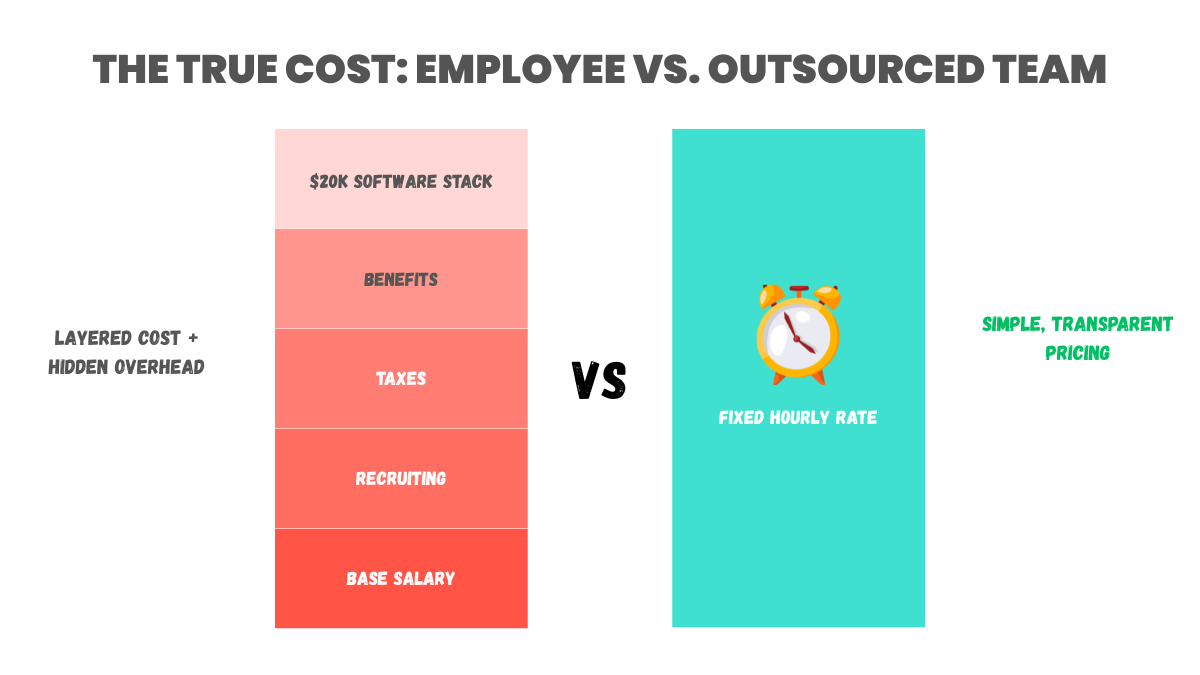
When people compare in-house vs outsourced marketing ROI differences, they often start with salary. That is too narrow.
A salary is only the visible part of the cost. The real cost of building an internal marketing team includes recruiting time, benefits, employer payroll taxes, management time, onboarding, training, software licenses, paid time off, hardware, and the risk of hiring the wrong person for a role that keeps changing.
The U.S. Bureau of Labor Statistics reported that the median annual wage for marketing managers was $161,030 in May 2024. The same BLS data shows a median wage of $61,300 for graphic designers and $90,930 for web developers in May 2024. That means even a lean internal team with strategy, design, and website execution can become a six-figure investment quickly before benefits, payroll costs, tools, or recruiting are included.
Benefits are not a small add-on either. BLS employer-cost data for December 2025 showed private industry benefits accounted for 29.9% of total employer compensation costs. In plain language, a full-time employee costs more than the number on the offer letter.
Then there is the software stack. A marketing team does not just need people. It needs tools. A realistic setup might include CRM and automation, SEO research, reporting dashboards, design tools, project management, stock assets, AI tools, scheduling platforms, email testing, and ad optimization tools. HubSpot Marketing Hub Professional starts at $800 per month, while Semrush Pro+ is listed at $248.17 per month when billed annually. Add design software, collaboration tools, reporting add-ons, and creative assets, and a serious marketing stack can move into five-figure annual spend before anyone publishes a campaign.
Source: U.S. Bureau of Labor Statistics
| Cost Area | In-House Marketing Team | Managed Outsourced Setup |
|---|---|---|
| Payroll | Fixed salaries for each role, even when workload changes. | Flexible support hours based on current execution needs. |
| Benefits and Taxes | Employer-paid benefits, payroll taxes, paid leave, and compliance costs. | Built into the service structure rather than added as employee overhead. |
| Software | Company pays for subscriptions, user seats, upgrades, and training. | Tools and workflows can often be centralized within the managed support process. |
| Hiring Time | Recruiting, interviewing, onboarding, and replacement risk. | Sourcing and vetting are handled by the provider. |
| Management Load | Internal leaders manage deadlines, quality, and task coordination. | A managed framework reduces the owner's day-to-day coordination burden. |
The Skill Gap Trap and the Software Licensing Bleed

The biggest mistake I see in this conversation is what I call the Unicorn Trap.
That is when a company hires one marketer and quietly expects that person to be a PPC analyst, SEO strategist, blog writer, designer, social media management support, email marketer, website editor, automation specialist, and reporting analyst. If you're deciding where to invest first, our guide on choosing SEO or PPC support for your marketing team explains how to prioritize based on your business goals, budget, and stage of growth.
That person may be talented. They may be hardworking. They may even be great at two or three things. But modern marketing is too fragmented for one person to own every channel at a high level.
PPC requires data discipline and constant testing. Technical SEO requires a different kind of thinking. Long-form content requires research and writing judgment. Design requires visual skill. Email requires segmentation, deliverability awareness, and copywriting. Website updates require platform knowledge and attention to detail.
When one person is asked to do everything, quality usually drops somewhere. The owner may not notice right away because tasks are technically getting done, but the real cost shows up in weaker creative, inconsistent publishing, slow reporting, missed optimization opportunities, and campaigns that never get enough focused attention to improve.
Traditional digital agencies solve part of that problem by giving you access to multiple skill sets, but they often come with another issue: rigid retainers, long discovery cycles, and strict scopes. That can work for strategy-heavy campaigns, but it is not always ideal for the messy, ongoing execution that growing businesses need every week.
Freelancer marketplaces create another problem. You can find talent, but you also inherit the management burden. You have to vet the person, explain the work, check the quality, coordinate timelines, protect access, and find someone new if the fit falls apart.
This is why I believe the strongest marketing support model for many scaling businesses sits between a full in-house department and a traditional agency. You need access to specialists, but you also need management structure, accountability, and flexibility.
The Hybrid Alternative: Building an Outsourced Marketing Infrastructure via Managed VAs
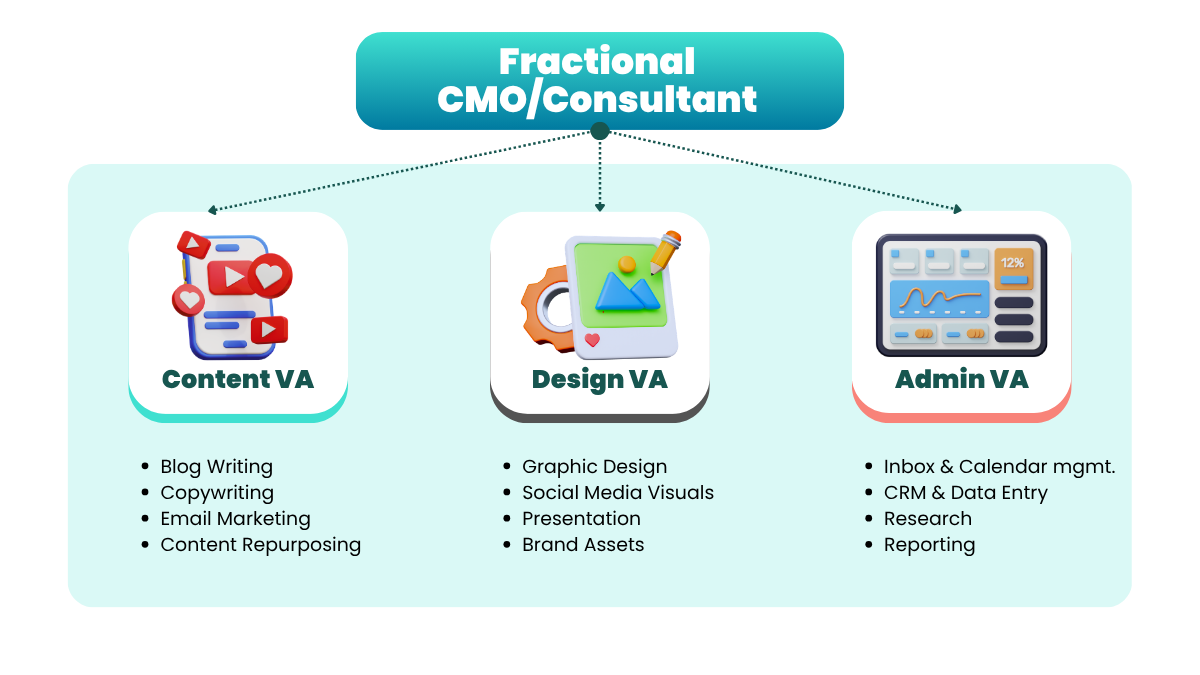
Building an outsourced marketing infrastructure through managed VAs gives business owners a third option.
You do not have to choose between carrying the fixed cost of an internal team and handing your marketing over to a large agency with a rigid retainer. You can build a managed execution layer that adjusts around your workload.
This is where managed marketing virtual assistants become powerful. Instead of hiring one overloaded generalist, you can build a coordinated bench of remote execution specialists. One person may support content uploads and scheduling. Another may help with social media graphics. Another may handle SEO research, website updates, CRM cleanup, reporting, or email production. or email production. For businesses looking to expand sustainably, our guide to managed remote assistant services for scaling marketing execution explains how this model creates a flexible marketing infrastructure that grows alongside your business.
At Smart VAs, this matters because we are not trying to give clients a random list of freelancers. We are building support around real operational needs. Our goal is to help business owners get execution off their plate without making them responsible for managing every small moving part.
I saw this with John Moore, founder of 305 Spin. Before working with Smart VAs, John had already built a business that helped companies grow through technology, web development, and search engine marketing. But during the COVID-19 downturn, he needed reliable support that would help him scale efficiently after difficult experiences with other VA companies. Over time, the relationship grew into a 41-month collaboration where Smart VAs helped streamline processes, support reporting, reduce hiring stress, and give his team more room to focus on strategic growth.
What I appreciate about John’s story is that it is not flashy. It is practical. He did not need another complicated vendor relationship. He needed reliable people, clear communication, and a team he could treat as an extension of his business instead of a revolving door of contractors.
That is the difference between outsourcing tasks and building outsourced infrastructure.
| Operational Factor | Full-Time Internal Employee | Full-Service Traditional Agency | Smart VAs Managed Team |
|---|---|---|---|
| Financial Risk | High fixed payroll liability. | High monthly retainer commitment. | Predictable, scalable support hours. |
| Skill Breadth | Limited to one or two core competencies. | Broad, but often bound by contract scope. | Multi-specialist support that can shift as needs change. |
| Deployment Speed | Slow because hiring can take months. | Moderate because of discovery and onboarding phases. | Faster because support can begin through a managed setup loop. |
| Management Burden | Internal leadership manages the person directly. | Lower, but often detached from day-to-day realities. | Managed workflow with clearer communication and accountability. |
| Best Fit | Stable companies with predictable, full-time workload. | Large campaigns with large budgets and fixed scope. | Growing brands that need execution flexibility without hiring overhead. |
Navigating Your Decision Matrix for In House vs Outsourced Marketing
Step 1: Audit Your Monthly Capital Stability and Budget Runway
Look honestly at your cash flow. If your business cannot comfortably support fixed salaries, benefits, software licenses, and a long hiring process, do not force a full internal team too early. Variable-cost execution may protect your runway while still giving marketing the support it needs.
Step 2: Map Out Your Target Channel Width
List the channels you actually need to execute in the next 90 days. If your plan requires technical SEO Support from remote marketing specialists, content production, email nurture, social media graphics, web updates, and reporting at the same time, you do not need one generalist. You need a multi-specialist structure.
Step 3: Quantify Your Internal Management Bandwidth
Be honest about leadership time. If you do not have the hours to vet freelancers, write detailed briefs, check every deliverable, and chase deadlines, you need a managed virtual assistant framework rather than a loose collection of contractors.
Step 4: Separate Strategy From Execution
Strategy should guide the work, but execution is where marketing usually breaks. Many companies already know what they should be doing. They simply do not have the people or process to keep it moving every week.
Step 5: Measure ROI by Speed, Consistency, and Opportunity Cost
Marketing ROI is not only revenue attributed to a campaign. It is also the cost of delays, missed follow-ups, abandoned content plans, slow reporting, and leadership time spent managing tasks instead of growth.
Why Scaling Brands Choose Smart VAs as Their Marketing Engine
Scaling brands choose Smart VAs because they need marketing execution without creating another management problem.
I know how much pressure business owners feel when they are trying to grow. They know they need content, design, reporting, email follow-up, better systems, and campaign consistency. But they also know that hiring a full in-house marketing department before the revenue supports it can create unnecessary financial pressure.
Smart VAs is built to solve that middle-stage problem. We help businesses access skilled remote support across multiple areas without asking them to source, vet, train, and manage every person alone.
The multi-specialist advantage is simple: your needs can shift without forcing you to rebuild your team every time. You may need a graphics professional for a brand refresh this month, an SEO writer next month, and website support after that. A managed model gives you room to shift your execution resources as the business changes.
It also reduces administrative drag. The hidden cost of outsourcing is usually not the hourly rate. It is the time spent explaining, re-explaining, checking, replacing, and coordinating. Our model is designed to reduce that friction so the owner can stay focused on decisions, strategy, client relationships, and growth. If you're unsure whether it's the right time to outsource, read our guide on signs your business needs remote admin and marketing support to identify the operational bottlenecks that indicate it's time to build a managed support team.
When in-house hiring feels too heavy and traditional agency retainers feel too rigid, a managed Smart VAs team gives you a more flexible path. You get execution support that can grow with you, without asking your business to carry every full-time liability before it is ready.
Build Your Variable-Cost Marketing Engine Without the In-House Liabilities
Stop compromising between the high overhead of internal recruiting and the rigid retainers of traditional agencies.
Smart VAs provides your business with a fully managed team of specialized remote virtual assistants, giving you the execution support you need to scale lead generation, improve consistency, and increase marketing ROI. If maintaining a regular publishing schedule is one of your biggest challenges, explore our guide on virtual assistants for consistent social media marketing execution to see how managed support keeps your content and campaigns moving without adding internal workload.
Let us manage the operational infrastructure while your team focuses on high-level business growth.
Schedule your free Smart VAs growth strategy session today.
Smart Virtual Assistant
👍🤵
Smart Virtual Assistant 👍🤵

What if you could reclaim 40 hours this month?
Find out inside this free guide.
Frequently Asked Questions
-
In-house marketing can be better when a company has stable cash flow, predictable workloads, and enough leadership bandwidth to manage employees. Outsourced marketing can be better when the company needs flexible execution, specialist access, and lower fixed overhead.
-
The hidden costs include recruiting, onboarding, benefits, payroll taxes, software licenses, training, management time, paid leave, replacement risk, and the opportunity cost of slow execution.
-
The Unicorn Trap is the mistake of expecting one marketing hire to master every channel, including paid ads, SEO, content, design, social media, automation, reporting, and website updates.
-
Managed marketing virtual assistants improve ROI by giving businesses access to specialized execution support without the fixed cost of multiple full-time employees or the management burden of separate freelancers.
-
A company should consider outsourcing when marketing tasks are falling behind, campaigns lack consistency, the team needs multiple skill sets, or leadership is spending too much time managing execution instead of growth.
-
Smart VAs provides a managed support structure rather than a marketplace of independent contractors. The goal is to reduce sourcing, vetting, coordination, and follow-up burden while giving clients access to skilled remote specialists.
About the Author:
Kristy Yoder, Founder

Kristy Yoder is the Founder of Smart VAs, a virtual assistant agency that helps entrepreneurs grow through reliable administrative and digital marketing support. With extensive experience building and managing remote teams, she specializes in delegation, operational efficiency, and scalable business growth.
Passionate about helping business owners reclaim their time, Kristy leads Smart VAs in connecting entrepreneurs with skilled virtual professionals who provide dependable support and contribute to long-term success.