Key Takeaways
Outsourcing marketing does not have to mean handing over your entire brand. It can mean getting outside support for the tasks your internal team cannot consistently handle.
The biggest signs to outsource marketing are missed deadlines, inconsistent campaigns, unclear reporting, rising lead costs, and founders still doing too much execution work.
Hiring one in-house marketer often creates the “unicorn marketer” problem, where one person is expected to manage content, design, SEO, paid ads, email, analytics, and website work at the same time.
A hybrid model lets the business keep control of strategy and brand voice while a managed remote marketing team handles execution.
Before outsourcing, businesses should protect account ownership, document brand guidelines, define success metrics, and start with the tasks slowing growth down the most.

ARE YOU STILL TRYING TO DO IT ALL?
Discover the SMART way to delegate without losing control—and finally free up your time.
I have talked to many founders who do not realize they have outgrown their current marketing setup until the pressure is already showing everywhere.
The emails are late. The website updates keep getting pushed. The content calendar exists, but no one has time to follow it. The internal marketer is doing their best, but they are being asked to think like a strategist, write like a copywriter, design like a creative team, understand SEO, track analytics, manage social media, coordinate campaigns, and still show up with fresh ideas every week.
That is not a people problem. Most of the time, it is a structure problem.
Inside Smart VAs, I see this often with growing businesses. They do not always need a massive agency retainer. They also do not need to keep piling work onto one internal person. What they need is the right support model for the stage they are in.
So if you are asking, “When should I outsource marketing?” I would not start with a simple yes or no. I would look at the signs. The real question is whether your current team structure can keep up with the kind of growth you are trying to create.
What Does It Mean to Outsource Your Marketing?
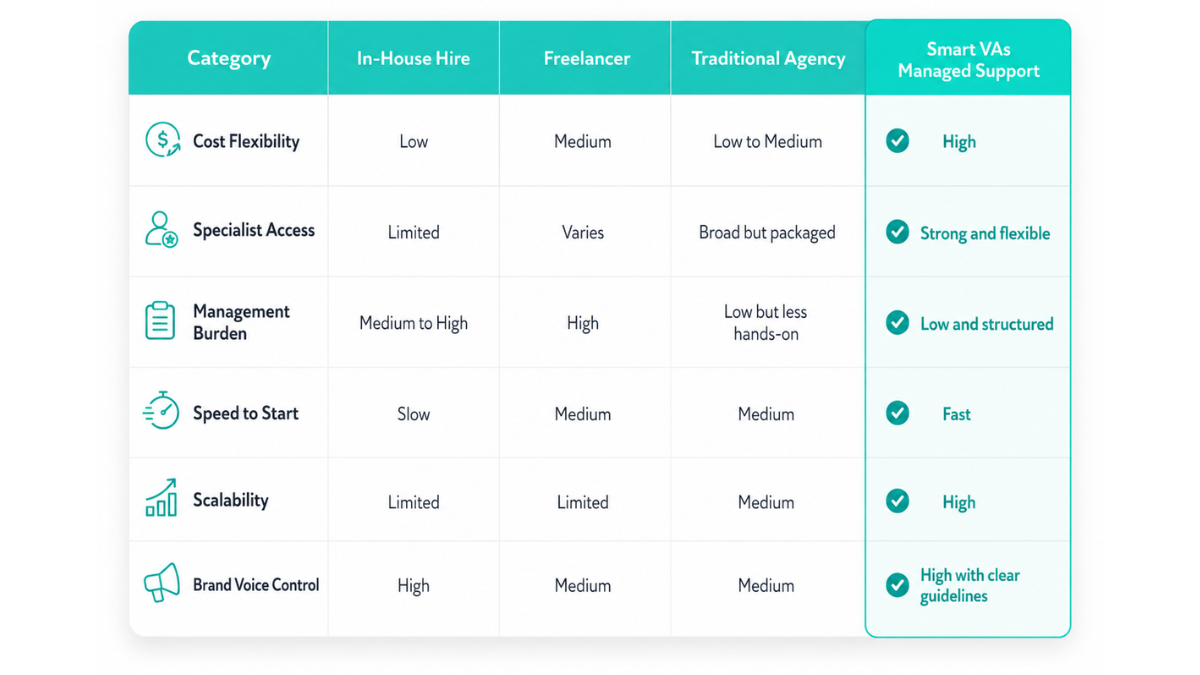
Outsourcing marketing means bringing in outside support to help with marketing strategy, execution, systems, or reporting. It does not always mean giving up your entire marketing department to an outside agency.
For some businesses, outsourcing means hiring help with social media scheduling or blog publishing. For others, it means bringing in an external team for SEO, email marketing, graphic design, website updates, Google Ads support, CRM cleanup, or campaign reporting.
The best version of outsourcing is not about losing control. It is about getting the right help where your business is overloaded.
Does outsourcing mean giving up control of your brand?
No. At least, it should not.
A healthy outsourced marketing setup still keeps strategy, customer insight, positioning, and final approval close to the business. The outside team should support execution, not take the brand out of your hands.
That distinction matters. Many founders hesitate to outsource because they worry an outside person will not understand the voice, values, or expectations of the company. I understand that fear. Your brand is not just a logo or a color palette. It is how people experience your business.
That is why I usually recommend a clear handoff process: brand guidelines, examples of approved work, target audience notes, words to avoid, and an approval workflow. Those simple pieces protect the voice while giving the support team enough direction to move.
What marketing tasks can you outsource first?
You do not have to outsource everything at once. In fact, I usually prefer starting with the tasks that are slowing the business down the most.
Blog formatting, publishing, and content repurposing
CRM cleanup and lead tracking support
Weekly marketing reports and campaign dashboards
Marketing admin tasks that keep getting delayed
The goal is to remove friction from the work that already matters, not create a complicated new system before the team is ready.
Why Do Growing Businesses Outsource Marketing?
Growing businesses usually outsource marketing because the work becomes too wide for one person to manage well.
Marketing used to feel simpler for many small businesses. Post on social. Send an occasional email. Update the website. Run a few ads. But now each of those areas has its own tools, rules, metrics, and expectations. Content has to be useful. Social media has to be consistent. SEO has to consider search intent and AI visibility. Email has to be segmented. Websites need conversion-focused updates. Ads need testing and tracking. Reporting needs to connect to real business outcomes.
That is too much to put on one founder or one generalist marketer.
Why one in-house marketer can quickly become overwhelmed
One in-house marketer may be very capable, but they are still one person. They may be strong in writing but not design. They may understand social media but not technical SEO. They may know your brand well but not have enough time to build reports, update landing pages, write email campaigns, and follow up on every content request.
This is where the “unicorn marketer” problem starts. A founder hires one person and quietly expects them to be an entire marketing department.
That person eventually becomes the bottleneck, not because they lack effort, but because the role has become unrealistic.
Why outsourcing can help protect consistency, speed, and quality
When outsourcing is done well, it gives your business more capacity without adding several full-time roles. It also gives your internal team room to focus on the work they do best.
For example, your internal marketer may own strategy, messaging, and approvals. A managed remote marketing team can support the execution: graphics, scheduling, blog uploads, email setup, CRM updates, SEO support, and reporting.
That kind of structure helps marketing move faster without forcing one person to carry the whole system.
What Are the Biggest Signs to Outsource Marketing?
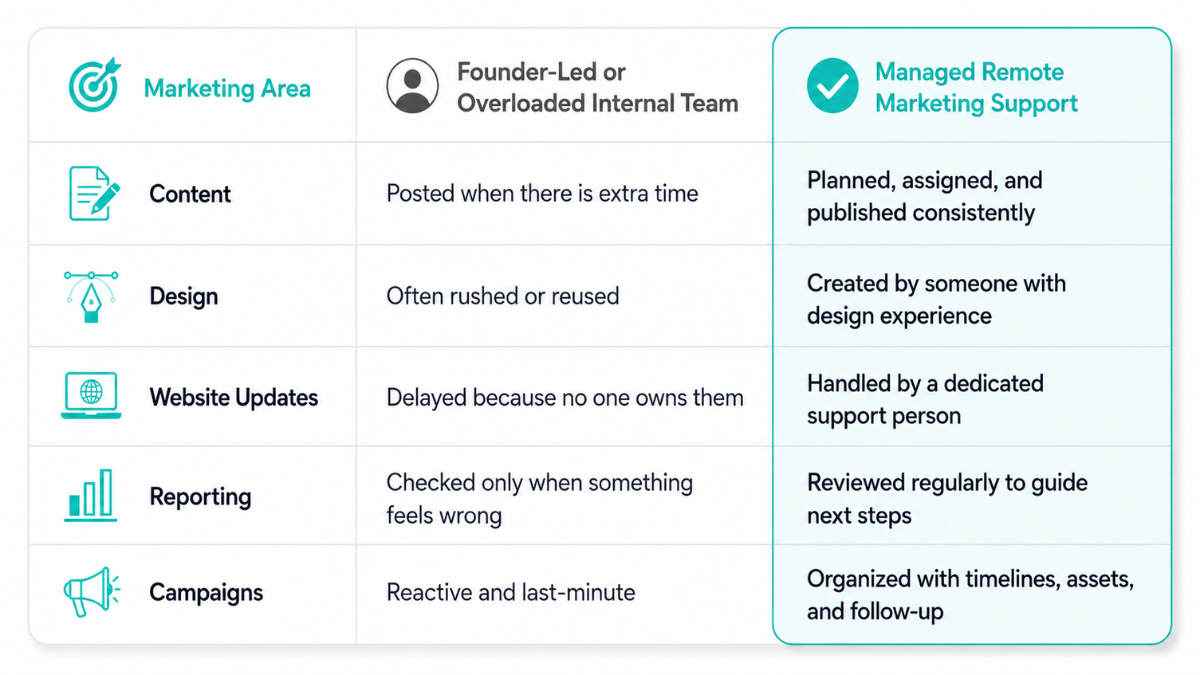
Before you outsource anything, look at what is actually slowing marketing down. Sometimes the issue is not that your team is failing. It is that your business has outgrown the structure around them.
These are the most common signs to outsource marketing before delays, missed opportunities, and inconsistent execution start affecting growth.
Sign 1: Is your team always behind on marketing tasks?
If your team is always catching up, your marketing capacity is probably too thin.
This can look like late newsletters, postponed blog posts, inconsistent social media, campaign assets waiting for approval, or website updates that keep getting moved to next week.
One late task may not matter. A pattern of late tasks does. It means marketing is depending on leftover time instead of a reliable system.
If every campaign feels like a scramble, the team may not need more pressure. They may need more support.
Sign 2: Are you still doing too much marketing work yourself?
This is one of the biggest signs I look for with founders.
If you are still resizing graphics, writing captions, editing emails, checking analytics, uploading blogs, chasing campaign assets, or fixing the website yourself, your marketing structure is not really built to scale yet.
A founder should not be the default backup plan for every unfinished marketing task. Your role should be growth strategy, sales direction, partnerships, leadership, and customer insight. If marketing execution keeps pulling you back into the weeds, it may be time to outsource part of the work.
Sign 3: Do you know which marketing efforts are actually working?
A drop in leads is a problem. But the bigger problem is not knowing why leads dropped.
If your team cannot explain which channel is working, which campaign is wasting budget, which offer is converting, or what should be improved next, you are making expensive guesses.
This is where outsourced marketing operations support can help. A strong support team can help organize reports, clean up tracking, maintain dashboards, and make the marketing work easier to evaluate.
You do not need vanity metrics alone. You need answers that help you make better business decisions.
Sign 4: Does your marketing feel rushed, reactive, or inconsistent?
Reactive marketing usually happens when the business is busy and the team has no clear execution rhythm.
A random post goes out because someone remembered. A promo email is rushed because the launch is tomorrow. A campaign is built around whatever assets are available, not what the audience actually needs.
This kind of improvised marketing does more than waste time. It can weaken trust. Prospects notice when messaging feels scattered, visuals look inconsistent, or follow-up disappears after the first touchpoint.
Consistent marketing makes a business feel stable. Rushed marketing makes even a strong company look less organized than it really is.
Sign 5: Are you preparing for a launch, rebrand, or website update?
Some business moments create a temporary surge of marketing work.
A launch, rebrand, website redesign, event, new offer, or sales campaign can require copywriting, design, web updates, email sequences, landing pages, social media assets, CRM updates, and reporting all at once.
Your day-to-day internal team may be able to manage normal workload, but these milestone projects can overload them quickly. That is often the right time to outsource digital marketing services, especially if you only need extra specialist help for a specific season.
Sign 6: Are you spending more to get lower-quality leads?
Customer acquisition cost is a simple idea: how much you spend to bring in a new customer or qualified opportunity.
If you are spending more on ads, software, content, or promotions but the leads are not improving, something needs attention. It may be the message. It may be the offer. It may be tracking. It may be targeting. It may be follow-up.
The danger is continuing to spend without understanding the leak. This is where specialist support can help the business look at the full path from visibility to lead quality instead of only looking at surface-level activity.
Sign 7: Are you paying for marketing tools your team barely uses?
Marketing software can quietly become a major expense.
A business may pay for CRM seats, SEO tools, design platforms, reporting dashboards, email software, scheduling tools, landing page builders, and ad platforms. But if no one has time to use those tools properly, the subscription is not solving the problem.
Software does not create marketing results on its own. You still need people who know what to do with it.
For context, HubSpot lists Marketing Hub Professional starting at $800 per month with required Professional onboarding at $3,000, while Semrush lists paid SEO and AI search plans ranging from $117.33 to $455.67 per month when billed annually. Those tools can be valuable, but they are only useful when someone owns the workflow behind them.
Is It Cheaper to Outsource Marketing or Hire In-House?
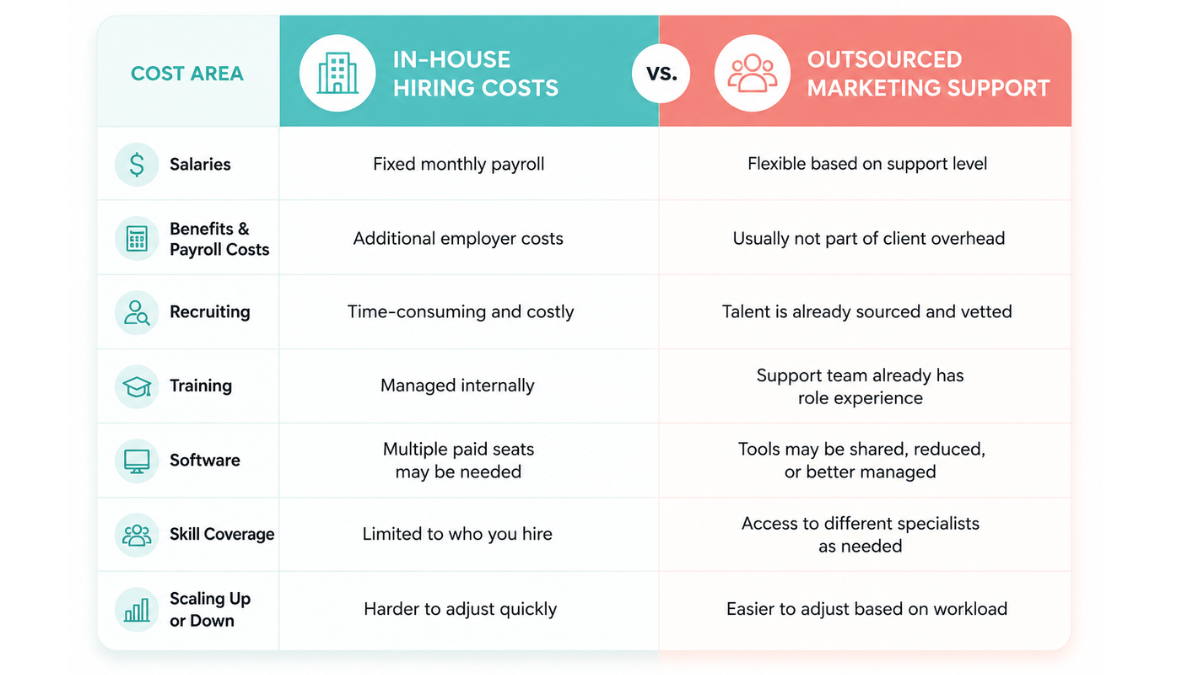
For many SMBs, outsourcing is more flexible than building a full internal marketing department too early. That does not mean in-house is bad. It means the numbers need to be honest.
When founders compare options, they often compare only salary to outsourced cost. That is too narrow. The real cost of hiring includes benefits, taxes, recruiting, onboarding, software, equipment, training, management time, and replacement risk.
The U.S. Bureau of Labor Statistics reported that the median annual wage for marketing managers was $161,030 in May 2024, while market research analysts had a median annual wage of $76,950. BLS compensation data also shows that benefits accounted for 29.9% of private-industry employer compensation costs in December 2025. Those numbers help explain why building an internal marketing department is often more expensive than the base salary suggests.
What are the hidden costs of hiring an in-house marketing team?
The hidden costs usually show up after the hire is made.
Recruiting time and job posting costs
Interviewing and onboarding time
Benefits, payroll taxes, and paid leave
Software seats and training resources
Manager time spent assigning, checking, and coaching
Turnover risk if the role is overloaded or poorly scoped
Specialist gaps that still require outside help
Why one “unicorn marketer” usually is not enough
A common mistake is hiring one marketer and expecting that person to cover every channel.
They may be asked to write copy, design graphics, run ads, manage SEO, update landing pages, track analytics, create reports, maintain the CRM, plan campaigns, and manage social media. That is not one role. That is a department squeezed into one job description.
This is why a fractional marketing team model can work better for growing SMBs. Instead of expecting one person to master everything, you build access to different skills based on what the business actually needs.
How outsourced marketing solutions for SMBs can reduce fixed overhead
Outsourced marketing solutions for SMBs can reduce fixed overhead because you are not committing to multiple full-time salaries before the business is ready.
You can start with the support layer you need now, then adjust as the workload changes. That might mean content and design support first, then website updates, email marketing, CRM cleanup, or reporting support later.
Should You Outsource Everything or Use a Hybrid Marketing Model?
You do not have to outsource everything.
In many cases, the best option is a hybrid marketing model. This means your internal leadership keeps ownership of strategy, brand voice, customer insight, and approvals while an outside support team helps execute the work.
This is often the most comfortable model for founders because it protects control while solving the capacity problem.
What is a hybrid marketing model?
A hybrid marketing model combines internal direction with outsourced execution. Your team decides what needs to happen and why. The external team helps make it happen consistently.
For example, your internal team may set the campaign goals and approve the message. A remote support team can help create the graphics, schedule posts, upload the blog, prepare the newsletter, update the website, and organize the report.
How can an outsourced team support your internal marketer?
The outside team should make your internal marketer stronger, not replace them by default.
If you already have one marketing generalist, outsourcing can give that person breathing room. They can focus on strategy, audience understanding, and approvals while the outsourced team handles the execution pieces that keep slowing them down.
How do you keep your brand voice consistent when outsourcing?
Brand voice stays consistent when expectations are clear.
Start with a simple brand guide. Include who you serve, what problems you solve, how you want to sound, what words you use, what words you avoid, examples of approved content, and the approval process. Then give feedback early and clearly.
A good outside team should not need to guess forever. They should learn, document, and improve with each round of work.

How Do You Choose the Right Marketing Partner?
External marketing partner selection matters. The wrong partner can create more work, more confusion, and more risk. The right partner should make the work easier to manage.
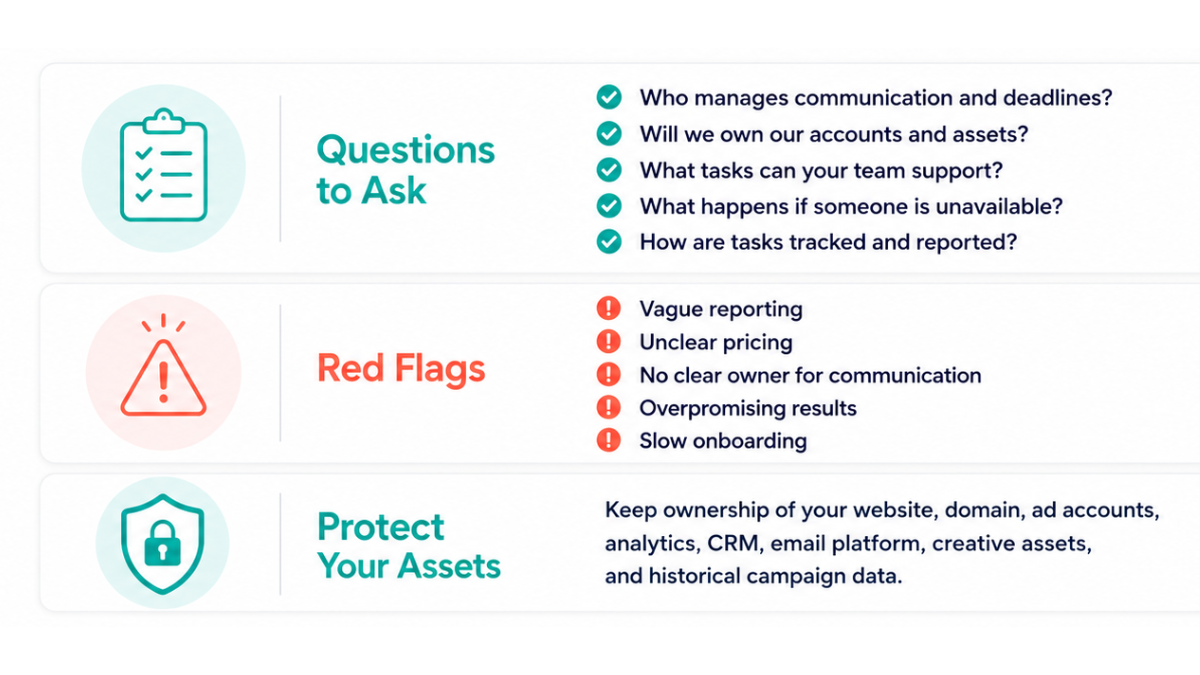
What questions should you ask before outsourcing marketing?
Who will manage communication and deadlines?
Will we own our ad accounts, website, analytics, CRM, and creative assets?
What tasks can your team support?
Do you provide specialists or one generalist?
How do you protect passwords and sensitive data?
What happens if one team member is unavailable?
How quickly can support scale up or down?
How are tasks tracked and reviewed?
What red flags should you watch for when hiring an external marketing partner?
A few red flags should make you pause:
Vague reporting with no clear business connection
No clear owner for communication
Unclear pricing or hidden scope limits
No process for protecting account access
Overpromising fast results without context
Refusing to work inside the client’s own accounts
Poor documentation or slow onboarding
How do you protect your data, accounts, and brand assets?
Keep ownership of the accounts that hold your business history. That includes your website, domain, ad accounts, analytics, CRM, email platform, creative files, landing pages, and historical campaign data.
Use password managers, role-based access, and clear permissions. Do not surrender master ownership just because someone needs to run a task.
How Do You Start Outsourcing Marketing Without Disrupting Your Business?

The transition does not have to be messy. I recommend starting with a simple process that protects your existing assets and gives the outside team enough context to help quickly.
Step 1: List your current marketing tools, accounts, and assets
Document your website, CRM, email platform, social accounts, ad accounts, analytics, brand files, templates, landing pages, reports, and any active campaigns.
Step 2: Decide which results matter most
Choose the outcomes you actually care about. That may be better lead quality, more booked calls, consistent publishing, faster launches, stronger email engagement, cleaner website updates, or better reporting.
Step 3: Document your brand voice and approval process
You do not need a 50-page brand book to start. A short guide with audience notes, tone-of-voice examples, words to avoid, approved samples, and approval steps can make a major difference.
Step 4: Give access safely without giving away ownership
Use password managers and role-based permissions. Keep admin ownership inside your own accounts whenever possible.
Step 5: Start with the tasks slowing your team down the most
Begin with the bottlenecks: blog uploads, social scheduling, design requests, newsletter setup, CRM cleanup, weekly reporting, or campaign coordination.
When Is Smart VAs the Right Fit for Outsourced Marketing Support?
Smart VAs is a good fit when your business needs marketing execution help but you do not want to hire several full-time employees or manage disconnected freelancers on your own.
Inside Smart VAs, we help growing businesses build support around the work that keeps getting delayed. That can include social media management, email marketing support, website updates, content support, blog formatting and publishing, SEO support tasks, graphic design, CRM and marketing operations, reporting support, and campaign coordination.
I saw this clearly with Melissa Martin of Creative Island. Before working with Smart VAs, Melissa was juggling client work, marketing, and operations with little room to grow. Once our team supported the execution side of her business, including design, web development, copywriting, blog writing, and other client deliverables, she was able to focus more on strategy, client relationships, and growth. In her case, the added support helped her take on larger projects and more than double her revenue.
I do not believe every business needs the same marketing setup. Some need only a few hours of support. Some need a more consistent remote team. Some need a hybrid model where the founder or internal marketer stays close to strategy while we help with execution.
The point is to build a support structure that fits the stage of the business, not force a business into a model that is too expensive, too rigid, or too difficult to manage.

Ready to Get Marketing Support Without Hiring a Full-Time Team?
If your marketing is moving slower than your business, it may be time to stop asking one person to carry the whole system.
Smart VAs helps growing businesses get reliable marketing execution support without the cost and pressure of building a full in-house team. Whether you need help with content, design, social media, website updates, CRM tasks, or campaign coordination, we can help you build a support structure that fits your stage of growth.
Schedule your free Smart VAs discovery call today.
Smart Virtual Assistant
👍🤵
Smart Virtual Assistant 👍🤵
What if you could reclaim 40 hours this month?
Find out inside this free guide.
Frequently Asked Questions
-
It is time to outsource your marketing when your internal team is consistently behind, leadership is stuck doing execution work, campaigns feel rushed, reporting is unclear, or your team lacks the specialist skills needed for SEO, paid ads, email marketing, design, website updates, or marketing operations.
-
For many growing SMBs, outsourcing is more cost-effective than building a full in-house marketing department. Hiring internally includes salary, benefits, recruiting, training, software, equipment, management time, and turnover risk. Outsourcing gives businesses access to support without taking on every fixed cost at once.
-
The main risks are mismatched brand voice, communication gaps, unclear ownership, weak reporting, and losing control of data or accounts. These risks can be reduced by keeping ownership of your accounts, using clear brand guidelines, setting approval steps, and choosing a partner with transparent task tracking.
-
A hybrid marketing model combines internal leadership with outsourced execution. The internal team keeps control of strategy, customer insight, brand voice, and approvals while the outside team helps with tasks like design, SEO support, email setup, content publishing, website updates, and reporting.
-
Start with tasks that are important but consistently delayed. Common examples include social media scheduling, blog uploads, email newsletter setup, graphic design, website updates, CRM cleanup, campaign reporting, and content repurposing.
-
Smart VAs provides a managed support structure rather than a marketplace of independent contractors. The goal is to reduce sourcing, vetting, coordination, and follow-up burden while giving clients access to skilled remote specialists.
About the Author:
Kristy Yoder, Founder

Kristy Yoder is the Founder of Smart VAs, a virtual assistant agency that helps entrepreneurs grow through reliable administrative and digital marketing support. With extensive experience building and managing remote teams, she specializes in delegation, operational efficiency, and scalable business growth.
Passionate about helping business owners reclaim their time, Kristy leads Smart VAs in connecting entrepreneurs with skilled virtual professionals who provide dependable support and contribute to long-term success.