How to Build a High-Performing Marketing Team Without Hiring Full-Time Employees
Key Takeaways
Marketing is now too fragmented for one full-time generalist to own every channel well.
The real cost of building an in-house marketing team includes salaries, benefits, software, recruiting, training, and management time.
A lean team can work when strategy, execution, and systems are separated instead of forced into one overloaded role.
The strongest structure for many growing companies is a fractional strategy lead supported by specialized marketing VAs and clear asynchronous workflows.
Melissa Martin’s Smart VAs story shows how specialized support can help an agency owner take on bigger projects, protect quality, and double revenue.
Smart VAs fits this model by providing a fully managed virtual assistant team, a Client Success Partner, and access to specialists across marketing, content, design, web, and operations.

ARE YOU STILL TRYING TO DO IT ALL?
Discover the SMART way to delegate without losing control—and finally free up your time.
The Death of Fixed Overhead Marketing
I talk to business owners every week who know they need stronger marketing, but they are not ready to build a traditional internal department.
They need content created. They need social posts scheduled. They need email campaigns built, websites updated, lead magnets polished, reports pulled, and follow-ups organized. But when they look at the cost of hiring every role full time, the math gets uncomfortable fast.
That is the part of marketing growth that many people do not talk about enough. The issue is not always that a business lacks ideas. Often, the issue is that the owner is trying to fund a fixed-overhead marketing structure before the company has predictable demand for every role.
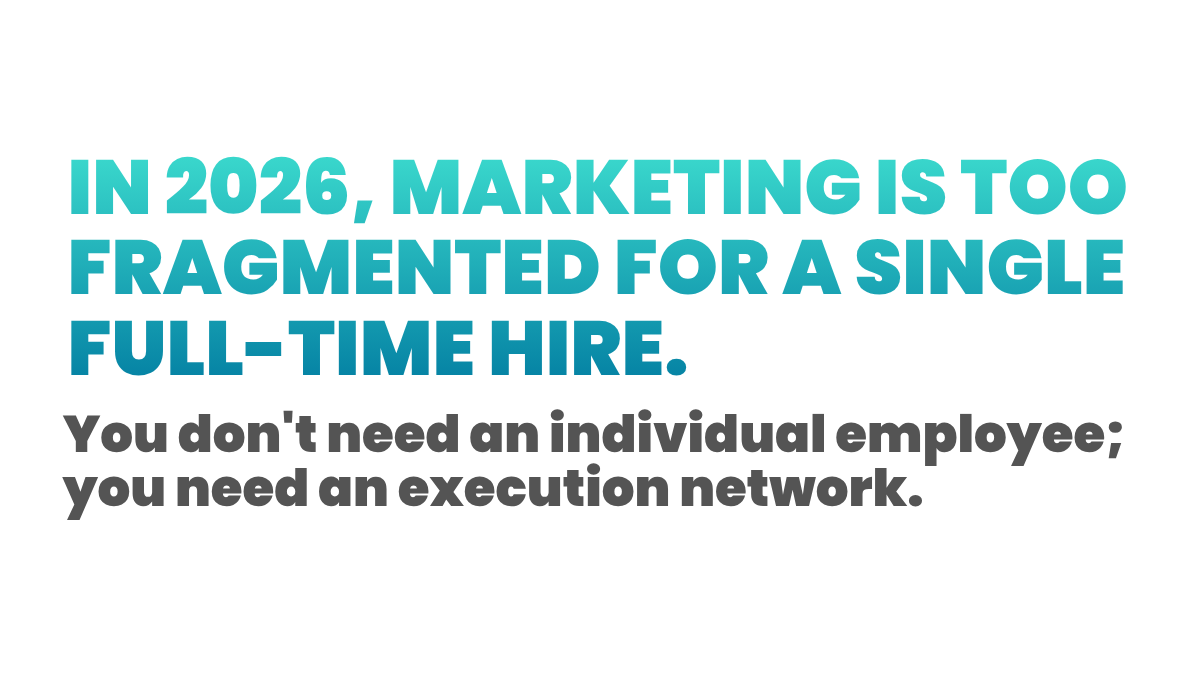
In my experience building Smart VAs and supporting growing businesses, I have seen a clear shift: marketing is too fragmented for a single full-time hire to carry it all. You do not need one employee who tries to do everything. You need a flexible network of specialized execution support that can move with your priorities.
That is the real advantage of an agile, on-demand talent model. It lets you build marketing capacity around actual business needs instead of forcing your business into a payroll structure it may not be ready for yet.
In 2026, marketing is too fragmented for a single full-time hire. You do not need a single employee; you need a network of specialized execution nodes.
This article breaks down how I think about building a marketing team without creating unnecessary full-time overhead, and how a managed virtual assistant marketing team can help growing businesses execute more consistently.
The Financial Reality of Building a Marketing Team Today

Traditional marketing teams are expensive because they are not really one hire. Even a lean internal department may need strategy, content, design, website support, analytics, campaign coordination, social media, and project management.
According to the U.S. Bureau of Labor Statistics, the May 2024 median annual wage for marketing managers was $161,030. Graphic designers had a median annual wage of $61,300, web developers and digital designers had a median annual wage of $95,380, and market research analysts had a median annual wage of $76,950. Those figures do not include benefits, software, recruiting costs, payroll taxes, training time, or the management attention required to keep everyone aligned.
That is why the real cost of building an in-house marketing team is usually higher than the salary line items. You are also paying for unused capacity when work is uneven. A designer may be overloaded during a launch and underused the next week. A content person may need SEO direction. A strategist may not be the right person to create graphics or update a landing page.
This is where many owners fall into what I call the Unicorn Trap.
The Unicorn Trap is the belief that one marketer can do strategy, copywriting, SEO, design, paid ads, analytics, automation, social media, email marketing, video editing, and website updates at a high level. That person sounds efficient on paper. In real life, they usually become overwhelmed, and the business ends up with inconsistent output.
Marketing has become too specialized for that approach. Algorithms change. Platforms change. Search behavior changes. AI tools change. Creative formats change. A strong marketing system needs different skills at different moments.
That does not mean every business needs to hire a full-time specialist for every channel. It means the structure has to be flexible enough to access the right skills when they are needed.
| Role / Capability | Typical In-House Cost Signal | Flexible Team Alternative |
|---|---|---|
| Marketing Strategy | Marketing manager salary plus benefits and leadership time. | Fractional CMO or growth lead for a limited number of strategic hours. |
| Design Execution | Full-time designer or recurring freelance costs. | Graphic design VA support for campaign assets, social graphics, and layouts. |
| Website / Landing Pages | Developer or web designer salary, contractor retainers, or agency fees. | Website support VA for updates, formatting, page uploads, and basic implementation. |
| Content and SEO | Separate writer, editor, SEO, and publishing workflows. | Blog writing, SEO, and content support VAs working from a shared brief. |
| Campaign Coordination | Project manager or founder time spent tracking everything. | Managed workflow with clear task routing and accountability. |
Related Article: How VAs Help Build a High‑Converting Real Estate Email Marketing Campaign
Tactical Framework for Building a Marketing Team Without Full-Time Hires
When a business owner asks me how to build marketing capacity without hiring a full department, I do not start with roles. I start with layers.
The strongest fractional marketing team structure has three layers: the strategic brain, the execution engine, and the automation glue. When those layers are clear, the business does not have to choose between doing everything internally or handing everything to a detached agency.
Layer 1: The Strategic Brain
This is the person responsible for direction. It could be the founder, a fractional CMO, a consultant, or a growth lead. Their job is not to touch every task. Their job is to decide what matters most.
A strategy lead defines the offer, audience, messaging, campaign priorities, KPIs, and channel focus. Without this layer, execution talent gets buried in random requests and the business confuses activity with progress.
Layer 2: The Execution Engine
This is where specialized marketing VAs become powerful. Instead of asking one person to do everything, you assign execution by channel and skill set.
A content VA can help with blog formatting, content briefs, repurposing, and publishing.
A social media VA can help schedule posts, organize assets, prepare captions, and maintain consistency.
A design VA can create graphics, layouts, presentation materials, lead magnets, and campaign visuals.
An SEO VA can help with keyword research, metadata, internal linking, content updates, and optimization checklists.
A website support VA can update pages, upload blogs, format landing pages, and keep campaign assets live.
This is not about throwing more people at the problem. It is about routing the right task to the right person so the founder is not the default executor for everything.
Layer 3: The Automation Glue
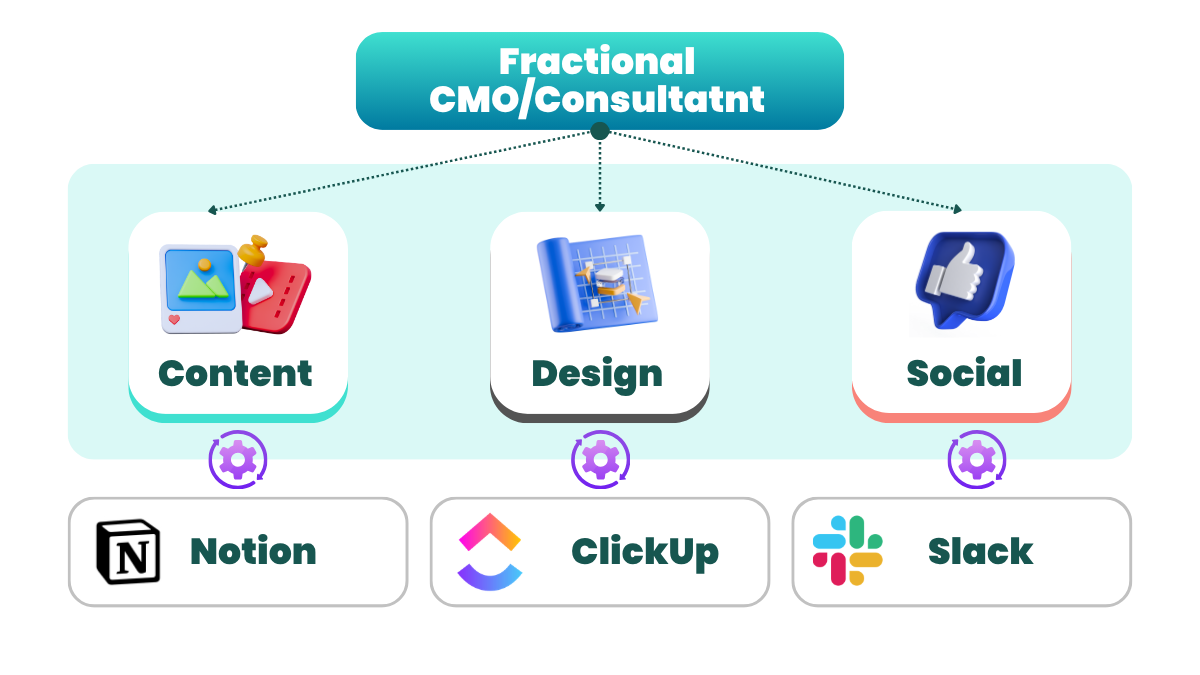
A distributed team only works if the system is clear. This is where tools like Notion, ClickUp, Asana, Google Drive, Slack, and Loom matter.
The tool itself is not the strategy. The system is. You need one place for briefs, one place for deadlines, one place for assets, and one place for status updates. Otherwise, the business owner becomes the operating system, and that defeats the purpose of hiring support.
Inside Smart VAs, this is one reason I care so much about process. A good marketing VA team should not create more scattered communication for the owner. It should reduce the number of decisions and follow-ups sitting on the owner's plate.
The Non-Negotiable Roadmap to Building a Marketing Team Successfully
A lot of businesses hire too quickly because they are tired. I understand that. But hiring from overwhelm usually leads to unclear roles, messy handoffs, and disappointment on both sides.
Here is the order I recommend when building a marketing team without full-time hires.
Phase 1: Establish Strategic KPIs First
Do not hire execution talent until you know what the business needs marketing to accomplish. Are you trying to increase top-of-funnel reach? Improve mid-funnel conversion? Nurture existing leads? Reactivate old clients? Support sales conversations?
The answer determines the role you need first.
For example, if your bottleneck is visibility, you may need content and social support. If your bottleneck is conversion, you may need email, landing page, and sales asset support. If your bottleneck is retention, you may need client communication, case studies, and nurture campaigns.
Good delegation starts with knowing what outcome the work is supposed to support.
Phase 2: Deploy Dedicated Channel Experts
Once the strategy is clear, assign support by channel instead of forcing one generalist to own everything.
This is where hiring marketing VAs works especially well. You can bring in people who are comfortable with specific execution lanes without committing to multiple full-time salaries before your workload justifies them.
A practical structure may look like this:
One VA supports social media scheduling, engagement tracking, and content organization.
One VA supports blog formatting, SEO checklists, internal links, and publishing.
One VA supports graphics, lead magnet layouts, and campaign visuals.
One VA supports website updates, landing page uploads, and CRM or email platform tasks.
The founder or strategy lead still owns the big decisions. The marketing VA team owns consistent execution.
Phase 3: Standardize Asynchronous Systemic Flows
The fastest way to ruin a remote marketing team is to manage everything through memory, scattered texts, and last-minute voice notes.
A strong remote marketing infrastructure needs simple rules:
Every campaign gets a written brief.
Every asset has one clear owner.
Every task has a deadline.
Every file lives in the right folder.
Every weekly review looks at output, blockers, and next priorities.
This does not have to be complicated. A clean ClickUp board, Notion dashboard, or shared Google Sheet can work. What matters is that the team can see what is moving, what is stuck, and what is complete without waiting for another meeting.
Managed Virtual Assistants vs. Solo Freelancers: The Operational Difference

There is a place for freelancers. I have worked as a freelancer myself, and I respect the independence and skill many freelancers bring to the table.
But when a business is trying to build repeatable marketing execution, solo freelancers can create operational gaps. The owner may have to source the talent, test quality, manage deadlines, handle replacements, and coordinate multiple people who do not know each other.
A managed VA ecosystem is different because it gives the business access to remote talent inside a more reliable operating structure. At Smart VAs, we are not just placing a person into a company and leaving the owner to figure everything out. We help create a support setup that can include specialized VAs, Client Success Partner oversight, backup coverage, and flexible scaling based on workload.
| Operational Attribute | Traditional Digital Agencies | Marketplace Freelancers | Smart VAs Infrastructure |
|---|---|---|---|
| Cost Predictability | Premium fixed retainers that may be difficult for growing businesses to sustain. | Erratic hourly fluctuations and project-by-project pricing. | Fixed, scalable hourly support that can adjust with workload. |
| Management Burden | Lower day-to-day burden, but often detached from daily operations. | Very high manual overhead for the founder or internal team. | Streamlined, process-driven execution supported by a Client Success Partner. |
| Agility and Scale | Rigid contractual scopes can slow pivots. | Limited by each freelancer's personal bandwidth and availability. | Fluid talent scaling through a managed team with specialists and backup support. |
| Skill Coverage | Broad, but often bundled into agency retainers. | Depends on whoever you can find and manage. | Access to marketing, admin, design, web, SEO, content, and operational support under one managed structure. |
| Continuity | Can be stable, but often expensive. | Risk increases if one freelancer disappears or is unavailable. | Backup support and extended team access help protect continuity. |
A Real Client Proof Point: Melissa Martin and Creative Island
One client example that reflects this is Melissa Martin of Creative Island. Melissa first saw the value of Smart VAs while working with another digital agency that had hired our team, and later brought us into her own business when she needed more reliable marketing execution.
Instead of scrambling for one-off help every time a client needed social media, design, copywriting, web development, blog writing, or graphic design, Melissa gained a more dependable support structure. That helped her take on larger projects, improve workflow, and eventually more than double her revenue. The main lesson is simple: consistent marketing execution becomes easier when the business has a team structure instead of relying only on the founder.
Mitigating Risks and Maintaining Alignment in a Distributed Team
Remote marketing teams work best when they are built with clarity. Without clear systems, distributed support can turn into missed details, duplicate work, and too many status checks.
Here are the risk controls I recommend before scaling marketing with VAs.
Prevent Data Siloing
Do not let campaign information live only in one person's inbox or memory. Keep briefs, brand guidelines, asset links, login instructions, campaign calendars, and reporting dashboards in a shared workspace. The goal is to make work visible without needing constant meetings.
Create Better Creative Briefs
A good creative brief should include the goal, audience, offer, tone, examples, required dimensions, due date, approval steps, and where the final asset should be saved. If the brief is vague, the team will either guess or ask more questions than necessary.
Use Weekly Metrics Trackers
You do not need to micromanage every task, but you do need to review output. Track simple weekly indicators such as content published, email campaigns sent, landing pages updated, leads followed up, creative assets completed, and blockers waiting on founder input.
Document What Works
Every recurring campaign should become easier over time. Save templates, checklists, examples, and notes. When the team repeats a workflow, the process should become smoother instead of starting from scratch again.
When You Are Ready to Build Your Marketing Team, Smart VAs Can Help
Building a marketing team does not have to mean hiring five full-time employees, managing multiple freelancers, or trying to become the project manager for every campaign.
At Smart VAs, we help business owners build flexible marketing support around the work they actually need done. That can include social media management, content production, blog writing, SEO support, design, website updates, email marketing tasks, CRM support, and the operational follow-through that keeps campaigns moving.
The goal is not to replace strategy. The goal is to give your strategy an execution engine.
When the right people, systems, and oversight are in place, you can stop carrying every marketing task yourself and start leading growth with more clarity.
Ready to Scale Your Brand Without the Full-Time Overhead?
Sourcing, vetting, and managing independent contractors can quickly become a full-time job of its own. Smart VAs solves the execution puzzle by connecting your business with skilled, vetted marketing virtual assistants who can help manage campaigns, design assets, organize content, support website updates, and keep your growth engine moving.
Let us handle the operational framework while you focus on high-level growth strategy.
Schedule your free growth strategy session with Smart VAs.
Smart Virtual Assistant
👍🤵
Smart Virtual Assistant 👍🤵
What if you could reclaim 40 hours this month?
Find out inside this free guide.
Frequently Asked Questions
-
The best way is to separate strategy, execution, and systems. Use a fractional CMO or growth lead for direction, specialized marketing VAs for channel execution, and a shared project management system to keep work visible.
-
A virtual assistant marketing team is a remote support structure made up of VAs who help execute marketing tasks such as content formatting, social media scheduling, graphic design, email setup, website updates, SEO support, CRM organization, and campaign coordination.
-
The cost depends on scope, skill level, and management needs. Outsourcing can be more flexible than hiring full-time employees because businesses can access specific capabilities without carrying several full-time salaries, benefits, and recruiting costs.
-
Marketing VAs are not automatically better than freelancers, but a managed VA team can reduce the burden of sourcing, vetting, managing, and replacing independent contractors. The right choice depends on whether the business needs one-off projects or ongoing execution support.
-
A business should consider hiring marketing VAs when marketing tasks are consistent, growth campaigns are delayed, the founder is still doing too much execution, or the company needs support across content, social, email, design, web, or CRM without hiring full-time employees.
-
Yes. Smart VAs supports growing businesses with marketing execution across services such as social media management, blog writing, SEO support, graphic design, website support, video editing, CRM support, and administrative operations.
About the Author:
Kristy Yoder, Founder

Kristy Yoder is the Founder of Smart VAs, a virtual assistant agency that helps entrepreneurs grow through reliable administrative and digital marketing support. With extensive experience building and managing remote teams, she specializes in delegation, operational efficiency, and scalable business growth.
Passionate about helping business owners reclaim their time, Kristy leads Smart VAs in connecting entrepreneurs with skilled virtual professionals who provide dependable support and contribute to long-term success.