7 Signs It's Time to Hire a Remote Admin Assistant
Key Takeaways
If administrative tasks are taking up more than 10 hours of your week, that time is coming directly from your growth.
Missed follow-ups and slow client responses aren't a discipline problem; they're a capacity problem.
A CRM full of incomplete records is a silent revenue leak most business owners don't catch until they've already lost deals.
When your team can't move forward without your input on routine tasks, you've become the bottleneck, not the leader.
Working evenings and weekends while managing a full team is almost always a delegation problem, not a time problem.
Sales calls, partnerships, and new client pitches can't compete with a full inbox when there's no one to handle the inbox.
Hiring remote admin support isn't an expense; at the right stage, it's what unlocks your capacity to grow.

ARE YOU STILL TRYING TO DO IT ALL?
Discover the SMART way to delegate without losing control—and finally free up your time.
There's a stage most growing businesses hit where the work is good, the clients are there, the revenue is moving, and yet somehow the owner is more buried than ever. The calendar is out of control. The inbox is a nightmare. Important follow-ups are slipping. And the strategic work that would actually push the business forward keeps getting bumped to next week.
I've seen this pattern play out with businesses across industries. At Smart VAs, we work with founders and operators who often come to us not because things are falling apart, but because they can feel the ceiling getting closer. The administrative load has outgrown the current setup, usually long before anyone admits it.

The challenge is that administrative overload doesn't announce itself clearly. It creeps in gradually: one missed email here, one postponed project there. By the time the bottlenecks start affecting client experience or stalling team decisions, the business has already been absorbing the cost for months.
What follows are the seven signs I see most consistently — the ones that tell me a business owner is long overdue for administrative support.
Related Article: How to Hire an Administrative Assistant in 5 Easy Steps
1. You're Spending More Time on Administrative Support Than Strategic Work
This one sounds obvious when you say it out loud, but most business owners don't realize how much time they've ceded to admin until they actually track it for a week. Email management. Scheduling. Data entry. Document preparation. These tasks have a way of filling every available gap in the day, and then borrowing from tomorrow.
Executives spend an average of 16 hours per week on administrative tasks that could be delegated.
Source: Mickinsey
I often hear business owners describe their week as "mostly meetings and emails" with growth work happening "when there's time." There's rarely time. Because administrative tasks expand to fill the space available to them, and the space available grows as the business does.
A business generating $50K a month in revenue probably needs more than one person to manage the administrative workload supporting revenue. The question isn't whether administrative work needs to get done; it's whether the highest-paid person in the company should be the one doing it.
Common admin tasks clients delegate to Smart VAs: inbox processing and email management, calendar scheduling and appointment setting, data entry and database maintenance, document drafting and file organization, internal reporting, and preparation of materials before client meetings.
If you're the one personally handling all of these on a regular basis, the business has outgrown the current support structure. That's not a character flaw. It's just a growth stage that calls for a different setup.
2. Important Follow-Ups and Customer Communications Are Falling Through the Cracks
This is one of the first signs business owners notice, and one of the last ones they associate with administrative overload. When a follow-up email doesn't go out, or a client sits waiting three days for a response, the instinct is to blame a lack of discipline or a bad week. The real culprit is usually a to-do list that was never going to get fully done, and a communication workflow with no one consistently owning it.
Missed follow-ups are expensive. A warm lead goes cold. A client who felt valued starts to wonder if they still are. A potential partnership never gets past the first conversation. These aren't dramatic failures; they're quiet ones, and they compound.
Communication challenges like these are almost universal among growing businesses that haven't yet established dedicated administrative support. The owner is responsive when they can be, but "when they can be" becomes less and less reliable as the business grows. That's not a sustainable model for client experience.
What a remote admin assistant handles here: monitoring and sorting the inbox, drafting responses for owner review, sending follow-up emails on schedule, managing client communication logs, and ensuring no inquiry goes unanswered past an agreed SLA.
3. Your Calendar Is Controlling Your Day Instead of Supporting It
A well-managed calendar is a strategic tool. What most overloaded business owners have instead is a reactive document: a running list of whoever scheduled first, punctuated by double-bookings, last-minute reschedules, and back-and-forth email threads that took 45 minutes to produce a single meeting time.
When your calendar is driving your day rather than reflecting your priorities, you end up in a permanent state of response mode. You're attending the meetings that got scheduled, not necessarily the ones that matter most. Important thinking time disappears. Recovery time between calls doesn't exist. And the strategic work that requires uninterrupted focus gets pushed to evenings.
Structured calendar management changes this entirely. A remote admin assistant can own the scheduling process end-to-end: setting up booking systems, protecting focus blocks, managing rescheduling, and making sure your calendar reflects what the business actually needs from your time.
What gets fixed: double bookings stop happening, scheduling back-and-forth gets eliminated, focus blocks are protected, and your calendar starts functioning as a strategic asset instead of a source of daily friction.
4. Your CRM and Business Systems Are No Longer Up to Date
This is the sign most competitors don't talk about, and it's one of the most consequential. A disorganized CRM isn't just an administrative problem; it's a revenue problem that hides in plain sight.
Incomplete customer records mean follow-ups get missed. Outdated lead stages mean you're working from a distorted picture of your pipeline. Contacts logged inconsistently mean your marketing and sales data is unreliable. And when the CRM reflects what someone had time to enter rather than what actually happened, every decision made from it is slightly off.
Business owners who have outgrown their admin capacity often describe their CRM as "a mess" or something they "need to get back on top of." The intention is always to clean it up and keep it up to date. It just never rises to the top of the list. Because to keep a CRM genuinely maintained, someone needs to own it every day, not just when there's a spare hour.
What a remote admin assistant handles here: logging new contacts promptly, updating lead statuses after calls and meetings, ensuring follow-up tasks are created and tracked, cleaning up duplicate or incomplete records, and running regular CRM hygiene checks so the data you're working from is actually accurate.
A clean, updated CRM doesn't just feel better; it directly improves conversion rates and client retention. This is one of the clearest ROI cases for remote admin support.
5. You're Becoming the Bottleneck in Your Business Operations
This is one of the hardest signs to see clearly when you're inside it. If your team is regularly waiting for your input, your approval, or your action to move forward on routine tasks, you're not leading the business; you're holding it up.
The bottleneck problem looks different from different angles. From the team's perspective, things stall because the person who needs to make a decision hasn't had time to look at it yet. From the owner's perspective, it feels like there's always something urgent pulling attention away from what was supposed to be a priority. From the outside, the business seems to move slowly despite having people.
Most of this kind of operational dependency doesn't start as poor leadership. It starts as a small business that scaled without building an administrative infrastructure to match. The owner made every decision when the company was three people. Now there are ten people, but the decision-making structure hasn't been updated. Every process still runs through the same person, whether that's actually necessary or not.
What remote admin support changes: a dedicated admin assistant takes on the coordination layer: managing approvals workflows, organizing information before it needs owner review, fielding routine questions, and ensuring team members have what they need to keep moving. The owner makes strategic decisions. Everything else gets handled.
6. You're Working Longer Hours Despite Having a Full Team
If you're regularly working evenings and weekends while managing a team of full-time people, that's not a work ethic problem. It's a structural one.
What typically happens is this: the team handles their defined responsibilities, but the administrative surface area around those responsibilities, the emails, the coordination, the follow-ups, the data management, doesn't belong clearly to anyone. So it defaults to the owner. Because the owner is the one who notices when it hasn't been done.
The result is a workday that ends whenever the last task gets completed, which is rarely before 7 pm and often spills into weekends. The owner is the catch-all. Every loose thread eventually lands with them.
Constant context switching makes this worse. Moving between a client deliverable, a scheduling email, a data entry task, and a financial report in the same hour is cognitively expensive, even if each individual task seems small. The mental overhead of managing everything is as tiring as the tasks themselves.
Delegation best practice from our work with clients: the first step isn't always identifying the biggest tasks to hand off, it's identifying the tasks that interrupt deep work most frequently. Those are usually the best starting points for an admin assistant, because reclaiming uninterrupted focus blocks has a greater impact on overall productivity.
7. Revenue-Generating Activities Keep Getting Pushed Aside
This is the sign that cuts deepest, and the one that most competitors don't connect to administrative overload at all.
Sales outreach that keeps getting deferred. Discovery calls that take weeks to book because the scheduling process is clunky. Partnership opportunities that never got a follow-up. Proposals that sat in draft for a week before going out. A content strategy that exists in a document but never gets executed.
When you trace back why these things aren't happening, it almost always comes back to the same answer: there wasn't enough time. And when you look at where the time went, it's usually a combination of inbox management, scheduling, CRM tasks, and coordination work. All legitimate, all necessary, and none of them more valuable than the revenue-generating activities they displaced.
Administrative overload doesn't just cost time. It costs growth. The business development activities that would bring in new clients, open new markets, and expand existing relationships get perpetually reprioritized behind tasks that feel urgent but don't move the needle.
A remote admin assistant doesn't just free up hours; it frees up the right hours. The ones that should be going to the work only the business owner can do.
Business owners who delegate effectively earn 33% more revenue than those who don't.
Source: Gallup Study
Related Article: Meet Our Smart VAs Team
What This Looks Like in Practice
The pattern I've described across these seven signs isn't hypothetical. It shows up in almost every business that comes to us after a period of growth without the right support structure in place.
Melissa Martin, founder of Creative Island, a digital marketing agency specializing in email marketing, SMS, social media content, and copywriting, was in exactly that position. She was doing everything herself: client work, operations, and marketing, and found she had no real capacity to take on new business. Growth was something she talked about, but couldn't actually reach because there was no room for it in the day.
After bringing in a Smart VAs team to handle design, content writing, web development, and ongoing creative support, the business shifted. She was able to take on larger clients, deliver at a higher level, and perhaps most telling, step away from the business entirely for ten days without the whole operation stalling.
“I was able to take a 10-day vacation and completely unplug from work without worrying about anything falling apart. That’s what having the right support in place actually feels like.”
— Melissa Martin, Founder, Creative Island
What Melissa's story illustrates isn't that Smart VAs did something extraordinary. It's when the right administrative and operational support is in place, a business owner can actually function at the level the business needs, instead of being the last line of defense for everything that would otherwise fall through the cracks.
You can read Melissa's full story at SmartVirtualAssistants.com/melissa-martin-case-study.
What Administrative Tasks Can You Outsource to a Remote Admin Assistant?
If you've recognized yourself in more than a couple of the signs above, the next practical question is what to hand off first. Here's a breakdown of the administrative tasks that remote admin assistants most commonly take on:
Email Management
Inbox triage, flagging priority emails, drafting responses for owner review, unsubscribing from noise, and maintaining a clean inbox system.
Calendar Management
Scheduling meetings, managing booking links, protecting focus time, handling rescheduling requests, and preparing daily or weekly schedule overviews.
CRM Updates
Logging new contacts and leads, updating deal stages, creating follow-up tasks, running hygiene checks, and ensuring data integrity across the system.
Travel Arrangements
Researching and booking flights, hotels, and ground transportation; building itineraries; managing changes and cancellations.
Meeting Coordination
Sending meeting agendas, preparing briefing documents, taking notes during calls, distributing action items, and following up on next steps.
Reporting
Compiling weekly or monthly reports from existing data, formatting dashboards, pulling performance metrics, and preparing summaries for stakeholder review.
Data Entry
Maintaining spreadsheets, updating databases, entering information from forms or documents, and ensuring records are complete and consistent.
Customer Follow-Ups
Sending check-in messages, following up on proposals, responding to inquiries, and maintaining communication cadence with active and prospective clients.
Document Management
Organizing digital files, creating and formatting documents, maintaining version control, and preparing templates for recurring communications.
The Cost of Waiting Too Long to Hire Administrative Support
Most business owners who eventually hire administrative support say the same thing afterward: they wish they'd done it sooner. The cost of waiting rarely feels concrete in the moment; it shows up in the aggregate, over months.
Lost productivity is the most obvious cost. Every hour the business owner spends on tasks that could be delegated is an hour not spent on decisions, relationships, and compounding work.
Missed opportunities are harder to quantify but often more significant. The partnership that didn't get followed up. The proposal that went out late. The client who chose a competitor in the window between their inquiry and your response.
Customer experience suffers in ways that aren't always visible until a client mentions they've felt a change, or quietly takes their business elsewhere. Slow response times and inconsistent communication erode trust. Slowly at first, then faster.
Founder burnout is the most personal cost, and the one that affects everything else. An overloaded business owner makes worse decisions, has less capacity for the relationships that matter, and eventually creates a ceiling for the entire business. No amount of hustle compensates for a structure that simply doesn't support the scale you're operating at.
Related Article: Rates for Administrative Tasks: Freelancers vs Agencies
How to Know if a Remote Admin Assistant Is the Right Next Step
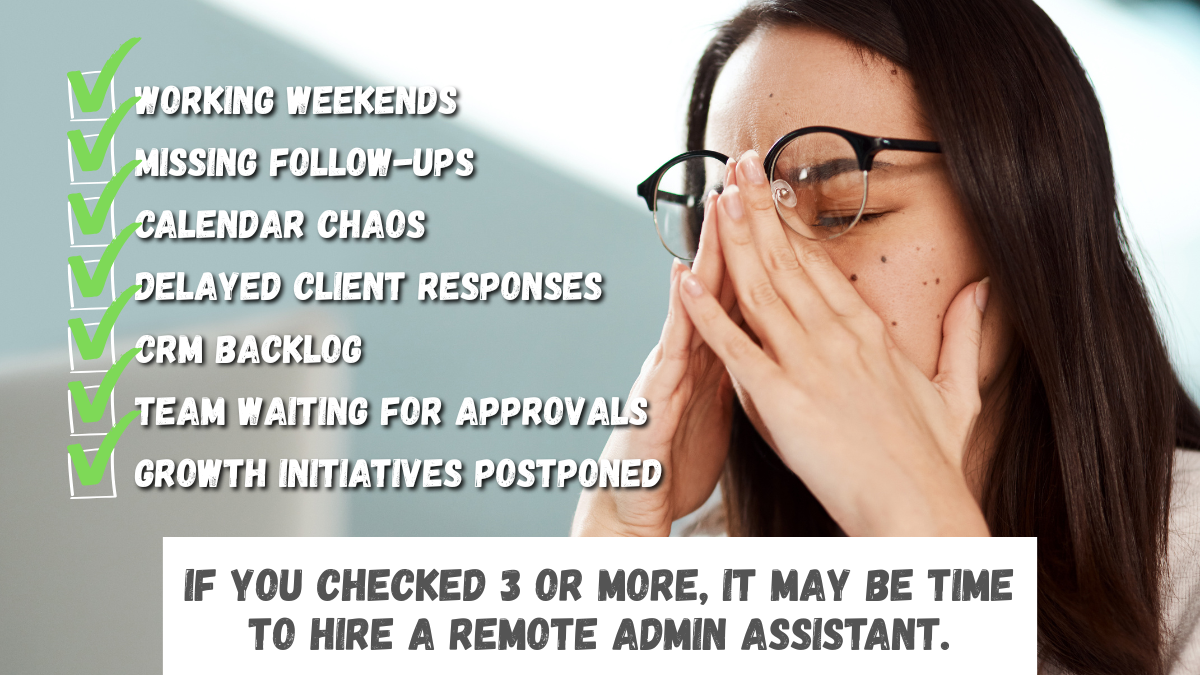
If you want a simple gut-check before booking a call, here's the checklist I'd use:
You spend 10 or more hours per week on administrative tasks.
Client follow-ups are becoming inconsistent or delayed.
Growth initiatives are repeatedly pushed to next week, next month.
Your team relies on you for routine coordination or approvals.
Your inbox and CRM feel unmanageable.
You regularly work evenings or weekends to catch up.
Revenue-generating activities keep getting displaced by administrative ones.
If three or more of these are true, remote admin support isn't a luxury; it's the next logical hire
What if you could reclaim 40 hours this month?
Find out inside this free guide.
Frequently Asked Questions
-
A remote admin assistant handles operational and administrative tasks from a remote location. Things like email management, calendar scheduling, CRM updates, data entry, document preparation, customer follow-ups, and meeting coordination. The specific scope depends on the business, but the goal is consistent: take operational load off the business owner so they can focus on growth.
-
The clearest indicators are spending 10 or more hours per week on admin tasks, experiencing missed or delayed client communications, feeling like a bottleneck in your own business, consistently working outside of normal business hours, and watching revenue-generating activities get pushed aside by administrative ones. Any combination of these signals that the current support structure has been outgrown.
-
Email and inbox management, calendar and scheduling, CRM maintenance, data entry, customer follow-ups, document management, meeting coordination, travel arrangements, and reporting are all tasks commonly handled by remote admin assistants. Many businesses start with two or three and expand the scope as the working relationship develops.
-
A virtual assistant is a broad category: VAs can specialize in admin, marketing, social media, customer service, graphic design, and more. A remote administrative assistant focuses specifically on operational and administrative support. At Smart VAs, rather than assigning a generalist VA, we provide a team of specialists, so businesses get the right person for each function rather than one person stretched across all of them.
-
Cost varies based on hours, experience level, and whether you hire through an agency or as a direct contractor. Agency-based arrangements like Smart VAs tend to offer better oversight, faster placement, and access to multiple specialists within a structured package, often at a lower total cost than hiring and managing a full-time employee for the same work.
About the Author:
Kristy Yoder, Founder

Kristy Yoder is the Founder of Smart VAs, a virtual assistant agency that helps entrepreneurs grow through reliable administrative and digital marketing support. With extensive experience building and managing remote teams, she specializes in delegation, operational efficiency, and scalable business growth.
Passionate about helping business owners reclaim their time, Kristy leads Smart VAs in connecting entrepreneurs with skilled virtual professionals who provide dependable support and contribute to long-term success.