Technical SEO vs On-Page SEO: What Does Your Business Actually Need?
Key Takeaways
Technical SEO removes barriers that can stop search engines from accessing, crawling, rendering, or indexing important pages.
On-page SEO improves how well a page matches search intent and communicates relevance to both users and search engines.
Most businesses do not need to choose one forever. I diagnose the current bottleneck first, then prioritize the work that can remove it.
A technically perfect site can still underperform with weak content, and excellent content can still fail when indexation or architecture is broken.
Routine SEO execution can be handled consistently by an SEO specialist, while advanced server, JavaScript, migration, or development issues may require deeper technical support.
SEO should be measured through search visibility and technical health, but ultimately through qualified traffic, leads, and business outcomes.
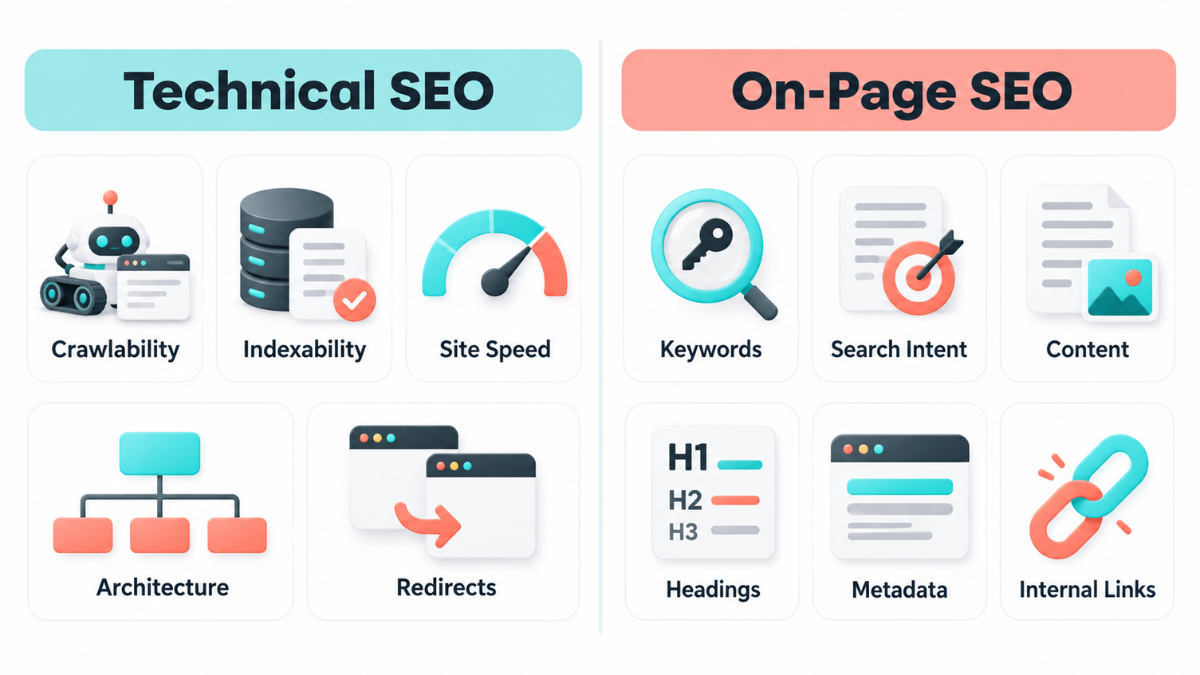
When I audit a website, I rarely start by asking, “Should we do technical SEO or on-page SEO?” I start by asking what is actually stopping the site from growing. Is Google struggling to access or index the right pages? Or are the pages already accessible but too weak, generic, or misaligned with what people are searching for? That distinction matters because technical SEO and on-page SEO solve different problems.
The short answer is simple: technical SEO makes sure a website can be properly accessed, crawled, rendered, and indexed, while on-page SEO makes individual pages useful, relevant, and aligned with search intent. Most businesses need both over time, but they do not always need both with the same urgency.
In my work at Smart VAs, I have seen businesses spend weeks rewriting content when the real issue was indexation, and I have seen teams chase site-speed scores while their service pages did not answer the questions buyers were actually asking. My job is to separate the symptom from the cause so the business is not spending time on the wrong layer of SEO.
What Is the Difference Between Technical SEO and On-Page SEO?
I think of technical SEO as the foundation and on-page SEO as the communication layer. The foundation needs to be stable enough for search engines to access the site, but the pages still need to deserve visibility once they are found.
| Area | Technical SEO | On-page SEO |
|---|---|---|
| Primary goal | Make the site accessible and technically sound | Make pages relevant, useful, and aligned with search intent |
| Main focus | Crawlability, indexability, performance, architecture | Content, keywords, headings, metadata, intent |
| Typical work | Sitemaps, robots.txt, canonicals, redirects, Core Web Vitals | Content optimization, titles, headings, internal links |
| Main stakeholders | SEO + developer/web team | SEO + content/marketing team |
| User visibility | Mostly behind the scenes | Mostly visible to users |
| Business outcome | Removes technical barriers | Improves relevance, engagement, and conversion potential |
What Does Technical SEO Actually Include?
Technical SEO is not simply “fixing website errors.” When I review the technical side of a site, I am trying to understand whether search engines can discover the right pages, interpret them correctly, and move through the site without unnecessary friction. I also look for technical decisions that can accidentally dilute or block visibility.
How Does Technical SEO Improve Crawlability and Indexability?
This is usually where I start if important pages are missing from search. I review XML sitemaps, robots.txt rules, noindex directives, crawlable internal links, response codes, and indexation patterns. For larger websites, I also pay attention to whether crawl resources are being wasted on duplicate, faceted, or low-value URLs.
A common mistake is assuming that “the page exists” means Google can use it. A page can be live for customers and still be blocked, canonicalized elsewhere, buried behind poor linking, or excluded from the index. That is why I verify the actual crawl and indexation state instead of relying on the CMS screen.
How Do Site Architecture and URL Structure Affect Technical SEO?
I want important pages to be easy to discover from the site’s main structure. A logical hierarchy, descriptive URLs, breadcrumbs, and sensible internal navigation help both users and crawlers understand how the site is organized. Orphan pages and unnecessarily deep structures often tell me that content exists without a clear place in the site’s information architecture.
How Do Page Speed and Core Web Vitals Fit Into Technical SEO?
I use performance metrics such as LCP, INP, and CLS as diagnostic signals, not as a magic ranking formula. If a page is slow, unstable, or difficult to use on mobile, I want to know why. Large images, heavy scripts, slow server responses, or poor mobile implementation can become both usability and technical SEO problems.
What I do not do is chase a perfect score while ignoring bigger issues. If key pages are blocked from indexing, that matters more than squeezing a few extra points out of a performance tool. Prioritization is part of technical SEO.
Why Do HTTPS, Mobile-Friendliness, Canonicals, and Redirects Matter?
These are the details that often become expensive when they are handled inconsistently. I check HTTPS, mobile usability, canonical tags, duplicate URLs, 301 redirects, redirect chains, and 404 patterns. After a redesign or migration, this becomes especially important because a small redirect or canonical mistake can affect many pages at once.
When the issue requires implementation beyond normal SEO configuration, I coordinate with a website design specialist or developer rather than pretending every technical problem belongs to the SEO person. That handoff is important for server configuration, advanced JavaScript problems, complex migrations, and custom development.
How Does Structured Data Support Search Visibility?
Structured data gives search engines additional context about the entities and content on a page. Depending on the site, that may include Organization, Article, Breadcrumb, Product, or other relevant schema types. I treat schema as a way to improve machine understanding and eligibility for supported search features, not as a guarantee of rankings or rich results.
What Does On-Page SEO Actually Include?
Once I know a page can be crawled and indexed, I shift to a different question: does this page deserve to rank for the query we are targeting? That is where on-page SEO becomes the priority.
How Does Keyword Research Influence On-Page SEO?
I use keyword research to understand language, demand, and intent, not to create a checklist of phrases that must be repeated. I map a primary topic, related terms, long-tail questions, and the type of page that should target them. If two pages are targeting the same query without a clear reason, I also look for cannibalization or an opportunity to consolidate.
How Does Search Intent Shape an Optimized Page?
Intent is one of the first things I check when a page is indexed but not performing. A technically healthy page can still fail if the searcher wants a comparison and the page is a generic service pitch, or if the searcher wants to buy and the page reads like a beginner’s guide. Informational, navigational, commercial-investigation, and transactional queries need different page experiences.
This is why I care more about matching the query than mechanically inserting a keyword. The page has to solve the right problem.
Which On-Page Elements Should You Optimize?
I review the title tag, meta description, H1, H2/H3 structure, body content, URL, image alt text, internal links, and anchor text. Google’s Search Essentials reinforces the same basic principle I use in practice: make content helpful for people, use the language people search with in meaningful places, and make links understandable and crawlable.
How Does Content Quality and Topical Depth Affect On-Page SEO?
Good on-page SEO is not “add 500 more words.” I want the page to answer the query completely, show real knowledge where the business has it, address related questions, and give the reader a reason to trust the information. Our approach to SEO content optimization follows that same idea: structure and keywords matter, but they work best when the content is genuinely useful and current.
When I update an older page, I also look for stale examples, weak explanations, missing subtopics, and opportunities to add first-hand experience. Thin content is not only about word count. A long page can still be thin if it says the same obvious thing in five different ways.
How Do Internal Links Support Both Users and Search Engines?
I use internal links to connect related topics, help users move to the next relevant page, and show how content fits together. I also pay attention to anchor text. “Click here” tells me very little. A contextual anchor should help both the reader and the search engine understand what the destination page is about.
Which Is More Important: Technical SEO or On-Page SEO?
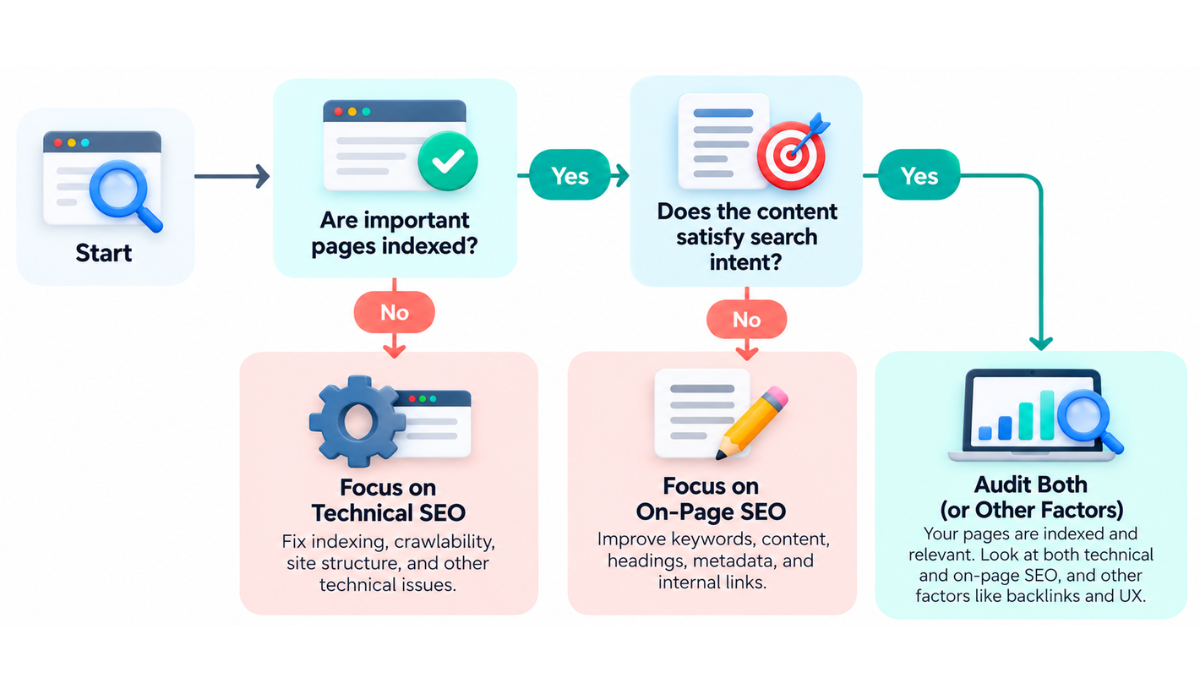
I do not give every client the same answer because the priority depends on the bottleneck. If search engines cannot properly access important pages, technical SEO comes first. If the pages are accessible but weak, irrelevant, or poorly structured, on-page SEO becomes the bigger priority.
How I diagnose the priority
Great content + noindex = technical problem. Crawlable page + thin content = on-page problem. Strong content + poor architecture = both. Fast site + wrong search intent = on-page/strategy problem. Strong rankings + weak conversions = often a page/message problem, not just a technical one.
This diagnostic mindset matters because SEO work can look productive without actually removing the constraint. I would rather fix the one issue holding back ten important pages than spend the same time polishing minor warnings that are not affecting performance.
How Can You Tell Whether Your Business Needs Technical SEO or On-Page SEO?
Signs I Treat as Technical SEO Problems
Important pages are not indexed or are excluded unexpectedly.
Search Console shows indexing, crawling, or rendering issues.
Redirects, canonicals, or robots directives are inconsistent.
A redesign or migration caused visibility or indexation problems.
Search engines are discovering duplicate or unintended URLs.
Severe performance or mobile issues are affecting important pages.
Signs I Treat as On-Page SEO Problems
Pages are indexed but do not rank for the queries they are meant to target.
Content does not match the searcher’s intent or buying stage.
Multiple pages compete for the same query without a clear purpose.
Titles, headings, internal links, or page structure are weak.
Content is generic, outdated, or missing important subtopics.
Organic traffic reaches the page but does not move toward a useful business action.
When Does a Business Need Both?
I often recommend both when a site is competitive, large, being redesigned, expanding into new topics, or has existing traffic but stagnant rankings. In those situations, technical and on-page work need to move together because improving one layer can expose weaknesses in the other.
What Should an SEO Strategy Include Beyond Technical and On-Page SEO?
Technical and on-page SEO are two important layers, but they are not the whole discipline. A complete SEO pyramid strategy can also include content strategy, off-page authority, local SEO where relevant, conversion optimization, analytics, and ongoing measurement.
I bring this up because businesses sometimes “finish” an on-page checklist and wonder why growth stalls. Rankings are influenced by more than what is written on one page. Authority, competition, topical coverage, website quality, and business relevance all matter to the larger strategy.
How Should Businesses Prioritize Technical and On-Page SEO Work?
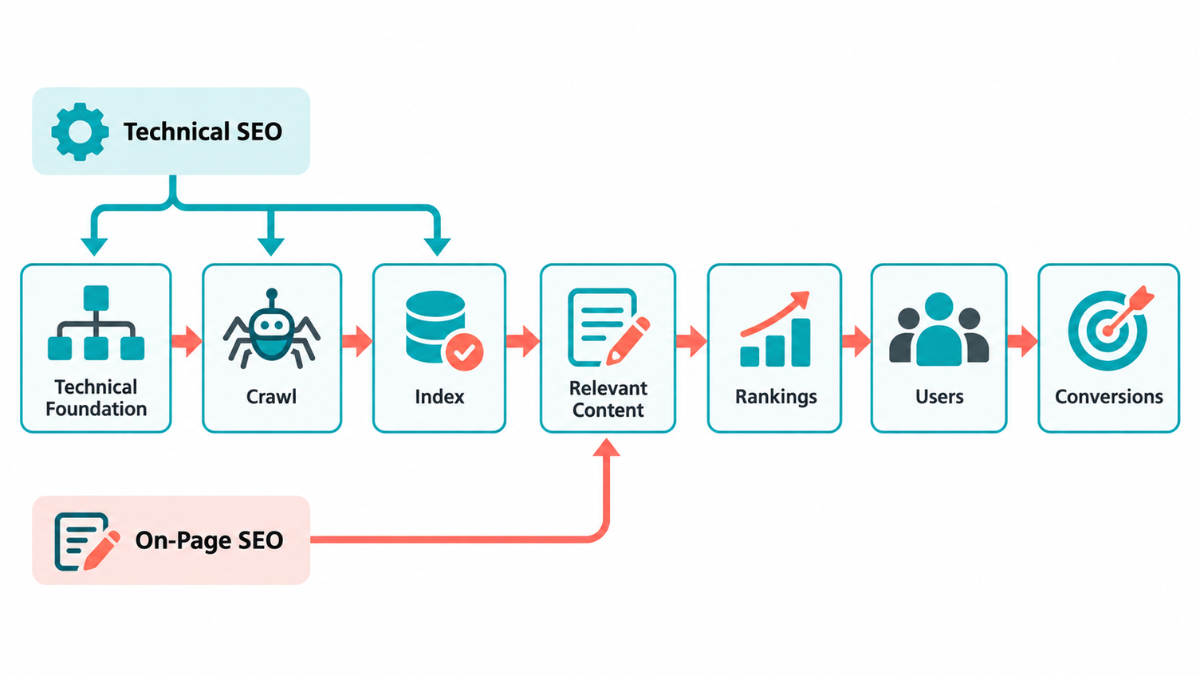
When I build an SEO action plan, I prioritize by impact and dependency. I do not want a content team optimizing pages that are going to be removed next month, and I do not want developers fixing low-priority warnings while revenue-driving pages are blocked or misaligned.
Priority 1: Fix Critical Technical Blockers
Indexation and crawlability issues
Accidental noindex or robots blocking
Major canonical problems
Broken migrations and redirects
Severe performance or rendering issues
Priority 2: Optimize High-Value Pages
Service pages
Product/category pages
Location or destination pages
Pages already generating impressions but underperforming
Priority 3: Improve Content Coverage
Search-intent gaps
Missing supporting subtopics
Weak topical relationships
Outdated content
Internal-link gaps
Priority 4: Monitor and Iterate
Google Search Console
Analytics
Rankings and visibility
Organic conversions
Technical monitoring
That order fits the way I think about an SEO strategy: fix what blocks progress, strengthen the pages that matter most, then expand and refine based on real data.
Which Technical and On-Page SEO Tasks Can an SEO Specialist Handle?
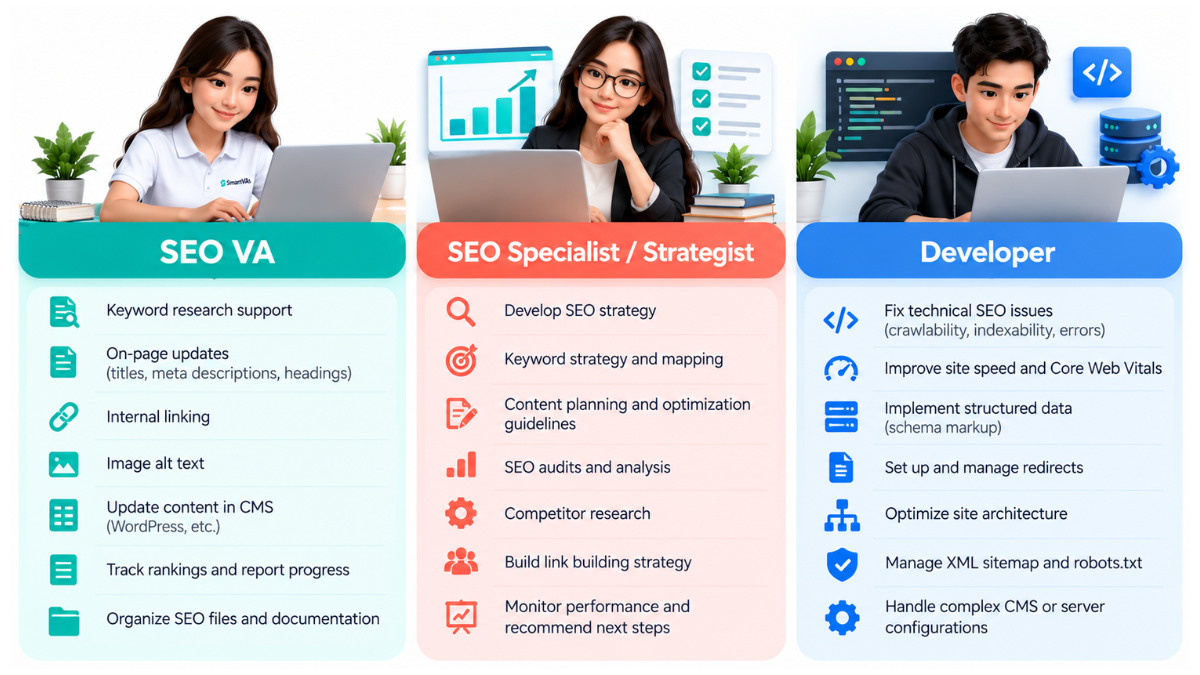
This is where I think businesses need a realistic view of SEO support. An SEO specialist can own a lot of the recurring execution, but that does not mean one person should independently solve every server, development, or architecture problem.
Which On-Page SEO Tasks Can I Handle?
Keyword and intent research
Content briefs
Title and meta optimization
Heading and page-structure improvements
Internal linking
Image and alt-text optimization
Content refreshes
On-page audits and recommendations
Publishing and formatting checks
Which Technical SEO Tasks Can I Help With?
Technical audit checklists
Identifying crawl and indexation issues
Monitoring Search Console
Checking redirects and canonicals
Reviewing robots and metadata directives
Implementing or validating basic schema where appropriate
Documenting technical issues
Coordinating fixes with web/development teams
Rechecking changes after implementation
Which Problems Usually Need a Developer or Deeper Technical Specialist?
Server configuration
Complex JavaScript rendering issues
Major CMS architecture changes
Database or server problems
Complex migrations
Advanced performance engineering
Large-scale indexing architecture
Custom development
At Smart VAs, that separation is important. Our professional SEO experts can handle ongoing research, optimization, monitoring, audits, and coordination, while technical implementation can involve the right web or development support when the issue requires it.
I also see the value of this structure in clients like Gabe Gibitz. His team includes an SEO lead alongside project support, which is a good example of what I mean by consistent execution and coordination. The proof point for me is not that one SEO task created a specific revenue result. It is that SEO can be owned as an ongoing function instead of becoming another task the business owner has to personally chase.
That is also why the managed specialist team model makes sense when SEO touches content, web design, reporting, and other marketing work. I can stay responsible for the SEO direction and checks while the right specialist handles the part that belongs to their discipline.
How Should You Measure the Success of Technical and On-Page SEO?
I measure the two areas differently because they solve different problems. A technical fix may not immediately show up as a lead, but it should improve the conditions that allow important pages to be crawled, indexed, rendered, and served correctly. On-page work is easier to connect to visibility, engagement, and conversion behavior.
| Measurement layer | What I watch |
|---|---|
| Technical SEO | Indexed pages; crawl/indexation issues; Core Web Vitals; crawl errors; redirect/canonical health; organic visibility after technical changes |
| On-page SEO | Impressions; clicks; CTR; rankings; organic traffic; engagement; conversions/leads |
| Business level | Qualified organic leads; conversion rate; sales/revenue contribution; efficiency; progress toward business goals |
I do not want a report that celebrates rankings while the wrong people are arriving, or a clean technical audit while important pages are not converting. SEO measurement should eventually connect back to the business outcome the site exists to support.
What Are the Most Common Mistakes Businesses Make With Technical and On-Page SEO?
Technical SEO Mistakes I See
Fixing minor audit warnings while critical indexation issues remain
Blocking important pages accidentally
Ignoring redirects after major website changes
Overlooking duplicate URLs and canonical conflicts
Chasing tool scores instead of diagnosing real search problems
Assuming an SEO plugin means technical SEO is finished
On-Page SEO Mistakes I See
Keyword stuffing
Writing for search engines instead of people
Creating pages without a clear search intent
Publishing thin or repetitive content
Ignoring internal links
Optimizing only blog posts while neglecting commercial pages
If a business is choosing outside support, I also recommend looking beyond promises and asking how the person actually diagnoses, prioritizes, and reports the work. Our guide on how to hire an SEO expert goes deeper into those evaluation questions, but the principle I use is simple: a good SEO partner should be able to explain why a task matters, not just add it to a checklist.
The strategic mistake underneath all of these is treating SEO as a one-time project. Search behavior changes, websites change, competitors publish, products evolve, and technical updates introduce new issues. I expect an SEO system to be monitored and refined over time.

DELEGATE SMART. SCALE FAST.
The step-by-step guide to reclaim your time and grow with confidence.
Smart Virtual Assistants
👍🤵
Smart Virtual Assistants 👍🤵
Can a Business Do Technical SEO and On-Page SEO at the Same Time?
Yes, and often I prefer it that way when the site has enough capacity. The key is sequencing the work so teams are not undoing each other. My usual workflow is: audit → prioritize → fix blockers → optimize important pages → improve or publish content → monitor → iterate.
Technical and content work should communicate. If a developer changes templates, URL structure, or rendering, I want to know. If the content team creates a new topic cluster, I want the internal-link and site-architecture implications considered at the same time.
So, What Does Your Business Actually Need: Technical SEO, On-Page SEO, or Both?
| If your situation looks like this... | Prioritize |
|---|---|
| Important pages aren't indexed | Technical SEO |
| Site has major crawl/indexation problems | Technical SEO |
| Pages are indexed but don't match intent | On-page SEO |
| Content is thin or outdated | On-page SEO |
| Rankings plateau despite good content | Technical + on-page audit |
| Site is being redesigned or migrated | Technical SEO first + on-page validation |
| You want to scale organic traffic | Both + broader SEO strategy |
| You don't have internal SEO execution capacity | Consistent specialist support |
If I had to reduce the entire article to one rule, it would be this: fix the problem that is actually limiting the site. Do not choose technical SEO because it sounds advanced, and do not choose on-page SEO because it feels easier to see. Diagnose first, prioritize second, execute consistently, and measure what changes.
For a business owner, the goal is not to become the person who manually checks canonicals, rewrites title tags, and monitors Search Console every week. The goal is to know that the right SEO work is being done in the right order and that someone is accountable for following through.
What if you could reclaim 40 hours this month?
Find out inside this free guide.
Frequently Asked Question
-
Technical SEO focuses on whether search engines can properly access, crawl, render, and index a website. On-page SEO focuses on whether individual pages are relevant, useful, well structured, and aligned with search intent. I usually diagnose both before deciding which one needs attention first.
-
Not universally. Technical SEO becomes the priority when access, crawling, rendering, or indexation problems are blocking important pages. On-page SEO becomes more important when the site is technically accessible but the pages do not match search intent, communicate relevance, or convert organic visitors.
-
Fix critical technical blockers first. There is little value in heavily optimizing a page that search engines cannot properly access or index. But you do not need to wait for every minor technical warning to disappear before improving content. I prioritize by impact, then run technical and on-page work in parallel where practical.
-
Yes, if the site is already technically healthy enough to be crawled and indexed. Improving search intent, page structure, content depth, internal links, and metadata can strengthen performance. If technical problems are preventing access or indexation, however, on-page improvements may have limited effect until those blockers are resolved.
-
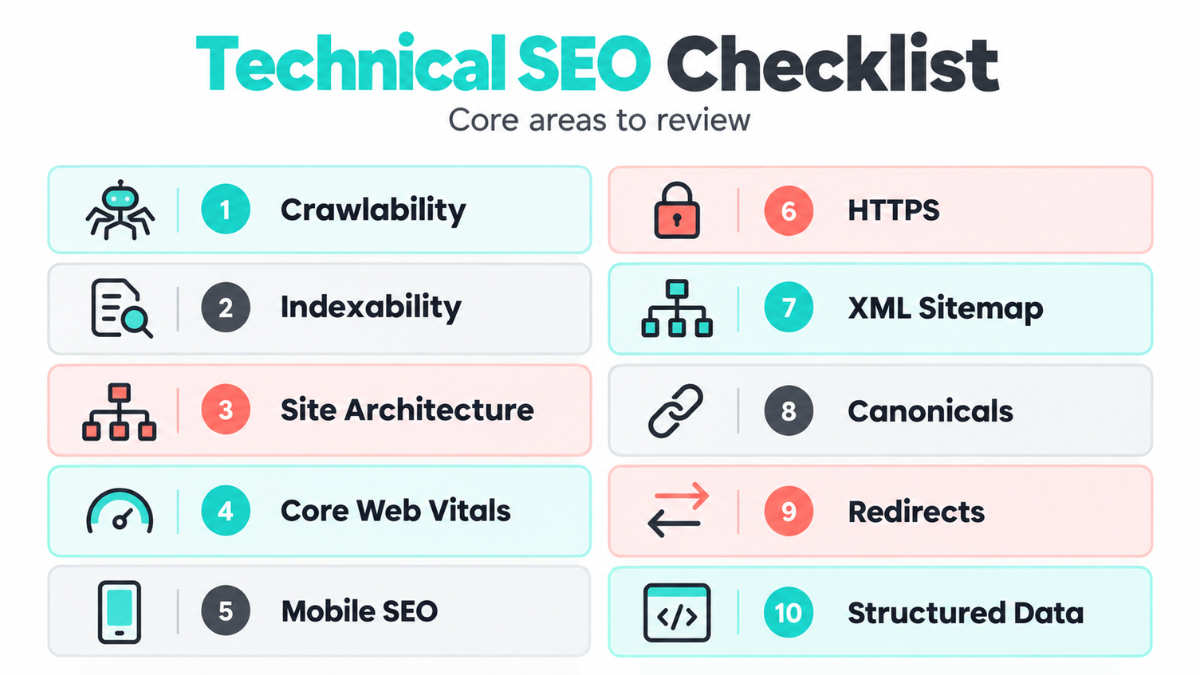
Technical SEO includes XML sitemaps, robots.txt, noindex directives, crawl errors, canonicals, redirects, HTTPS, mobile performance, Core Web Vitals, site architecture, structured data, and indexation monitoring. The exact priority depends on the site, so I do not treat every audit warning as equally important.
-
On-page SEO includes keyword and intent research, title tags, meta descriptions, headings, body content, image alt text, URLs, internal links, anchor text, content updates, and topical depth. The goal is to make a page clearer, more useful, and more aligned with what the searcher expects.
-
There is no single schedule for every site. I recommend more frequent monitoring for large, frequently updated, e-commerce, or recently migrated sites. Smaller stable websites may need less frequent full audits, but Search Console, indexation, redirects, and major technical changes should still be monitored consistently.
-
Update on-page SEO when search intent changes, rankings decline, content becomes outdated, competitors cover the topic better, or business information changes. I also revisit high-value pages that already receive impressions because small improvements to intent, structure, or conversion messaging can be more valuable than publishing another new page.
-
An SEO specialist can handle audits, monitoring, basic technical checks, redirects, directives, schema support, documentation, and coordination. Complex server configuration, JavaScript rendering problems, major migrations, architecture changes, or custom development often need a developer or deeper technical SEO specialist. Good support includes knowing when to escalate.
-
Bring in deeper technical support when the problem involves servers, JavaScript rendering, large-scale indexing architecture, complex migrations, CMS limitations, database issues, or custom development. I would rather escalate the issue early than pretend a general SEO checklist can solve a problem that belongs to engineering.
-
Yes, but the scope is usually smaller. A small business still needs important pages to be accessible, indexable, mobile-friendly, secure, and technically stable. The goal is not to build an enterprise SEO program. It is to prevent technical mistakes from blocking the pages that matter to the business.
-
Yes. In many projects, I run them together after critical blockers are identified. Technical work keeps the site accessible and stable while on-page work improves relevance and usefulness. The most important part is coordination so technical changes, content changes, and internal linking support the same SEO strategy.
Rene Aaron Tañada | SEO, Smart VAs

Aaron has been working as an SEO Specialist for years before joining SMART VAs and is also adept in drag and drop web development. His top priority is to make sure that your site performs to its full potential and increase your search visibility through improved rankings. He will be your main VA for all SEO needs.