Why More Businesses Are Switching to Managed SEO Services
Key Takeaways
SEO now spans technical, content, UX, and AI search visibility work that rarely fits inside one job description anymore.
Managed SEO services give you ongoing execution across specialists instead of a single hire trying to cover every discipline.
Hiring one in-house SEO specialist typically costs well over $85,000 a year before software, training, and management time are added in.
Google's AI Overviews now appear on roughly half of all searches, which means visibility depends on more than ranking in the traditional top ten.
A hybrid model, where you keep strategy and brand voice in-house and hand execution to a managed team, tends to outperform an all-in-house or fully hands-off approach.
The right managed SEO partner gives you account ownership, clear reporting, and a documented process, not vague promises about rankings.

ARE YOU STILL TRYING TO DO IT ALL?
Discover the SMART way to delegate without losing control—and finally free up your time.
I've watched SEO change more in the last two years than it did in the previous ten. When I started building out marketing operations for the businesses I work with, SEO mostly meant picking the right keywords, writing decent content, and building a few links. That's not the job anymore.
Google's algorithms now weigh technical performance, content depth, user experience, and trust signals together. AI-powered search, from Google's AI Overviews to ChatGPT and Perplexity, has added an entirely new layer on top of traditional rankings. A business can rank on page one and still lose visibility if it isn't showing up in an AI-generated answer.
That growing complexity is exactly why I've seen so many founders and marketing leads move away from the old model of hiring one SEO person, or worse, hoping a generalist marketer can handle SEO on the side, and toward managed SEO services instead. In this piece, I'll walk through what managed SEO actually is, why the shift is happening, what results businesses can realistically expect, and how to tell if it's the right fit for where your business is right now.
What Are Managed SEO Services?
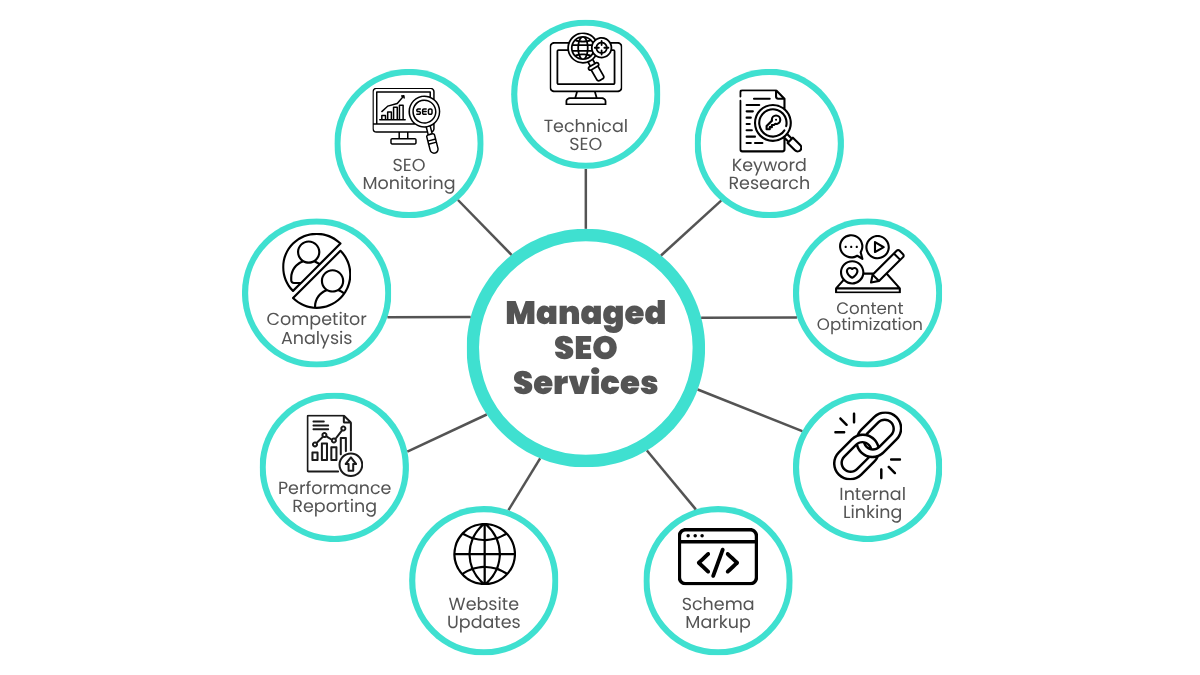
Managed SEO services are ongoing SEO execution handled by an outside team on a continuous basis, rather than a one-time project. Instead of paying for a single audit or a one-off content batch, you get consistent monthly work: strategy, optimization, content, and reporting that builds on itself month over month.
That distinction matters. A one-time SEO audit tells you what's wrong. Managed SEO is the ongoing work of actually fixing it, publishing against it, and adjusting as Google's algorithms and AI search behavior shift.
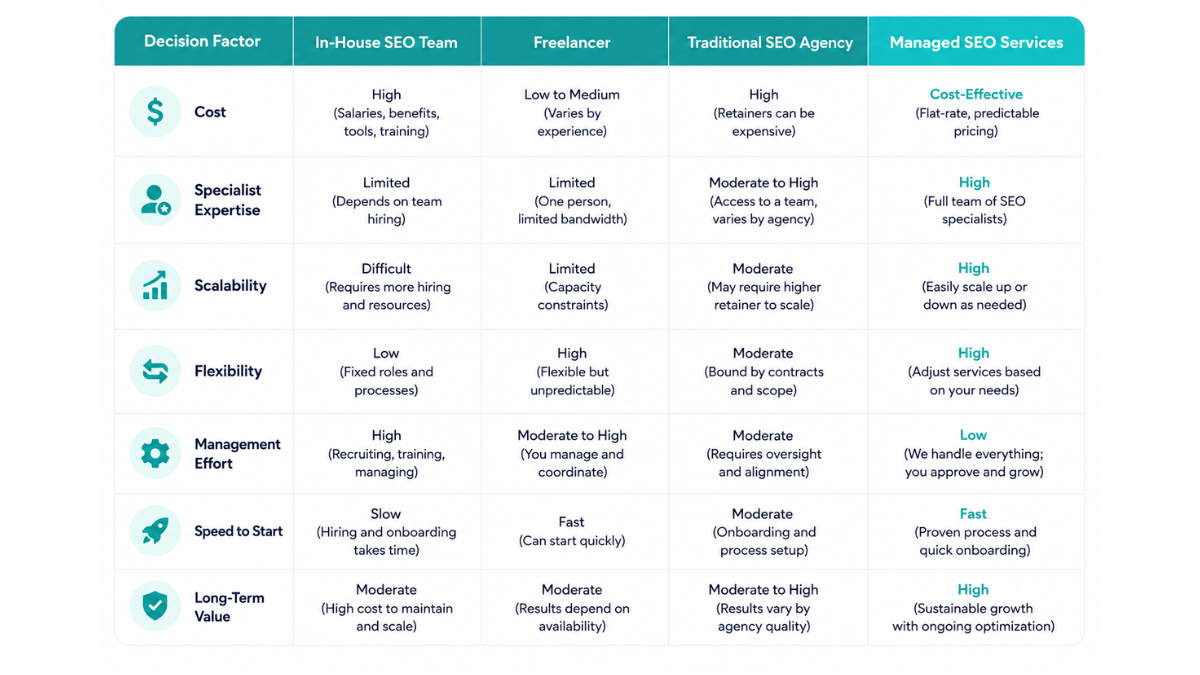
How are managed SEO services different from traditional SEO agencies?
| Model | How It Works | Common Limitation |
|---|---|---|
| Traditional Agency | Full-service retainer, often bundled with paid ads and other marketing services. | Higher retainers, less flexibility, and SEO can receive less attention than paid media. |
| SEO Consultant | Strategic guidance and recommendations. | You still need someone to execute the recommendations. |
| Freelancer | One person handling a defined scope. | Limited capacity, single point of failure, and a narrow skill set. |
| Managed SEO Support | A coordinated team executing strategy, content, technical fixes, and reporting continuously. | Requires clear communication and shared goals from the outset. |
What tasks are typically included in managed SEO services?
If you are still deciding what an SEO virtual assistant can do for your business, start with the execution
work that keeps getting delayed: updating pages, improving metadata, organizing internal links,
preparing SEO briefs, publishing content, and cleaning up reporting.
The exact scope depends on the business, but managed SEO services often include the work that keeps SEO moving after the strategy is created.
SEO strategy and priority planning
Keyword research and search intent mapping
Technical SEO checks and fixes
On-page optimization for existing pages
Content optimization and refreshes
Internal linking updates
Schema markup recommendations and implementation support
Content publishing support
Website updates and basic page improvements
Performance monitoring in GA4 and Google Search Console
Competitor monitoring
Reporting that connects SEO activity to traffic, leads, and conversion
Why Has SEO Become More Complex Than Ever?
I think this is the part a lot of business owners underestimate. SEO used to be something a smart, motivated employee could pick up alongside other responsibilities. That's not realistic anymore, and it's worth understanding why before deciding how to staff it.
Google's algorithms now reward overall website quality, not just keywords
Keyword placement alone stopped being enough years ago. Google's ranking systems now evaluate a site holistically: content depth and originality, page experience, technical health, and trust signals like author expertise and real-world credibility. You can't optimize your way around a thin or untrustworthy site anymore, you have to actually build one.
AI search and Google AI Overviews are changing how businesses compete
This is the shift I bring up most often with clients, because it's happening faster than most SEO advice has caught up with. AI Overviews now show up on roughly half of all tracked Google searches, and when they appear, they change user behavior significantly. According to Pew Research Center's study of nearly 69,000 real Google searches, users click through to a traditional organic result only about 8% of the time when an AI Overview is present, compared to roughly 15% when it isn't, a nearly 47% relative drop in clicks.
The businesses that come out ahead in that shift aren't necessarily the ones ranking first, they're the ones getting cited inside the AI-generated answer itself. That requires structured content, clear FAQ formatting, schema markup, and genuine expertise signals, which is a different (and more technical) skill set than traditional keyword-first SEO.
Modern SEO requires multiple areas of expertise
A single SEO hire is now expected to understand technical SEO, content strategy, user experience, Core Web Vitals, schema markup, internal linking architecture, analytics, conversion rate optimization, and entity SEO for AI search. That's not one job. It's closer to six.
Why Are More Businesses Switching to Managed SEO Services?
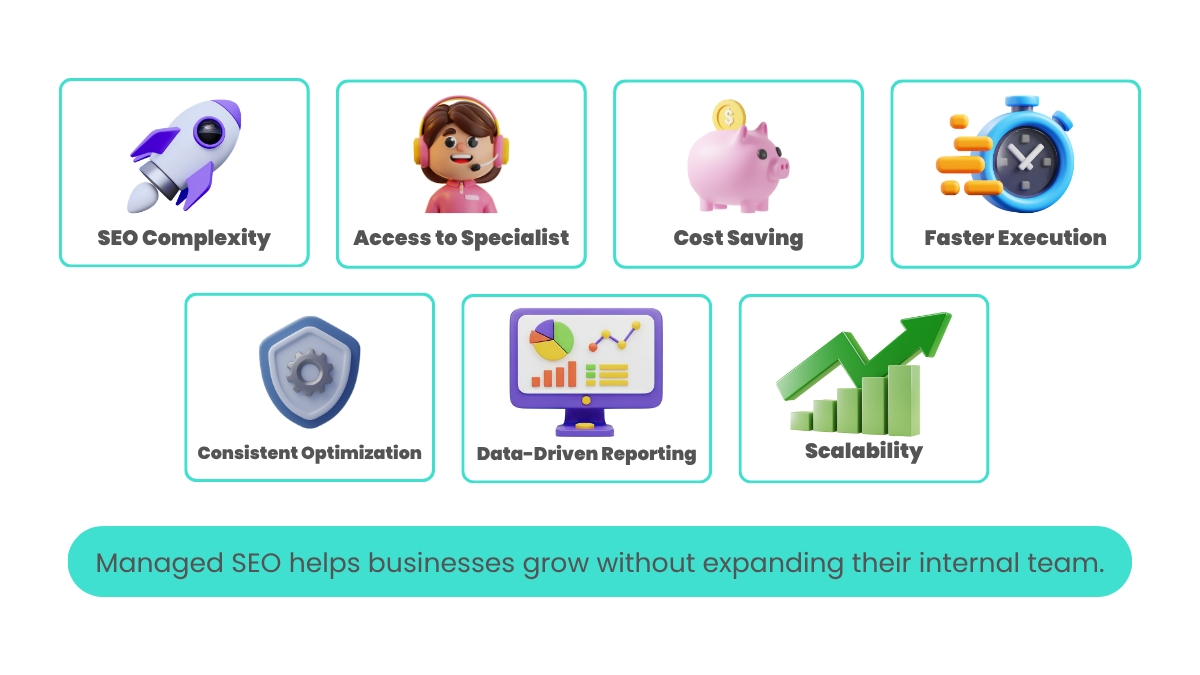
Here's what I want to be clear about: businesses aren't giving up on SEO. If anything, they're taking it more seriously. What's changing is how they execute it. Managed SEO services have become the preferred model because they solve problems that hiring one internal person simply can't.
Reason 1: SEO has become too specialized for one person
Given everything I just walked through, technical SEO, content, schema, analytics, AI search visibility, it's unrealistic to expect one hire to be excellent at all of it. Managed SEO solves this by giving you a team where each piece is handled by someone who actually specializes in it.
Reason 2: Hiring an internal SEO team is expensive
The salary is only part of the cost. Once you factor in benefits, recruiting, SEO software subscriptions, and ongoing training to keep up with algorithm changes, one in-house hire adds up fast. According to Glassdoor's compensation data, the average SEO specialist salary in the United States sits around $86,000 a year, with top earners well above $140,000, and that's before benefits, tools, or management overhead are added in.
For most growing businesses, that's a significant commitment for a single generalist hire, especially compared to a managed model that gives you access to a full team of specialists for a more predictable monthly investment.
Reason 3: Businesses want faster implementation
A common frustration I hear is watching SEO recommendations sit in a document for months because no one has time to actually implement them. Managed SEO services close that gap. Technical fixes, content updates, schema additions, internal linking, and publishing happen on an ongoing schedule instead of waiting for bandwidth to open up internally.
Reason 4: Managed SEO provides access to multiple specialists
A managed SEO model gives businesses access to different skills without hiring each role full time. Depending on the need, the work may involve a technical SEO specialist, content strategist, SEO writer, analyst, outreach support, or website support person.
At Smart VAs, this is the same reason we believe in a managed team model. The right work should go to the right skill set. SEO content writing support is not the same as technical implementation. Reporting is not the same as page optimization. Website fixes are not the same as keyword research.
Reason 5: Businesses need consistent SEO execution
SEO rewards consistency far more than intensity. A single big push followed by three quiet months doesn't build authority the way steady, ongoing execution does. Managed SEO is built around consistency by design, which is one of the biggest advantages over ad hoc or occasional optimization.
Reason 6: Better reporting leads to better business decisions
Good managed SEO support doesn't just execute, it explains what's working. Clear GA4 and Google Search Console reporting on organic conversions, landing page performance, and user behavior gives you the information you actually need to make decisions about where to invest next, instead of guessing.
Reason 7: SEO needs to scale as the business grows
As a business adds new services, expands its website, enters new locations, or launches new products, SEO needs have to scale right along with it. A managed team can flex up or down based on what the business actually needs that quarter, which is much harder to do with a single fixed hire.
What Results Can Businesses Expect From Managed SEO Services?
Managed SEO is not a magic switch. It is a system for making the right SEO work happen consistently. When the strategy is sound and the execution is steady, businesses can expect improvements in the areas that actually support growth.
This also connects to the larger question of content marketing vs SEO for ROI in 2026. Content can create trust and demand, but SEO helps that content become discoverable, measurable, and easier to improve over time.
Better search visibility across both traditional rankings and AI-generated answers
More qualified organic traffic, not just more traffic
Higher-quality leads tied to buyer-intent keywords
Improved website health and technical performance
Faster implementation of fixes and content
Better reporting and clearer decision-making
Long-term, compounding business growth rather than short-term spikes
Suggested visual: a before-and-after comparison graphic showing typical shifts in rankings, traffic quality, technical health, and reporting clarity after moving to a managed SEO model.
Is Managed SEO More Cost-Effective Than Hiring In-House?

Hidden costs of hiring an internal SEO team
The salary line is rarely the full cost. Recruiting fees, benefits, payroll taxes, software subscriptions (keyword research, technical auditing, and reporting tools alone can run into the hundreds of dollars a month), training to keep pace with algorithm and AI search changes, equipment, and the management time it takes to oversee the role all add to the real cost of an in-house hire.
Why one SEO specialist usually isn't enough
When founders compare SEO rates for freelancers vs agencies, the price difference is only one part of the decision. The bigger question is whether the person or team can handle technical updates, content improvements, reporting, and implementation without creating another management burden.
One SEO specialist can be valuable, but one person usually cannot be your strategist, technical SEO, writer, editor, web support, analyst, and CRO specialist at the same time. This is the SEO unicorn myth, and it creates the same problem I see across many growing businesses: one capable person becomes the bottleneck because the role is too broad.
How managed SEO services reduce overhead
| Cost Area | In-House SEO | Managed SEO Services |
|---|---|---|
| Salaries | Fixed, ongoing commitment. | Flexible, scales with need. |
| Recruitment | High cost and time investment. | Minimal, no hiring cycle required. |
| Training | Handled internally. | Included as part of the service. |
| Specialist Skills | Limited to one hire's strengths. | Access to multiple specialists. |
| Software | Multiple individual subscriptions. | Often included in the engagement. |
| Scalability | Slow to adjust. | Flexible up or down. |
Which Businesses Benefit Most From Managed SEO Services?
Managed SEO tends to be the strongest fit for businesses that need consistent execution but don't have the bandwidth or budget to build a full internal team. That includes:
SaaS companies
Professional services firms
Healthcare practices
Legal practices
Home services businesses
Marketing agencies that need white-label execution support
B2B companies
Ecommerce brands
Startups building organic visibility from the ground up
Multi-location businesses managing local SEO across markets
Generally speaking, managed SEO makes the most sense once a business has outgrown ad hoc efforts (a blog post here, a keyword update there) but isn't yet at the scale where a full internal department, with its own budget and headcount, makes financial sense.
Should You Outsource Everything or Use a Hybrid SEO Model?
What is a hybrid SEO model?
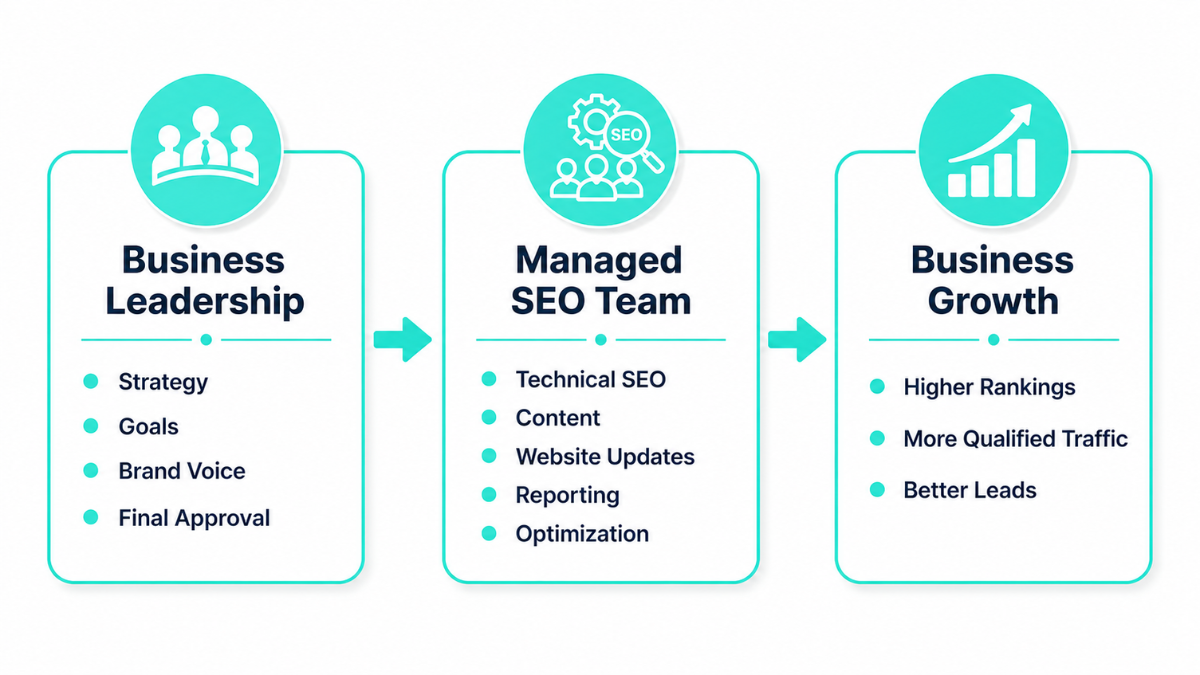
A hybrid model is the approach I recommend most often: the business keeps ownership of strategic and brand-level decisions while handing execution to a managed team. It's not all-in-house or fully hands-off, it's a deliberate split.
What should stay in-house?
Brand messaging and voice
Overall business strategy
Product and service knowledge
What can an outsourced SEO team handle?
Technical SEO
On-page and content optimization
Reporting and analysis
Content improvements and refreshes
Website support tied to SEO performance
How do you maintain control over your SEO?
This is the question I get most from founders considering outsourcing for the first time, and it's a fair one. You maintain control by keeping account ownership under your business (not the vendor), securing CMS-level permissions rather than handing over full admin access, documenting brand guidelines up front, and setting clear approval workflows for anything published under your name.
How Do You Choose the Right Managed SEO Partner?
Questions to ask before hiring
Who owns our accounts, our analytics, and our search console data?
How are reports delivered, and how often?
How often do you communicate with us directly?
What happens if a team member changes mid-engagement?
How do you measure success beyond rankings?
Red flags to avoid
Guaranteed rankings (no one can honestly promise this)
Lack of transparency about what work is being done
No regular reporting
Black-hat tactics that risk penalties
Hidden fees not disclosed up front
Poor or missing documentation
What KPIs should you track?
Organic traffic
Qualified leads generated through organic search
Conversions
Click-through rate
Keyword rankings
Indexed pages
Technical site health
Revenue influenced by SEO
Common Mistakes Businesses Make When Switching to Managed SEO
Expecting instant rankings instead of compounding, month-over-month results
Choosing the cheapest provider without evaluating the actual scope of work
Ignoring technical SEO in favor of content alone
Failing to document brand guidelines before work begins
Measuring success only by keyword rankings instead of leads and revenue
Changing SEO strategy too frequently before it has time to work
| Option | Best For | Watch Out For |
|---|---|---|
| In-house Team | Large organizations with dedicated marketing budgets. | High fixed costs. |
| Freelancer | Small, one-off projects. | Limited capacity. |
| Traditional Agency | Full-service marketing needs. | Higher retainers and less flexibility. |
| Smart VAs Managed SEO | Growing businesses needing consistent SEO execution. | Requires clear communication and defined goals. |
When Is Smart VAs the Right Fit for Managed SEO Support?
Smart VAs is the right fit when a business already understands the value of SEO but needs consistent SEO execution services to keep the work moving.
Our model works well for businesses that need a fully managed virtual assistant team for growing businesses, not just a list of disconnected freelancers. We help clients access managed marketing support across SEO, content, website updates, reporting, and related execution tasks.
For SEO-specific work, our professional SEO expert support can help with keyword research, on-page optimization, local SEO, content optimization, link building support, technical SEO fixes, and performance tracking.
When SEO needs content, our SEO content writing support can help create search-friendly blog posts that still sound human and aligned with the brand.
When SEO needs implementation, our website design specialist support can help with page updates, landing pages, mobile responsiveness, metadata setup, speed improvements, and tool integrations.
I also think of Gabe Gibitz from Blue Guru Marketing when I talk about scalable execution. Before working with Smart VAs, Gabe was stretched across web development, SEO, client communication, and project management. Our support started with project-based help and grew into a dedicated team helping with technical project management, social media, and operations. Gabe’s experience shows why growing businesses often need structure, not just another task-taker.
You can read Gabe’s Smart VAs case study for a closer look at how managed support helped his business scale.
Smart VAs can support managed SEO execution in areas such as:
Keyword research.
Technical SEO.
On-page optimization.
SEO content support.
Internal linking.
Schema implementation.
Website updates.
Reporting.
SEO monitoring.
Ready to Scale Your SEO Without Growing Your Payroll?
SEO success today requires consistent execution across multiple disciplines. It is not enough to publish once in a while, fix a few meta descriptions, and hope the site keeps growing.
Managed SEO services give businesses access to specialist expertise, flexible execution, and ongoing optimization without the overhead of hiring an entire in-house team.
If your business has outgrown ad hoc SEO efforts, a managed SEO model can help you build sustainable organic growth while keeping control of your strategy, brand voice, website, and data.
If you are ready to strengthen your SEO with the right execution support, schedule a free SEO strategy session with Smart VAs today.
Smart Virtual Assistant
👍🤵
Smart Virtual Assistant 👍🤵

What if you could reclaim 40 hours this month?
Find out inside this free guide.
Frequently Asked Questions
-
Managed SEO services are ongoing, continuous SEO execution, strategy, technical fixes, content, and reporting, handled by an outside team month over month, rather than a one-time audit or project..
-
Most managed SEO engagements include keyword research, technical SEO, on-page optimization, content optimization, internal linking, schema markup, publishing support, and ongoing GA4 and Search Console reporting.
-
Traditional agencies often bundle SEO with other services like paid media and can offer less day-to-day flexibility. Managed SEO services are typically more focused, with dedicated ongoing execution built around your specific goals.
-
Costs vary based on scope and business size, but managed SEO is generally more cost-effective than a single in-house hire once salary, benefits, software, and training are factored in.
-
Most businesses start seeing meaningful movement within three to six months of consistent execution, with results compounding further from there. SEO rewards consistency over quick fixes.
-
Yes, when it's built around buyer-intent keywords and paired with clear conversion paths, managed SEO is designed to bring in qualified leads, not just traffic.
-
With a well-structured managed SEO partnership, your business retains ownership of all accounts, analytics, and search console access, while the managed team works within permissions you control.
-
Organic traffic, qualified leads, conversions, click-through rate, keyword rankings, indexed pages, technical site health, and revenue influenced by SEO are the core metrics worth tracking.
-
Yes, this is actually one of the most common and effective setups. Your in-house team can own brand strategy and messaging while the managed SEO team handles execution, technical work, and reporting.
About the Author:
Kristy Yoder, Founder

Kristy Yoder is the Founder of Smart VAs, a virtual assistant agency that helps entrepreneurs grow through reliable administrative and digital marketing support. With extensive experience building and managing remote teams, she specializes in delegation, operational efficiency, and scalable business growth.
Passionate about helping business owners reclaim their time, Kristy leads Smart VAs in connecting entrepreneurs with skilled virtual professionals who provide dependable support and contribute to long-term success.