Key Takeaways
Brand voice usually gets lost because the handoff is too vague, not because outside support cannot learn the business.
A useful brand voice guide includes tone, message pillars, audience details, approved phrases, words to avoid, and examples of past posts that felt right.
The best approval process catches small tone problems early before they become a pattern across every platform.
A strong social media management partner should bring structure, not just captions: onboarding, calendars, review loops, reporting, and clear communication.
Outsourced content should feel like an extension of the brand. If the caption could belong to any competitor, the voice needs more calibration.

ARE YOU STILL TRYING TO DO IT ALL?
Discover the SMART way to delegate without losing control—and finally free up your time.
I can usually tell when a social media handoff is missing something. The post goes out on time, the graphic looks fine, and nothing is technically wrong. But the caption feels flat. It could belong to any business in the industry, and that is exactly what makes the owner nervous.

That fear is one reason many businesses hesitate to outsource social media. They do not want to lose the tone, point of view, humor, warmth, or directness that makes their brand recognizable. But brand voice loss is not automatic. In my work as a Social Media Management Specialist, I see it happen most often when there is no clear guide, no examples, and no review process. This article walks through how to outsource social media while keeping your content consistent, on-brand, and still recognizably yours.
What Does It Actually Mean to Lose Your Brand Voice When Outsourcing?
Losing your brand voice does not always mean the content is bad. Sometimes the captions are grammatically correct, posted on schedule, and matched to the right platform. The problem is that they do not sound like the business.
That can show up as captions that are too formal for a friendly brand, too playful for a professional service, too generic for a specialist business, or too sales-heavy for an audience that expects education first. The content may be correct, but it misses the personality and decision-making behind the brand.
When I help with outsourced social media management, I treat this as a process issue first. Before assuming the writer is wrong for the role, I look at the handoff. Was the tone documented? Were examples shared? Was the audience clearly explained? Were past posts reviewed? Without those pieces, even a skilled specialist is guessing.
What Is Brand Voice, and Why Is It the First Thing to Protect?
Brand voice is the consistent way a business communicates. It includes word choice, sentence length, humor, directness, warmth, confidence, and the way the brand handles questions or objections. On social media, it also affects how captions open, how replies are written, and how promotional posts are softened so they still feel human.
Brand voice matters because people rarely remember one isolated post. They remember the feeling of seeing the business show up again and again in a familiar way. A consistent voice helps the audience recognize the brand faster, trust it more easily, and understand what kind of experience they can expect.
That is why I do not start with a blank content calendar. I start with voice. Before I write or schedule anything, I want to understand how the business speaks when it sounds most like itself.
What Should You Document Before Handing Off Social Media to Anyone Else?
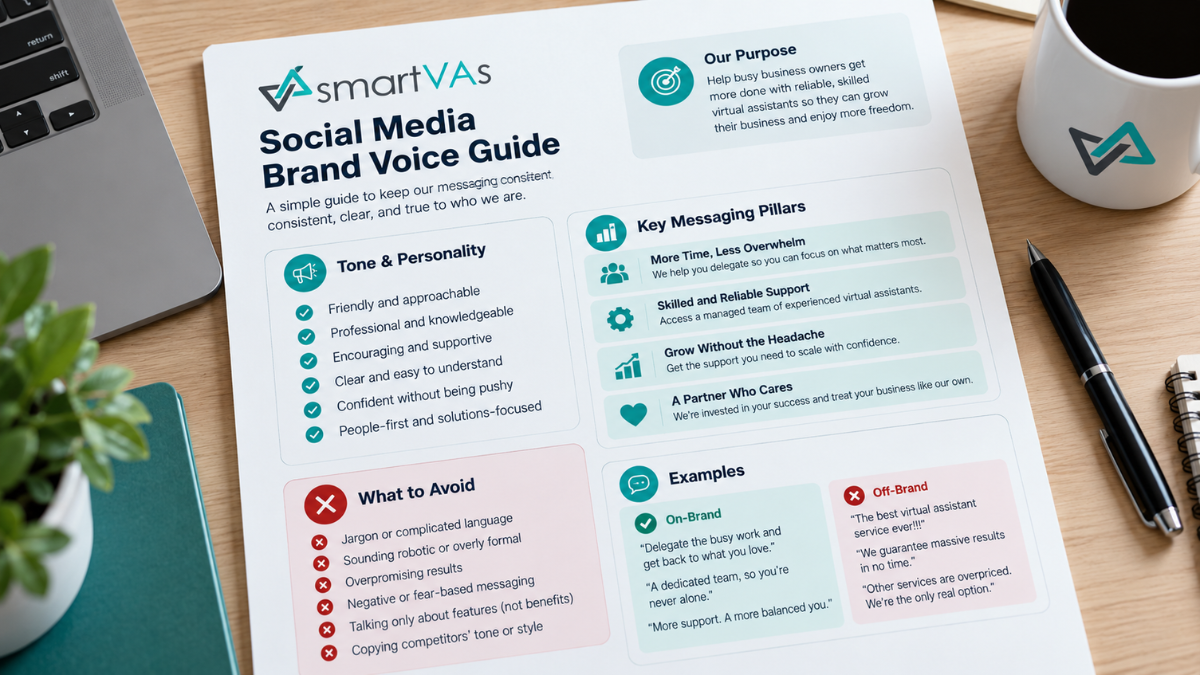
The first document I want before taking over social media is not a long brand book. It is a practical brand voice guide that can be used while writing captions, reviewing comments, and planning content.
A useful guide should include the brand personality, tone range, audience details, messaging pillars, approved phrases, topics to avoid, formatting preferences, call-to-action style, and examples of captions that already worked well. I also like seeing examples of content the business dislikes because that helps define the boundaries more clearly.
For example, a coaching brand may want content that feels direct and encouraging but never harsh. A legal or financial service may want content that feels clear and calm but not overly casual. A creative business may want captions that sound warm, visual, and story-driven. Those differences matter. Without documentation, everything slowly becomes generic.
How Do Content Frameworks and Reference Examples Prevent Off-Brand Content?
A brand voice guide tells me how the business should sound. Content frameworks tell me how that voice should show up in practice so brand consistency across every channel does not depend on memory, mood, or guesswork.
For social media, I like to build frameworks for educational posts, client proof posts, founder perspective posts, promotional posts, behind-the-scenes posts, and engagement posts. Each one can have a different structure while still keeping the same voice. A promotional caption may be shorter and more direct. A story-based caption may need more context. A carousel introduction may need a sharper hook.
Reference examples are what make this practical. I want to see the business's best-performing posts, captions the owner personally liked, comments from the audience, and even competitor content that should not be copied but can help explain the category. These examples become calibration points. They help a Social Media Management Specialist write in the right direction faster.
What Does a Strong Content Approval Process Look Like?
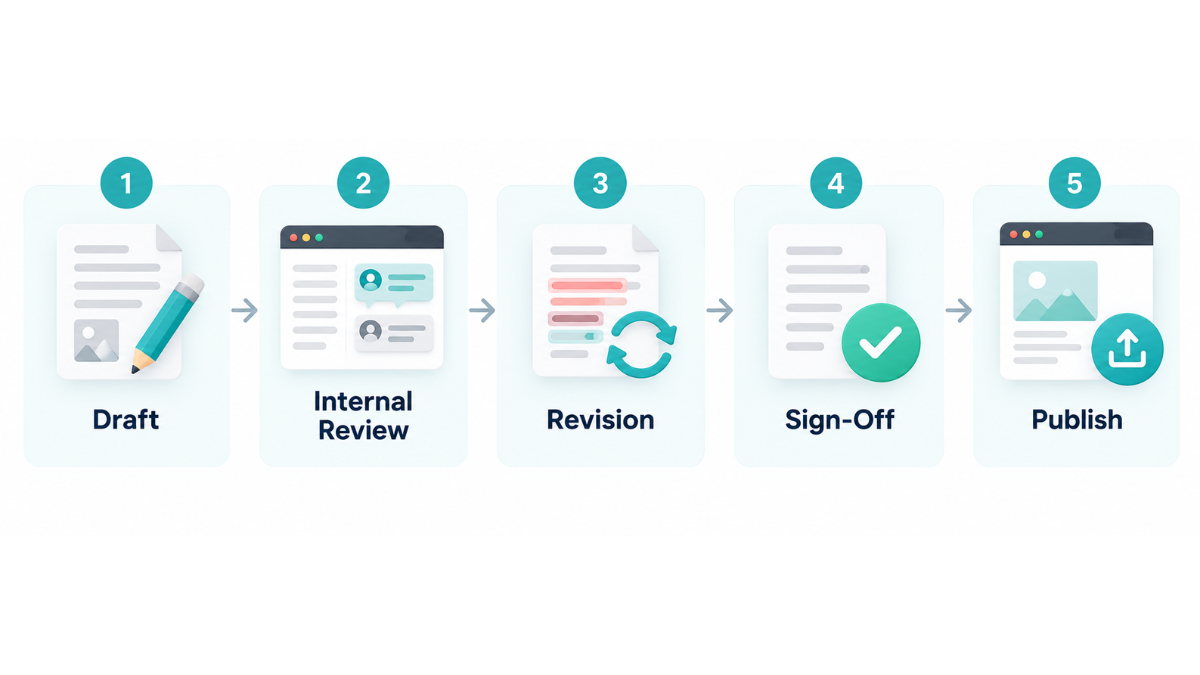
A strong approval process is not micromanagement. It is quality control. The goal is to catch voice drift while it is still small.
In a clean process, drafts are submitted with enough time for review. One person owns feedback so the specialist is not receiving conflicting comments from three different people. Revision timelines are clear, and final approval happens before anything is scheduled. This is how I think about outsourcing social media without losing control: the control comes from the system, not from the owner personally checking every detail forever.
The businesses that struggle most are usually the ones that approve in a rush or only comment when something feels wrong. The better approach is to explain why a caption feels off. Was it too formal? Too vague? Too promotional? Too far from how the founder would say it? That feedback helps the next batch improve.
How Do Regular Check-Ins Keep a Managed Team Aligned With Your Brand Over Time?
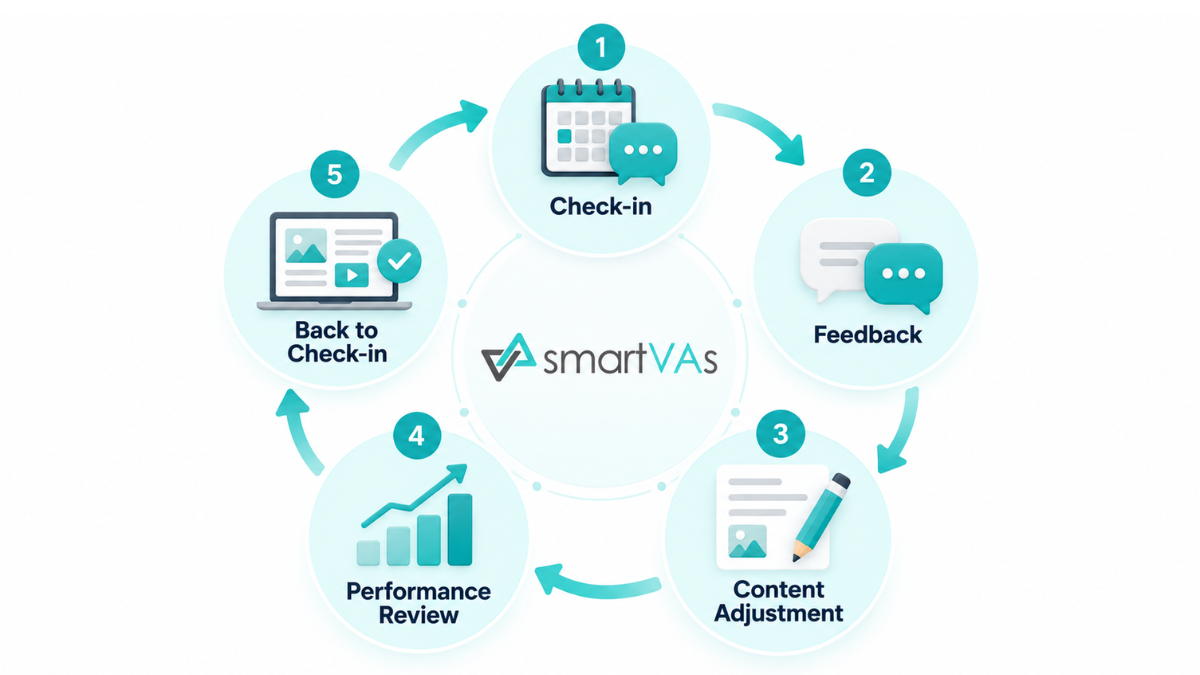
Brand voice is not something you hand off once and never revisit. Campaigns change, offers change, audience questions change, and the way a business talks about its work becomes sharper over time.
That is why regular check-ins matter. A weekly or bi-weekly review gives the team a chance to talk through what is coming up, what content felt strongest, what needed too many edits, and what the audience is responding to. This is also where the business can share new phrases, sales conversations, client objections, or founder opinions that should show up in future content.
In a managed structure, a dedicated Client Success Partner helps keep those conversations organized so the specialist is not working in isolation. That support is important when content, design, scheduling, and reporting all need to stay connected.
How Does Performance Data Help Refine Brand Voice Over Time?
Brand voice should not be based only on personal preference. The business should sound like itself, but performance data can show which version of that voice is connecting best with the audience.
I look at saves, shares, comments, profile visits, link clicks, direct messages, and post themes. If direct, practical posts keep getting saved, that tells us the audience values clarity. If behind-the-scenes posts start conversations, that tells us the audience wants more human context. If polished promotional posts get ignored, that may mean the offer needs a softer lead-in or stronger problem framing.
The important part is to use data to update the guide, not just the next caption. Over time, the brand voice guide should become more specific because the team has real examples of what the audience recognizes and responds to.
What Are the Most Common Mistakes Businesses Make When Outsourcing Social Media?
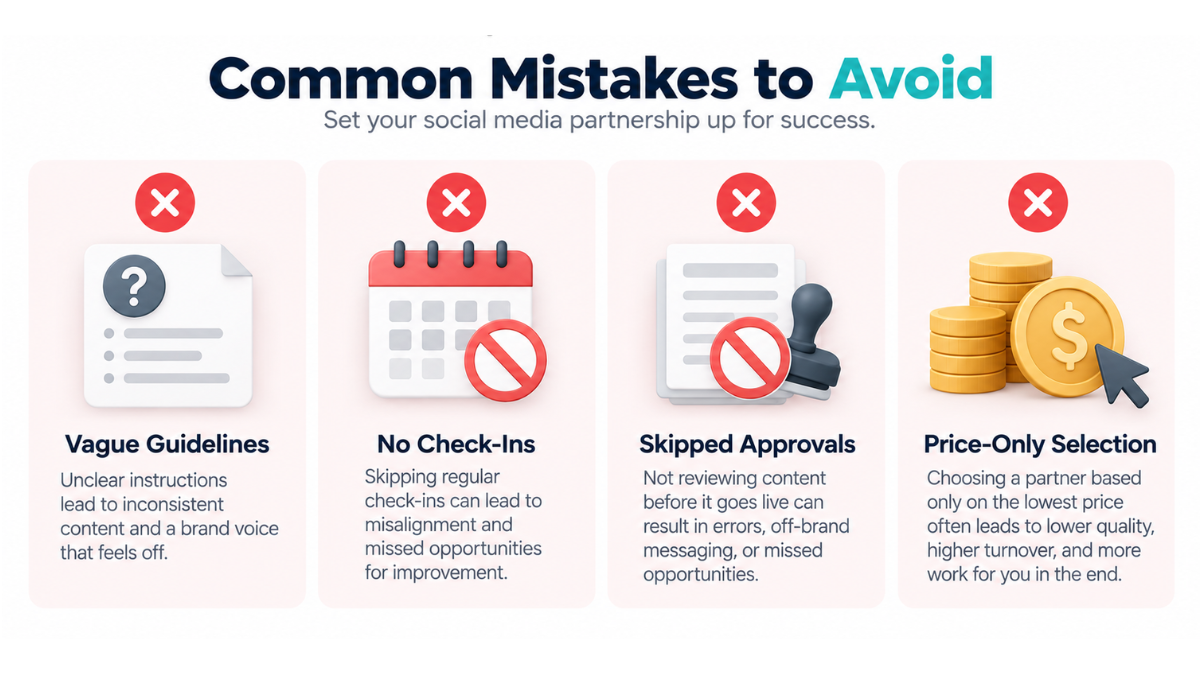
The first mistake is handing over social media with only a logo, a website link, and a few vague instructions like 'keep it professional' or 'make it engaging.' Those words mean different things to different people.
The second mistake is disappearing after onboarding. A social media management partner can take work off your plate, but they still need direction at the beginning. The voice becomes stronger when the owner or internal lead shares context, approves examples, and gives useful feedback early.
The third mistake is skipping the approval process because everyone is busy. That usually leads to small issues becoming bigger: captions get more generic, visuals drift from the brand, and the content calendar starts feeling disconnected from what the business is actually selling.
The fourth mistake is choosing support only because it is the lowest quote. Social media looks simple from the outside, but brand voice, audience judgment, creative direction, and consistency require more than quick posting. When the work keeps spilling into content, design, website updates, and follow-up, it may also be a sign to review when to outsource your marketing team instead of trying to patch each task separately.
What Should You Look For When Choosing a Social Media Management Partner?
When a business is choosing a social media management partner, I would look beyond the prettiest portfolio. A polished sample does not always show whether the partner can adapt to different brand personalities.
Ask how they onboard a new brand. Ask what they need before writing the first content batch. Ask how they handle revisions, how they document feedback, how often they report performance, and who your point of contact will be. A strong partner should be able to explain the process clearly.
At Smart VAs, this is why social support fits best inside a structured model. A Social Media Management Specialist can manage planning, captions, scheduling, engagement support, and reporting, while a Graphic Design Specialist can help keep recurring visuals aligned with the same brand system. The value is not just getting posts finished. It is keeping the voice and visuals moving in the same direction.
How Do You Know If Outsourced Content Still Sounds Like You?
Here is a simple test I use: could this caption be swapped with a competitor's post and no one would notice? If the answer is yes, the voice is probably too generic.
Another test is whether the internal team would recognize the caption without seeing the logo. Strong brand voice has signals: the way the business explains problems, the type of words it repeats, the level of warmth or directness, and the kind of examples it uses. If none of those signals are present, the content may be accurate but not ownable.
I also pay attention to how much editing is needed. If every caption requires heavy rewriting, the specialist may need better examples, clearer feedback, or a more detailed brand voice guide. If edits become lighter over time, the process is working.
How Smart VAs Keeps Social Media Support Aligned
The strongest social media support happens when the specialist is not guessing alone. The business provides the voice, the audience insight, and the approval direction. The specialist turns that into a repeatable content workflow built around practical social media management best practices, not random posting or last-minute ideas.
I have seen this work with Creative Island, a digital marketing agency that needed steady support with social media design, copywriting, web development, and blog writing. The handoff worked because the support was not treated as random task coverage. It was built around clear communication, reliable execution, and the standards the business already had for its own clients.
That is the real goal when you outsource social media. The content should feel like an extension of the business, not like it came from someone disconnected from the brand. A stronger process gives the specialist enough context to protect the voice while still removing the daily pressure from the owner.
Extending Your Voice, Not Losing It
Outsourcing social media should not mean handing over your personality and hoping for the best. It should mean building a process that lets someone else execute the work without stripping away what makes the brand recognizable.
The businesses that keep their voice strong usually have the same basics in place: clear voice documentation, strong reference examples, a content approval process, regular check-ins, and performance reviews that improve the system over time.
That is where a fully managed team of specialists can make social media feel lighter without making the brand feel less personal. The right support should extend your voice, not replace it. When the process is clear, outsourcing becomes less about losing control and more about finally having the consistency to show up well.
Smart Virtual Assistant
👍🤵
Smart Virtual Assistant 👍🤵
What if you could reclaim 40 hours this month?
Find out inside this free guide.
Frequently Asked Questions
-
Yes, but only when the business gives the specialist enough context to work from. A brand voice guide, approved examples, a review process, and regular check-ins make the difference. Without those pieces, outsourced content can become generic even when the person writing it is skilled.
-
A useful brand voice guide should include audience details, tone preferences, personality traits, messaging pillars, approved phrases, words to avoid, formatting preferences, and examples of posts that felt right. I also recommend including examples of content that does not fit so the specialist can understand the boundaries.
-
At the start, I recommend reviewing every content batch before it is scheduled. Once the voice is calibrated, the review process can become lighter, but it should not disappear. A monthly performance and voice review helps catch drift and update the content direction as the business changes.
-
Look for a partner with a clear onboarding process, experience adapting to different tones, strong communication habits, and a defined review workflow. Ask how they learn a new brand, how they handle revisions, how they report results, and who keeps the work organized once the content calendar starts moving.
About the Author:
Clarissa, Social Media Specialist, SmartVAs

Clarissa is a Social Media Specialist at Smart VAs who works with Smart VAs clients across different industries and business niches to strengthen their social media presence. She supports clients with a range of social media tasks, including content creation and scheduling, community management, and basic administrative work.
With a versatile approach to social media management, Clarissa helps clients maintain consistent, engaging content while keeping their social media activities organized and running smoothly.