
Why Podcast Editing Matters More Than Recording Quality
Key Takeaways
Podcast editing turns a raw recording into a finished listening experience by improving clarity, pacing, consistency, and flow.
Good recording quality still matters, but it does not remove rambling sections, uneven speakers, awkward transitions, or pacing issues.
Professional podcast editing should make the episode cleaner without stripping away the host’s natural voice and personality.
For business podcasts, consistent editing supports brand credibility because the podcast becomes part of how the audience experiences the company.
Smart VAs is best positioned as post-production and editing support for businesses that already record their own podcast content and need steady help after the recording is done.

ARE YOU STILL TRYING TO DO IT ALL?
Discover the SMART way to delegate without losing control—and finally free up your time.
Podcast editing is the process of shaping raw audio into a polished episode. It includes technical cleanup, conversation tightening, pacing adjustments, voice balancing, transition smoothing, and final preparation for publishing. Recording quality gives me the material. Editing helps decide what the listener actually hears and how easy it is to stay with the episode.
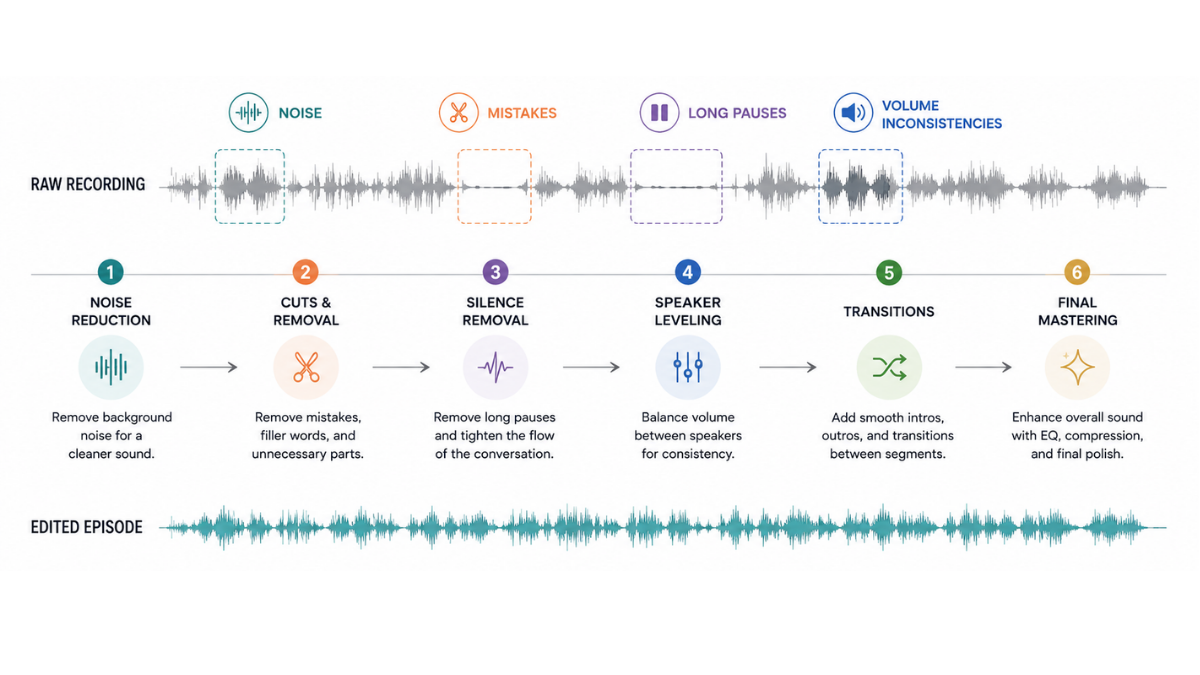
I separate this into two parts. Content editing looks at the conversation itself: repeated points, rambling sections, unclear transitions, false starts, and moments that do not support the episode’s purpose. Audio editing looks at how the episode sounds: volume, background noise, clarity, breaths, clicks, hum, and speaker balance. Both matter because a technically clean episode can still feel hard to follow, and a strong conversation can still feel unprofessional if the sound is distracting.
What Does a Podcast Editor Actually Do?
Remove unnecessary sections without changing the meaning of the conversation.
Cut obvious mistakes, false starts, and distracting pauses.
Reduce background noise where the source audio allows it.
Balance speaker volume so one voice does not overpower another.
Improve voice clarity and smooth transitions between sections.
Add or refine intros and outros when that is part of the editing scope.
Prepare the final audio file so it is ready for the next publishing step.
The important part is judgment. A podcast editor is not just deleting every imperfection. I’m listening for what helps the episode feel focused, clear, and human.
Why Does Podcast Editing Matter Even When the Recording Quality Is Good?
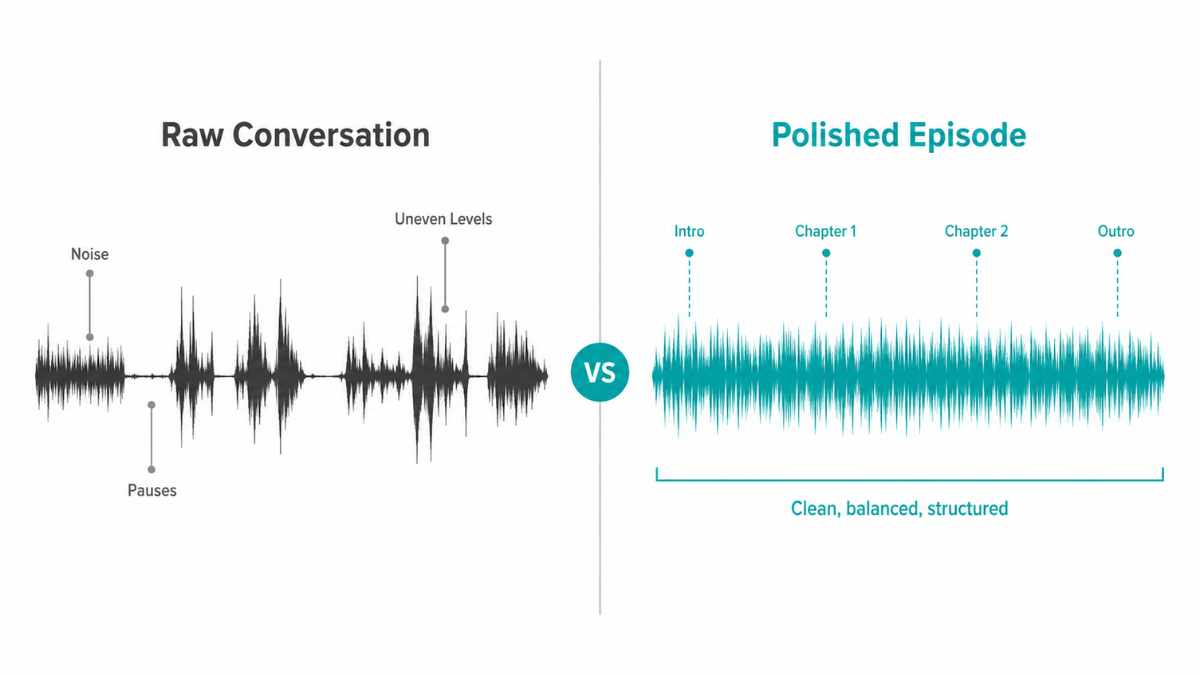
A good recording means the source audio is usable. It does not mean the episode is finished. Even strong recordings can include repeated explanations, awkward pauses, crosstalk, uneven speaker levels, long tangents, distracting breaths, or transitions that feel abrupt. These are not always recording problems. They are listening experience problems.
When I edit, I am not trying to make the host sound perfect. I am trying to help the episode sound intentional. A listener should not have to work hard to follow the point. They should not need to keep adjusting the volume between speakers. They should not get pulled out of the conversation because a pause runs too long or a tangent drifts away from the topic.
That is why professional podcast editing matters for business podcasts. The recording captures the conversation. The edit shapes the experience.
How Does Podcast Editing Improve the Listener Experience?
How Does Editing Improve Clarity?
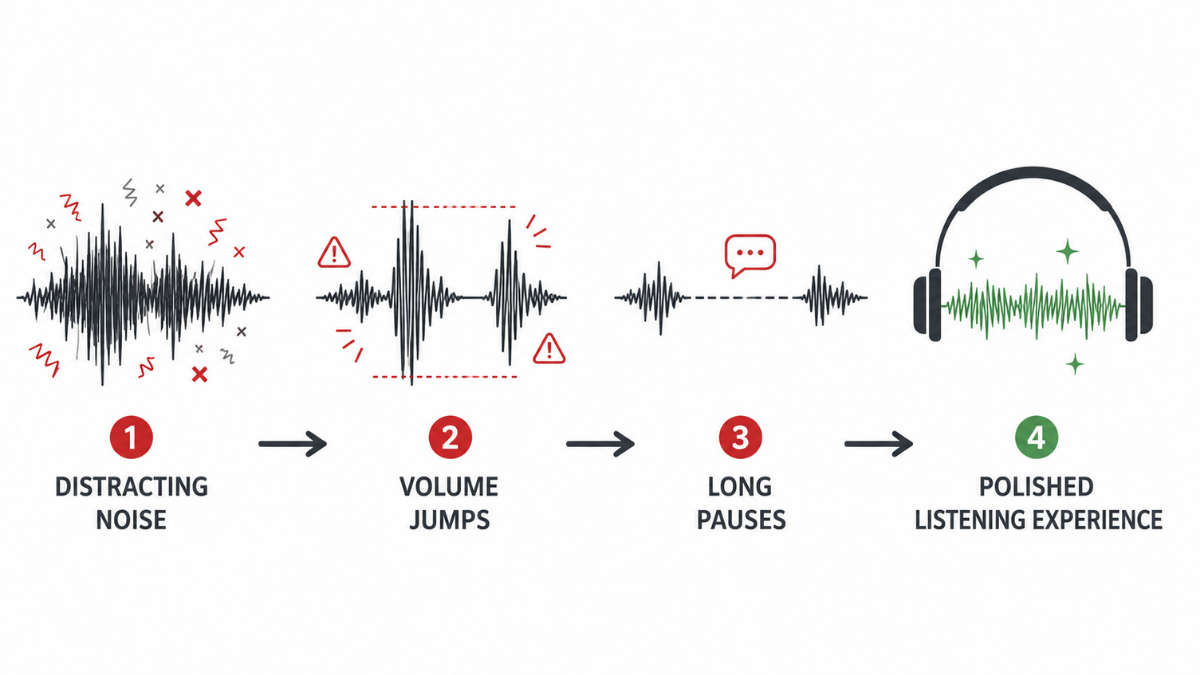
Clarity starts with intelligibility. If one speaker is too quiet, another is too loud, or background noise keeps fighting the voice, the listener has to spend energy just understanding the episode. Editing helps reduce that friction. I listen for uneven volume, harsh sounds, muddy speech, background hum, clicks, and moments where the voice needs more presence.
How Does Editing Improve Pacing?
Pacing is one of the biggest reasons editing matters more than people expect. A recording can be technically clean but still feel slow. I look for dead air, long pauses that do not add meaning, repeated explanations, and sections where the conversation takes too long to reach the point. The goal is not to make the episode feel rushed. It is to help the conversation move with purpose.
How Does Editing Keep Listeners Focused?
A listener can forgive a small audio flaw more easily than an episode that loses direction. Editing helps keep the conversation centered. When a guest repeats a point three different ways, I keep the strongest version. When a transition feels sudden, I smooth it. When a tangent weakens the episode, I tighten it so the listener stays connected to the main idea.
Can Professional Podcast Editing Make a Podcast Sound More Credible?
Yes. For a business podcast, editing affects more than sound. It affects how the audience experiences the brand. A podcast may be full of strong ideas, but if the audio is uneven, the pacing feels rough, or every episode sounds different, the overall impression can feel less professional than the message deserves.
In client feedback, one feeling that comes up often is relief. Clients appreciate having steady support for recurring creative and operational work, including podcast editing, video reels, research, and admin support, because they no longer have to chase every moving part themselves. That same consistency matters in podcast editing. When the editing process is steady, the host can focus on the conversation while the final episode still sounds polished and on brand.
Why Is Consistency Important for Branded Podcasts?
Consistency is what makes a podcast feel familiar from episode to episode. That includes consistent volume, voice treatment, intro and outro handling, pacing, music placement, and final audio quality. For a branded podcast, those details matter because the episode is not just content. It is another place where the audience experiences the company’s standards.
This is also why podcast content builds brand authority over time. Listeners return when the show feels useful, clear, and easy to listen to. Editing supports that trust by making each episode feel reliable.
What Can Podcast Editing Fix That Recording Alone Cannot?
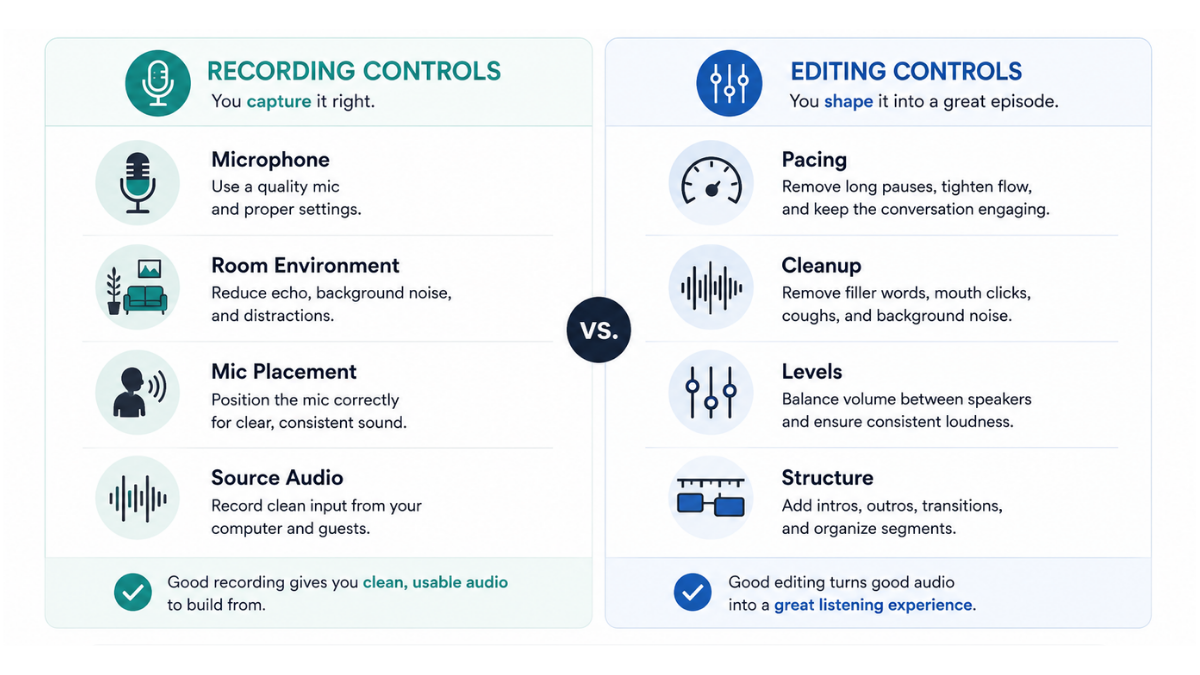
Recording and editing work together, but they are not the same job. Recording controls the quality of the raw capture. Editing controls how that raw capture is cleaned, shaped, and prepared for listeners.
| Recording Quality Controls | Podcast Editing Improves |
|---|---|
| Microphone placement | Voice balancing |
| Recording environment | Noise reduction |
| Source audio quality | Audio cleanup |
| Room acoustics | Pacing and flow |
| Input levels | Content trimming |
| Recording technique | Transitions |
| Speaker setup | Episode structure |
What Are the Essential Steps in Professional Podcast Editing?
Content and Conversation Editing
This is where I remove irrelevant sections, repeated points, false starts, and pauses that slow the episode down. I also make sure the episode still has enough context so the listener does not feel like pieces were cut out carelessly.
Noise Reduction and Audio Cleanup
This step focuses on background noise, hum, room tone, clicks, and other distractions. The goal is to reduce what pulls attention away from the voices while keeping the audio natural.
Voice Balancing and Leveling
Remote interviews often have speakers using different microphones, rooms, and recording levels. I balance the voices so the listener does not have to keep turning the volume up and down.
Voice Clarity and Audio Processing
EQ, compression, and speech enhancement can help voices sound clearer and more consistent. Used well, these tools make the episode easier to listen to. Used too aggressively, they can make speech sound unnatural.
Pacing and Flow
This is where the edit becomes more than cleanup. I tighten the conversation, smooth transitions, and keep the episode moving while preserving the host’s personality and the guest’s natural rhythm.
Final Mix and Mastering
Editing shapes the episode. Mixing balances the elements. Mastering prepares the final audio for consistent playback and distribution. I do not treat those steps as identical because each one solves a different problem.
How Should You Balance Professional Editing With an Authentic Podcast Voice?
Good editing should make the episode better without making the conversation sound fake. I do not believe every “um,” pause, or natural reaction has to disappear. Some small imperfections make a conversation feel real. The problem is not human speech. The problem is distraction.
Over-editing can remove personality. Under-editing can leave the episode feeling unfinished. The balance is knowing which moments support the conversation and which ones get in the listener’s way.
What Should a Podcast Editor Remove?
Distracting mistakes and false starts.
Long pauses that do not add meaning.
Repeated statements that slow the episode down.
Off-topic sections that weaken the main idea.
Technical problems that make the episode harder to hear.
What Should a Podcast Editor Leave In?
Natural conversational rhythm.
Meaningful reactions.
Personality and warmth.
Intentional pauses.
Speech patterns that feel authentic rather than distracting.
How Does Podcast Editing Differ Across Recording Scenarios?
Studio Podcast Recordings
Studio recordings usually start cleaner, so the edit often focuses more on pacing, structure, and final polish.
Remote Podcast Interviews
Remote interviews often need more volume balancing, noise control, and cleanup because speakers use different microphones, rooms, and internet setups.
On-Location or Event Recordings
On-location recordings usually involve room noise, ambience, audience sounds, or environmental distractions. Editing has to preserve the energy without letting the background take over.
Solo Podcasts
Solo episodes often need pacing support. I listen for repetition, dead air, vocal fatigue, and places where the host circles the same point too many times.
Branded and Business Podcasts
Business podcasts need repeatable standards. The edit should support the brand voice, keep the episode focused, and make each release feel consistent.
What Are the Most Common Podcast Editing Mistakes?
Publishing raw recordings without listening through the episode.
Removing every filler word until the conversation sounds unnatural.
Leaving long pauses, dead air, and repeated points.
Ignoring uneven speaker levels.
Leaving distracting background noise that could have been reduced.
Making abrupt cuts that call attention to the edit.
Skipping the final listening pass before publishing.
Treating every podcast as if it needs the exact same editing style.
Expecting editing to fully fix severely damaged source audio.
How Much Time Does Podcast Editing Take?
Podcast editing time depends on the episode. A short solo episode with clean audio may move quickly. A long remote interview with several speakers, background noise, repeated sections, and detailed content trimming can take much longer. That is why I avoid giving one universal editing time for every episode.
The main factors are episode length, number of speakers, recording quality, amount of content trimming, noise issues, revision needs, level of polish, and whether intro or outro work is included. The more consistent the recording and workflow are, the easier it is to keep editing time predictable. This is where podcast workflow support becomes useful because repeatable handoffs reduce confusion from episode to episode.
When Should a Business Outsource Podcast Editing?
A business should consider outsourcing podcast editing when the show starts taking more internal time than expected or when publishing becomes inconsistent because editing keeps getting pushed aside. I usually see this happen when the host is still excited about recording but dreads everything that comes after it.
Episodes are released inconsistently because editing takes too long.
The founder or host is editing recordings instead of preparing guests or leading the business.
Editing quality changes from episode to episode.
Remote interviews require more cleanup than the internal team can handle.
The team lacks audio editing experience.
Post-production has become a recurring marketing responsibility, not a one-off task.
The business wants the host to stay focused on content, ideas, guests, and promotion.
For some teams, outsourcing podcast management starts with editing because that is the part of the process that keeps delaying publication.
What Should Businesses Look for in Professional Podcast Editing Services?
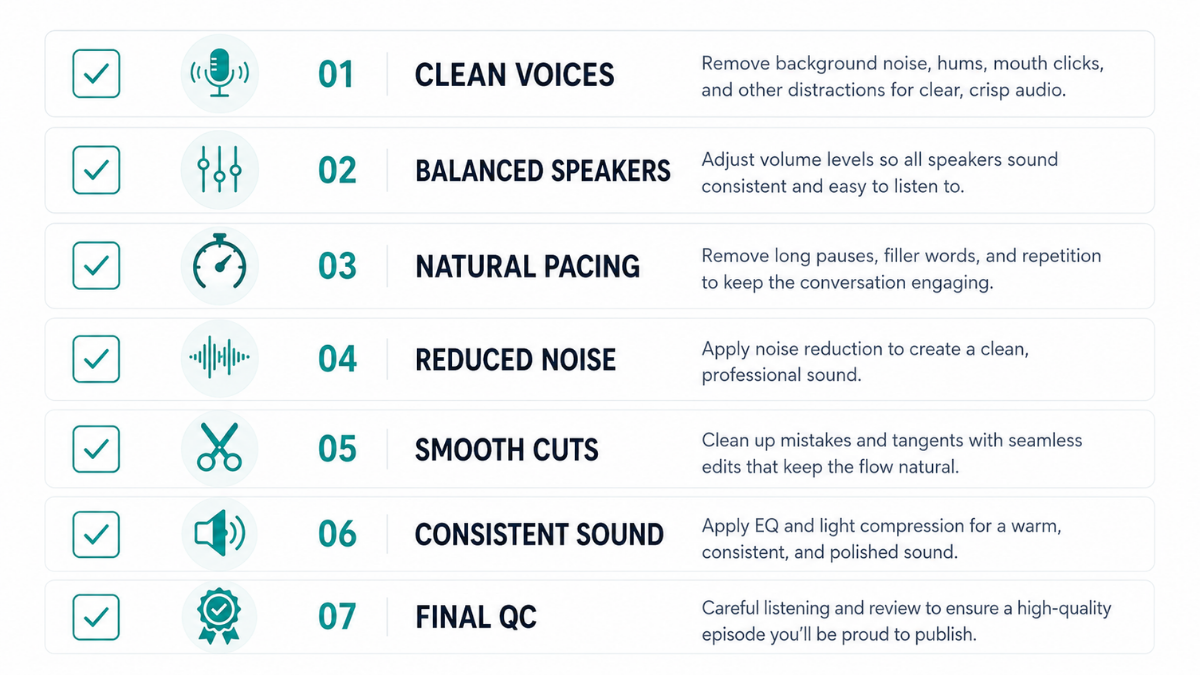
When I evaluate professional podcast editing services, I look beyond whether someone can cut audio. A good editing partner should understand spoken-word content, pacing, sound consistency, file handling, communication, and quality control.
Experience with interviews, solo episodes, and business podcasts.
A clear editing process from raw file submission to final delivery.
Consistent audio standards across episodes.
Noise reduction and voice cleanup without over-processing.
Speaker balancing and pacing support.
A final listening pass before delivery.
A clear revision process and realistic turnaround time.
Secure file handling and organized handoffs.
The ability to maintain a consistent style over time.
This is not the same as hiring a full studio to record the show for you. For many Smart VAs clients, the need is more focused: they already record the content and need a dedicated podcast editor to handle the recurring post-production work.
How Can Professional Podcast Editing Fit Into a Repeatable Content Workflow?
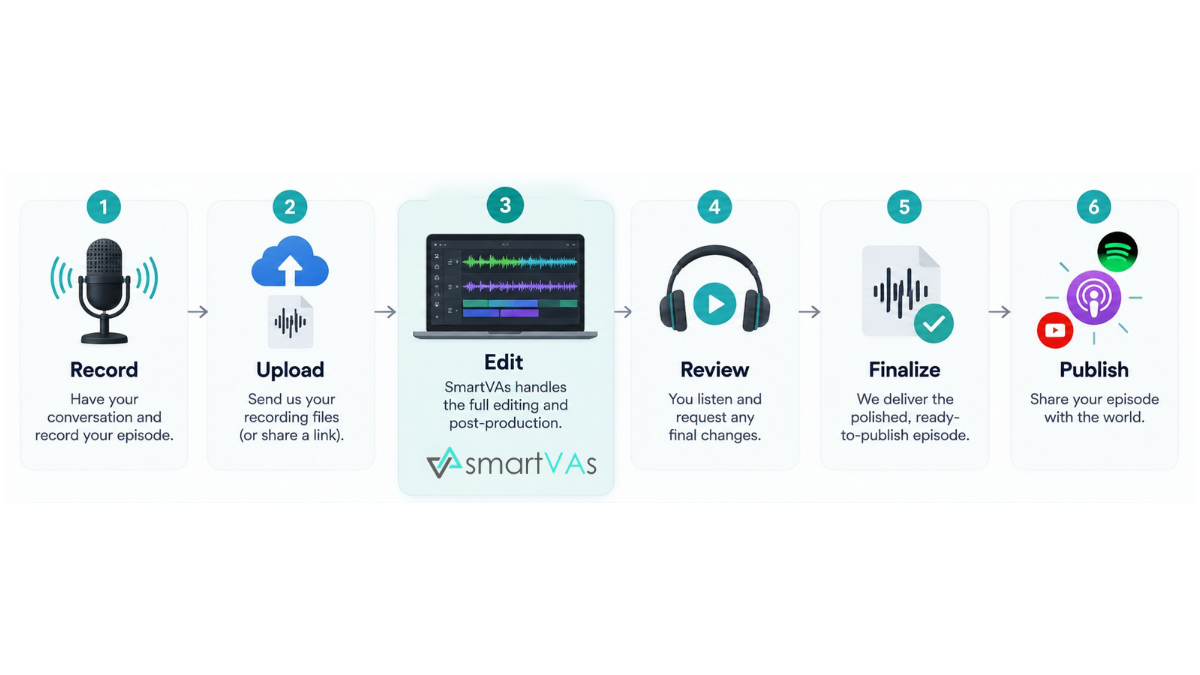
A strong workflow keeps podcast editing from becoming a weekly scramble. The simple version looks like this:
| Record | Submit Raw Audio |
Podcast Editing | Review | Final Audio | Publish |
When the post-production stage is handled consistently, the host and business team can stay focused on research, guest preparation, recording, thought leadership, promotion, and other business priorities. Editing becomes part of the system instead of the reason the podcast falls behind. A fully managed team of specialists can also support the surrounding pieces, such as clips, content repurposing, and publishing coordination when the scope requires it.
For shows that also use video, video editing support can help the same recorded conversation become social clips or website content without forcing the host to manage every asset manually.
Is Podcast Editing Worth It for a Business Podcast?
For a casual personal show, editing may be minimal. If the episode is short, informal, and the creator has time to edit comfortably, light cleanup may be enough. But business podcasts are different because the podcast reflects the company’s credibility. If the show is used for thought leadership, client education, expert interviews, sponsor relationships, or brand awareness, professional editing becomes much more valuable.
A good recording gives you the raw material. Editing determines how effectively that material reaches the listener. That is the central difference. Recording helps you capture the message. Editing helps the audience stay with it.
At Smart VAs, the fit is clearest when a business already records strong conversations but needs reliable post-production help to keep episodes clean, consistent, and ready to publish. The goal is not to take over the host’s voice. The goal is to protect it.
Smart Virtual Assistant
👍🤵
Smart Virtual Assistant 👍🤵
What if you could reclaim 40 hours this month?Why does call tracking matter for PPC lead generation?
Find out inside this free guide.
Frequently Asked Questions
-
Podcast editing is necessary when you want the episode to feel clear, focused, and easy to listen to. A raw recording may capture the full conversation, but editing removes distractions, balances sound, tightens pacing, and helps the final episode feel intentional instead of unfinished.
-
Podcast editing can improve many issues, including background noise, uneven volume, harsh sounds, and distracting pauses. It cannot fully repair every problem. Clipped audio, severe distortion, extreme echo, or very poor source files may still remain noticeable after cleanup.
-
A professional podcast editor cleans and shapes the recording. This can include content trimming, mistake removal, noise reduction, voice balancing, pacing improvements, transition smoothing, intro and outro placement, final mixing, and preparing the finished file for publishing.
-
Editing time depends on episode length, number of speakers, recording quality, cleanup needs, content trimming, and revision requirements. A clean solo episode may take less time than a long remote interview with uneven volume, background noise, and heavy restructuring needs.
-
Podcast editing focuses on shaping and cleaning the recorded episode. Podcast production can include a wider process, such as planning, recording, guest coordination, publishing, show notes, promotion, and analytics. Smart VAs is best positioned for editing and post-production support.
-
Editing shapes the episode by removing distractions and improving flow. Mixing balances voices, music, and audio elements. Mastering prepares the final file for consistent playback and distribution. They work together, but they are not the same step.
-
No. Removing every filler word can make a conversation sound stiff or unnatural. I usually remove filler words when they distract from the message, slow the episode down, or create confusion. Natural speech patterns should stay when they support authenticity.
-
Podcast editing cost varies by episode length, number of speakers, audio condition, editing depth, turnaround time, and included services. A light cleanup costs less than detailed content editing, heavy noise reduction, speaker balancing, and multiple revision rounds.
-
Outsource podcast editing when post-production is delaying releases, taking too much internal time, or creating inconsistent quality. It is especially useful for business podcasts where the host should focus on ideas, guests, recording, and promotion instead of weekly editing tasks.
About the Author:
Jong, Podcast Editor, SmartVAs

Jong is a Podcast Manager and Administrative VA at Smart VAs who supports Smart VAs clients with day-to-day operations and podcast production. He specializes in managing administrative tasks, coordinating podcast needs, testing and implementing automation, and preparing detailed reports to keep client operations running smoothly.
With a strong focus on organization and process improvement, Jong creates and maintains SOPs for recurring tasks while ensuring podcast production and administrative workflows are handled efficiently. He helps clients stay organized, streamline their operations, and manage their podcast needs effectively.