
LinkedIn Marketing Tactics to Grow Your Business and Generate B2B Leads
Key Takeaways
LinkedIn works best as a connected system. Content, targeting, outreach, advertising, follow-up, and measurement should support the same audience and offer.
Precision matters more than raw connection volume. A smaller group of relevant decision-makers is more useful than a large list of people who are unlikely to buy.
Lead Gen Forms can reduce friction, but the ad, offer, form, and follow-up still need to match. LinkedIn currently recommends starting with three to four form fields.
Retargeting can reconnect with people who already interacted with your website, Page, ads, video, documents, events, or Lead Gen Forms, depending on the audience type.
Organic content supports lead generation by helping prospects understand your expertise before a sales conversation starts.
Likes and impressions are useful context, but qualified conversations, discovery calls, opportunities, and pipeline are stronger business indicators.
ARE YOU STILL TRYING TO DO IT ALL?
Discover the SMART way to delegate without losing control—and finally free up your time.
You post on LinkedIn a couple of times a week. A few people react. Some profile views come in. Maybe a new connection sends a polite message. Then the week ends and none of it seems connected to an actual sales conversation.
I see this a lot when I support LinkedIn work for growing businesses. The problem is usually not that LinkedIn is useless. The problem is that the activity is random. A post goes out without a clear audience. Connections are made without a follow-up process. Ads run separately from organic content. Engagement is measured, but nobody checks whether it creates qualified conversations.
That is why I treat LinkedIn marketing tactics as parts of one system. Audience targeting, content, prospecting, paid campaigns, retargeting, social selling, follow-up, and measurement should reinforce each other. For a small business or lean marketing team, the goal is not to copy an enterprise playbook. It is to build a process you can actually keep running.
What Makes LinkedIn Different From Other B2B Marketing Channels?
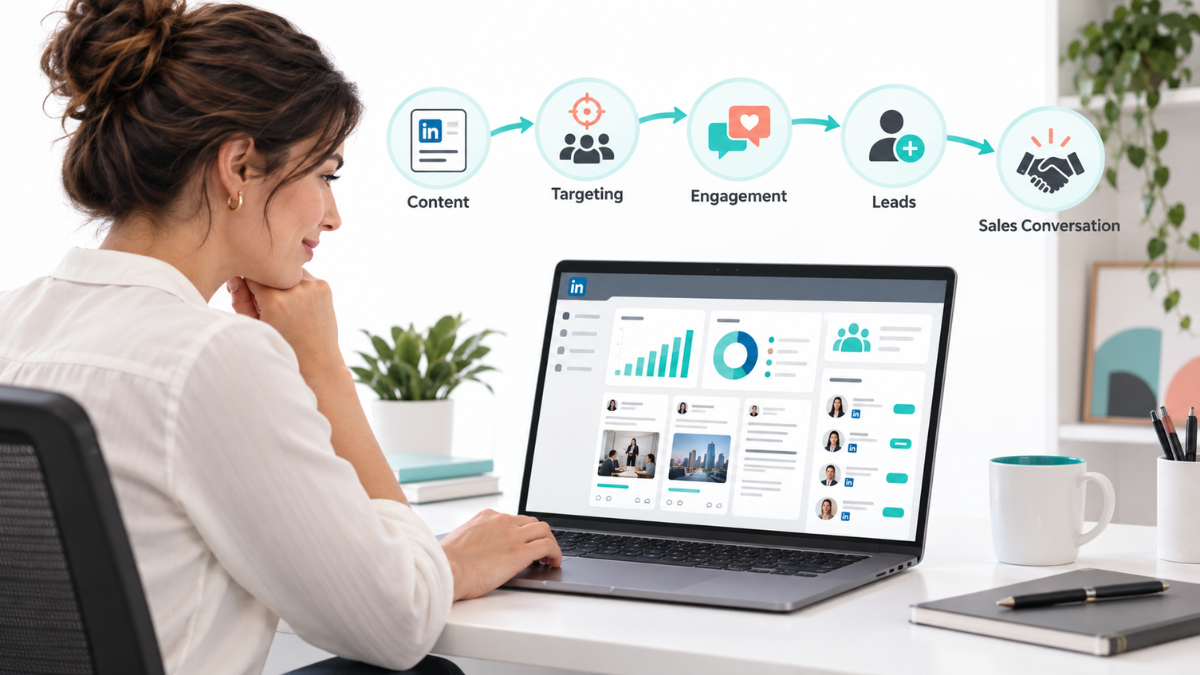
LinkedIn gives businesses something that is especially useful in B2B marketing: professional context. Instead of targeting only by broad interests, you can often narrow your audience using work-related details such as job title, seniority, industry, company, and location.
That does not mean every LinkedIn user is a good prospect. It means the platform gives you more ways to define who you are trying to reach. When I plan LinkedIn marketing for a small business, I would rather have a clear list of the right 100 prospects than a vague audience of 10,000 people who happen to work in the same general industry.
This is also why follower count should not be treated as the main measure of success. A smaller network of relevant decision-makers, peers, referral partners, and potential buyers can be much more useful than a large audience with no connection to the offer.
How Do You Identify and Reach the Right Decision-Makers?

Start With Your Ideal Customer Profile
Before I search for anyone on LinkedIn, I want the business to be clear on who it actually wants to reach. A practical ideal customer profile can include:
Industry
Company size
Job function
Seniority
Location
The business problem your offer solves
The business problem matters because a job title alone does not create intent. Two marketing directors at similar companies can have completely different priorities. Your content and outreach need to connect to a problem that is real for the person you are contacting.
Use LinkedIn Search to Narrow Prospects
Native LinkedIn search can be enough for basic research. I usually start by combining job title, industry, company, seniority, and location, then review profiles manually rather than treating every result as a lead.
Use Boolean Search Where It Helps
Simple Boolean operators such as AND, OR, NOT, and quotation marks can make searches cleaner when titles vary. The point is not to build a complicated search string. It is to reduce obvious mismatches so the team spends more time reviewing people who actually fit.
Precision matters more than connection volume. Connecting with 1,000 random people can create activity. It does not automatically create a useful pipeline.
Can LinkedIn Ads and Lead Gen Forms Generate Qualified Leads?

They can contribute to lead generation, but I would not treat the ad format as the strategy. The campaign still needs the right audience, offer, message, form, and follow-up process.
Choose the Ad Format Based on the Message
Single-image ads: Useful when one clear message, offer, or proof point needs to be understood quickly.
Carousel ads: Useful when the message needs a short sequence, several benefits, or multiple examples.
Video ads: Useful when demonstration, personality, explanation, or visual proof matters.
Document ads: Useful for guides, frameworks, checklists, reports, or educational assets people can preview on LinkedIn.
Conversation formats: Useful only when the targeting, message, permissions, and experience make sense. They should not become a shortcut for mass unsolicited outreach.
Reduce Friction With Lead Gen Forms
LinkedIn Lead Gen Forms can collect information through forms that are pre-filled with member data. That can reduce manual typing and keep the conversion step inside the LinkedIn ad experience.
LinkedIn currently recommends starting with three to four fields and keeping the ad message consistent with the form. I use that as a practical reminder: ask only for information the sales process actually needs at that stage. LinkedIn Lead Gen Form best practices explain the current platform guidance in more detail.
Make the Ad, Offer, and Form Match
If the ad promises a checklist, the form should clearly say the person is requesting that checklist. If the ad invites someone to a consultation, the confirmation step should explain what happens next. A mismatch creates confusion even when the creative looks polished.
Follow Up With Context
The lead is not finished when the form is submitted. Decide who receives it, how quickly it is reviewed, what qualifies the person for the next step, and what message they receive. Good lead generation still depends on a clear handoff to sales or the person responsible for follow-up.
How Does Retargeting Help Re-Engage Prospects?
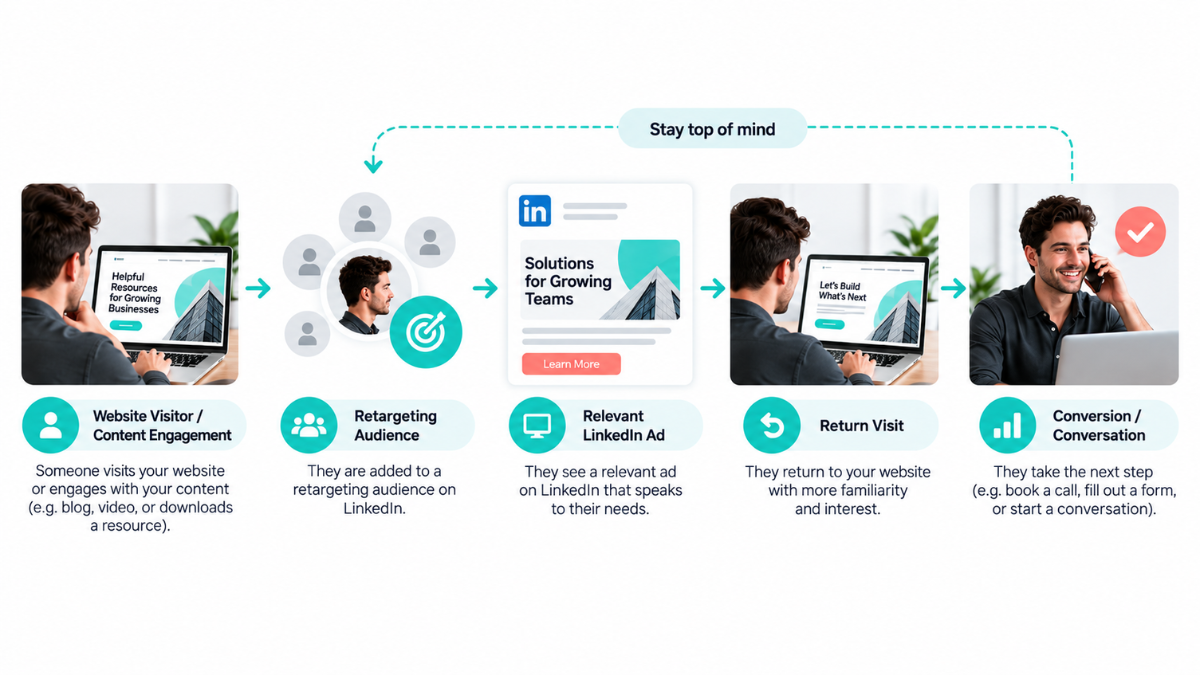
Not everyone who sees a post, visits a page, or opens a form is ready to talk. Retargeting gives the business another chance to show something relevant to people who have already interacted with the brand.
LinkedIn's current Matched Audiences documentation describes retargeting options for website visitors, Page engagement, ad engagement, video viewers, document engagement, Lead Gen Form activity, events, and other supported audience sources, subject to platform requirements and member preferences.
I would not send every engaged person the same message. Someone who only watched part of a video may need more education. Someone who opened a Lead Gen Form but did not submit may need a clearer offer. Someone who visited a service page may be ready for stronger proof or a direct next step. The audience action should influence the retargeting message.
How Can Brand Awareness Support Lead Generation?
Lead generation does not begin only when someone fills out a form. In many B2B situations, a prospect sees the company, the founder, or the team several times before starting a conversation. Consistent visibility helps the business become more familiar before buying intent is obvious.
I use educational posts, useful industry observations, client stories, case studies, leadership perspectives, and behind-the-scenes context to build that familiarity. The goal is not to post motivational filler every day. It is to give the right audience enough useful information to understand what the business knows, how it thinks, and what problems it solves.
This is where a broader approach to brand awareness through digital marketing can support LinkedIn instead of treating the platform as an isolated channel.
What Role Does Organic Content Play in LinkedIn Marketing?

Organic content gives prospects something to evaluate before a sales conversation starts. When someone receives a connection request, sees a comment, or hears your company name, they may look at the profile or Page before replying. A useful content history can answer questions that outreach alone cannot.
I prefer consistency over bursts of activity. Posting five times in one week and disappearing for a month makes it difficult to learn what the audience responds to. A realistic content calendar creates enough repetition to test themes, formats, hooks, calls to action, and audience response.
For the day-to-day execution side, our guide to social media management best practices covers the broader habits that help keep publishing organized across platforms.
It is also worth protecting brand consistency across every channel so a prospect does not see one voice on LinkedIn and a completely different business everywhere else.
How Can Your Whole Team Contribute to LinkedIn Lead Generation?
LinkedIn does not have to belong to one salesperson. A small team can contribute without turning everyone into a full-time content creator.
Team members can leave thoughtful comments, share relevant company content with their own perspective, participate in industry conversations, flag useful customer questions, and help leaders turn real work into content ideas. What I avoid is forcing employees to copy and paste the same corporate caption. That looks coordinated, but it rarely feels genuine.
For a small business, even a simple routine can help: one person owns the content calendar, subject-matter experts supply ideas or voice notes, leadership approves sensitive viewpoints, and the LinkedIn Specialist turns those inputs into organized drafts and publishing tasks.
Which LinkedIn Tools Actually Help a Growing Business?
| Tool | Purpose | When It Becomes Useful |
|---|---|---|
| LinkedIn Search | Basic prospect research | When the team needs simple manual research and a manageable prospect list. |
| Sales Navigator | More structured prospecting | When prospecting volume, filtering, account lists, and recurring research need more structure. |
| Campaign Manager | Advertising | When the business is ready to run paid LinkedIn campaigns with defined audiences, offers, tracking, and budget. |
| LinkedIn Analytics | Content and Page measurement | When the team needs to compare themes, formats, traffic, and audience response. |
| CRM / marketing automation | Lead management and nurture | When leads need ownership, qualification, follow-up steps, reminders, and reporting beyond LinkedIn. |
Tools do not fix an inconsistent process. I would establish the audience, messaging, content, targeting, follow-up, and measurement first. Then I would add more sophisticated tools where they reduce real friction.
How Do You Turn LinkedIn Engagement Into a Sales Conversation?

A useful LinkedIn journey can look like this: content engagement -> profile visit -> connection -> relevant conversation -> qualification -> discovery call. Not every prospect follows that exact path, but it shows why posting and outreach should not be managed as separate worlds.
Respond to relevant comments while the conversation is still useful.
Review the prospect before sending a message so the outreach has a reason to exist.
Personalize around a real business context, not a fake compliment.
Offer something useful before asking for a meeting when the relationship is still cold.
Move the conversation toward the business problem, not a long product pitch.
Take the conversation off LinkedIn when both sides are ready for a proper call or next step.
Consistency can be systemized. Relevance and personalization should not be. I would rather send fewer thoughtful messages than create a large automated sequence that damages trust.
Which Metrics Show Whether Your LinkedIn Efforts Are Actually Working?
Awareness Metrics
Reach, impressions, follower growth, and engagement help show whether more of the right audience is seeing and reacting to the content.
Traffic Metrics
Click-through rate and website visits show whether LinkedIn activity is creating enough interest for people to leave the platform and learn more.
Lead-Generation Metrics
Lead form completion, cost per lead, qualified leads, and lead source quality help evaluate paid and conversion-focused activity.
Business Metrics
Sales conversations, discovery calls, opportunities, and pipeline contribution show whether LinkedIn is creating business movement rather than only visible activity.
Likes and impressions are not useless, but they are not the finish line. A post can receive strong engagement and still produce no meaningful sales opportunity. I always want to connect platform metrics to what the business is actually trying to accomplish.
For a broader look at how social activity can support business outcomes, see how effective social media marketing is for businesses.
What Does Consistent LinkedIn Support Look Like in Practice?
One reason LinkedIn work becomes inconsistent is that the people with the strongest ideas are often the same people with the least time to organize them. Leaders are handling clients, sales, strategy, speaking, delivery, and team decisions. LinkedIn becomes another task that gets pushed to the bottom of the list.
Tabitha D. James is a useful Smart VAs example of that broader capacity problem. Her published case study describes how she was balancing consulting, speaking, community work, planning, and daily business responsibilities. With Smart VAs support, she delegated recurring work and gained more time for strategy, client impact, and growth opportunities.
That kind of support is exactly why operational capacity matters. When recurring work is delegated, leaders have more room to stay visible, share real expertise, and focus on the parts of marketing that need their voice. Tabitha's experience shows how creating that space can give a leader more time for strategy, client impact, and growth while a support team handles recurring execution.
Turning LinkedIn Marketing Tactics Into a Consistent Lead Generation System
Prospecting without follow-up creates a list, not a pipeline. Ads without clear targeting spend budget without enough relevance. Content without consistency disappears between bursts of activity. Lead generation without qualification creates work for sales without necessarily creating good opportunities. Retargeting without segmentation repeats the same message to people at very different stages.
The tactics work best when they are executed as one connected process. The audience should influence the content. The content should support the outreach. Paid campaigns should use the same offer logic. Follow-up should know where the lead came from. Reporting should connect platform activity to qualified conversations.
A growing business may already know what it wants to do on LinkedIn but lack the time to keep every part moving. A LinkedIn Specialist can support approved content planning, company-page or executive content preparation, publishing, routine engagement, newsletters, and reporting within an agreed scope. When broader cross-platform execution is also needed, a separate Social Media Management Specialist can support the wider social media workflow.
At Smart VAs, the goal is not to promise followers, virality, leads, or revenue. It is to create reliable execution around the responsibilities the business has approved, with clear inputs, review, and accountability.
That same operational principle is why outsourcing social media without losing control depends on clear responsibilities and review rather than simply handing over account access.
Make LinkedIn a System, Not Another Tab to Check
The most useful LinkedIn marketing tactics are not shortcuts. They are practical pieces of a repeatable process: define the right audience, create useful content, prospect with relevance, use paid campaigns where they fit, retarget meaningful engagement, follow up clearly, and measure whether the activity contributes to real conversations.
For a small or growing business, consistency matters because every part of that system competes with other priorities. The answer is not always another full-time hire. Sometimes the better move is to keep strategy, expertise, and approvals inside the business while delegating the recurring execution to people who can keep the workflow moving.
That is how I would approach LinkedIn lead generation: not as a collection of hacks, but as a system the business can understand, maintain, and improve over time.
If you need a coordinated team to keep marketing execution moving while you focus on the business, explore Smart VAs' fully managed specialist team and book a discovery call when you are ready to define the right scope.
Smart Virtual Assistant
👍🤵
Smart Virtual Assistant 👍🤵
What if you could reclaim 40 hours this month?
Find out inside this free guide.
Frequently Asked Questions
-
There is no single tactic that works best for every business. I would combine clear audience targeting, useful content, a relevant offer, thoughtful outreach, and consistent follow-up. The right mix depends on the sales cycle, offer, audience, budget, and how much internal expertise the business can contribute.
-
LinkedIn ad costs vary by audience, competition, objective, targeting, creative, bid strategy, and campaign setup. I would not use one universal cost-per-lead benchmark. Start with a defined test budget, track qualified lead quality as well as cost, and compare results against the business value of the opportunity.
-
Not always. Native LinkedIn search can be enough for a small, focused prospecting list. Sales Navigator becomes more useful when the business needs deeper filters, saved accounts or leads, recurring research, and a more systematic prospecting workflow. The tool should solve a real process problem, not create another subscription.
-
There is no reliable universal number. Buying cycles vary by industry, offer, urgency, price, relationship, and decision process. I would focus on making each interaction relevant and tracking the actual path your own qualified leads take instead of forcing every prospect through an arbitrary number of touches.
-
Yes, if responsibilities are clear. One person can own the process, while leaders or subject-matter experts contribute ideas, comments, and approved viewpoints. Keep activity realistic, document who follows up, and avoid spammy automation. A small team can be effective when the workflow is consistent and personal.
About the Author:
Kimberly Fernandez, LinkedIn Specialist, SmartVAs

Kim is the LinkedIn Specialist at Smart VAs, where she manages everything related to LinkedIn strategy, outreach, engagement, content posting, and the LinkedIn newsletter. She helps brands build meaningful connections and grow their presence on the platform through consistent, strategic engagement.
