Should You Hire a Shopify Expert or Manage Your Store Yourself?
Key Takeaways
A simple Shopify store can be reasonable to manage yourself, especially when the catalog is small and you have time to learn the platform.
The real cost of DIY is not only money. It also includes owner time, repeated troubleshooting, delayed updates, and the risk of operational errors.
A Shopify Specialist is most useful when recurring product, order, inventory, content, and store-maintenance work is becoming a bottleneck.
A hybrid model often works well: the owner keeps strategy, pricing, brand direction, and account ownership while a specialist handles recurring execution.
Store access should be controlled carefully. Delegating Shopify work does not require giving up ownership of the store or every admin permission.

ARE YOU STILL TRYING TO DO IT ALL?
Discover the SMART way to delegate without losing control—and finally free up your time.
Shopify makes it possible to run a store without being a developer. That is one of the reasons so many business owners start by doing everything themselves. You add the products, update the collections, answer customer questions, check orders, install apps, and make changes whenever something needs attention.
At first, that can be completely manageable. The problem usually appears when the store grows but the way you manage it does not. The same tasks that once took an hour here and there start showing up every day, and suddenly store administration is competing with product decisions, marketing, partnerships, and everything else only the owner can do.
That is when the question changes from 'Can I do this myself?' to 'Is this still the best use of my time?' In my work as a Shopify Specialist, I look at that decision through three options: keep the work in-house, delegate recurring Shopify tasks, or use a hybrid approach that keeps the owner in control while someone else handles the day-to-day execution.
What Does a Shopify Expert Actually Help With?
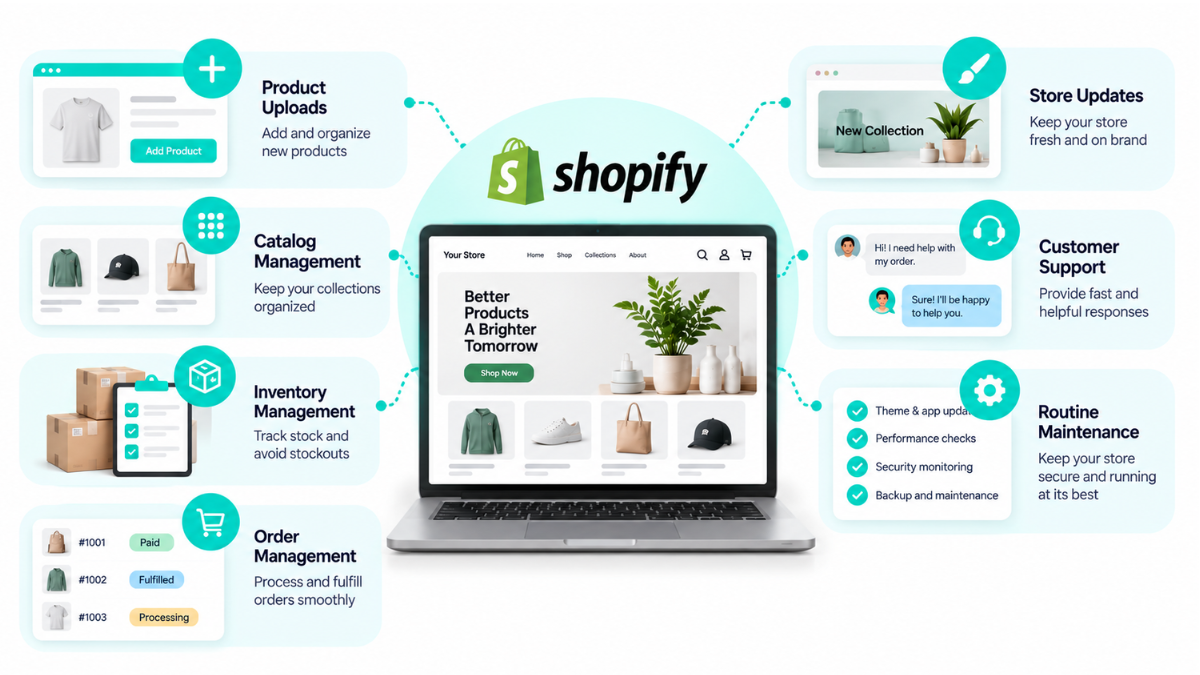
The phrase 'Shopify expert' can mean very different things. One person may focus on development and custom code. Another may specialize in store design. A Shopify Specialist or Shopify virtual assistant may focus more on the recurring operational work that keeps the store accurate, organized, and moving.
Store setup and configuration
For a straightforward store, this can include products, collections, navigation, basic settings, shipping information, and routine configuration. The important part is knowing where normal store administration ends and where deeper development work begins.
Product and catalog management
This is one of the most common workload areas I see. Products need titles, descriptions, images, variants, tags, collections, pricing updates, and organization. A store with a growing catalog can create a surprising amount of repetitive maintenance.
Day-to-day store management
Orders, customer details, inventory updates, content changes, and routine checks all take time. None of these tasks may feel difficult on their own, but the volume adds up quickly when they happen every day.
Store maintenance and support
A specialist can help monitor recurring store tasks, update content, research apps, document issues, and coordinate with a developer when a change requires deeper technical work. That is different from promising custom development as part of normal store management.
When Does Managing a Shopify Store Yourself Make Sense?
I do not think every Shopify store needs outside help. DIY can be the right choice when the store is still simple and the owner has enough time to learn how the platform works.
Your catalog is small and does not change often.
You are still testing the business or validating demand.
You have enough time to learn the platform without neglecting higher-value work.
Your store does not depend on complex integrations or custom functionality.
You are comfortable handling routine updates, orders, and customer questions yourself.
For a new store, doing the work yourself can also help you understand the operational details before you delegate them. The goal is not to outsource as early as possible. The goal is to notice when the store has become too operationally heavy for one person to keep managing well.
What Are the Hidden Costs of Managing Shopify Yourself?

DIY usually has the lower cash cost, but that does not mean it is free. The biggest cost is often the owner's attention.
Time cost
Product changes, order checks, inventory updates, customer messages, troubleshooting, and app research can turn into hours of fragmented work across the week.
Opportunity cost
Every hour spent fixing a routine store issue is an hour that cannot be spent on product strategy, partnerships, marketing, supplier relationships, or customer growth.
Error cost
A rushed product update, incorrect inventory adjustment, confusing collection setup, or poorly tested app can create extra work for the team and a worse experience for customers.
Scalability cost
As products, orders, and customer questions increase, the same DIY process has to absorb more volume. If the process depends entirely on the owner, the owner becomes the limit on how quickly the store can move.
Shopify's own inventory management documentation shows how much day-to-day control can sit inside the admin, from tracking stock levels to making adjustments and reviewing inventory history. Those tools are useful, but someone still has to keep the information current.
When Should You Consider Hiring a Shopify Expert or Specialist?
I would start thinking about support when Shopify work is no longer occasional. A store does not have to be technically complex to become operationally demanding.
Shopify tasks are taking time away from sales, product development, or business strategy.
Product and catalog updates keep piling up.
Orders, customer questions, or inventory changes are becoming harder to stay on top of.
You need someone who already understands the platform instead of learning every task from scratch.
Your store uses more apps, integrations, or workflows than you are comfortable managing alone.
You need ongoing support instead of a one-time setup project.
Delaying updates is starting to affect customers, campaigns, or internal operations.
Which Shopify Tasks Should You Keep In-House and Which Can You Delegate?

Delegation works best when the owner keeps the decisions that require business judgment and hands off the recurring execution that does not need to live with them.
| Task | Keep In-House | Delegate to Shopify Specialist |
|---|---|---|
| Basic product updates | Optional | Yes |
| Product uploads | Optional | Yes |
| Collection management | Optional | Yes |
| Inventory updates | Optional | Yes |
| Order administration | Optional | Yes |
| Routine store content updates | Optional | Yes |
| Customer support coordination | Optional | Yes |
| App research and routine management | Approve decision | Yes |
| Complex theme customization | Usually not | Website specialist/developer |
| Custom development | No | Developer |
| Product and pricing decisions | Yes | No |
| Brand direction and store strategy | Yes | No |
The owner should still control the store, the brand, pricing, high-level decisions, and who has access. A specialist can execute within those boundaries without becoming the owner of the business or the account.
How Does a Shopify Expert Compare With Doing Everything Yourself?

| Factor | DIY | Shopify Expert / Specialist |
|---|---|---|
| Upfront professional cost | Lower | Higher |
| Owner time | Higher | Lower for delegated tasks |
| Learning required | Higher | Lower |
| Routine workload | Owner-managed | Can be delegated |
| Technical complexity | Limited by owner skills | Depends on specialist scope |
| Scalability | Depends on owner capacity | Support can expand with workload |
| Control | Direct | Owner retains control; execution is shared |
| Ongoing support | Self-managed | Can be structured and recurring |
| Best fit | Simple or early-stage stores | Growing or time-constrained stores |
The important point is that neither side wins automatically. DIY gives you direct control and a lower professional-service cost. Specialist support gives you capacity and platform familiarity. The right choice depends on what the store needs now, not on what sounds more professional.
Is a Hybrid Shopify Management Approach Better for Some Businesses?
Often, yes. In practice, I like the hybrid model because it keeps business judgment with the owner while moving repetitive execution to someone who can handle it consistently.
The owner can keep product decisions, pricing, brand direction, supplier relationships, strategy, and final approvals. A Shopify Specialist can handle product uploads, catalog organization, recurring content changes, order-related administration, inventory updates, research, and routine store maintenance. When a task requires advanced code, a complex integration, or deeper theme work, that is the point to bring in the right technical specialist.
If store work starts moving into deeper design or platform customization, a Website Design Specialist can be a better fit for that part of the work than asking an operations-focused Shopify Specialist to act like a developer.
How Much Does It Cost to Hire a Shopify Expert Compared With Doing It Yourself?
There is no useful universal price for a 'Shopify expert' because the scope can mean anything from a few hours of store administration to a full development project. That is why I would compare the type of support before comparing rates.
DIY costs can include the Shopify subscription, domain, paid themes, apps, payment processing, marketing tools, and your own time. Outside support can be hourly, project-based, or ongoing, depending on whether you need setup, recurring store management, technical work, or a combination of services.
A better question than 'What is the cheapest option?' is 'What work am I paying for, and what does keeping that work with me prevent me from doing?' If the owner still has enough capacity, DIY may be the better financial choice. If routine store work is blocking higher-value work, the calculation changes.
What Should You Look for When Hiring a Shopify Expert?
I would look beyond the word 'expert' on a profile. The best fit depends on what you actually need them to own.
Relevant Shopify experience for the type of tasks you need.
A clear scope of work that separates store management from development.
Experience with catalogs, orders, apps, customer workflows, or store sizes similar to yours.
Defined responsibilities, approval points, and deliverables.
Clear communication and a practical reporting process.
Transparent pricing and boundaries around revisions or extra work.
A secure access process that does not require sharing the store owner password.
Documentation so recurring tasks are not dependent on one person remembering everything.
A clear handoff or offboarding process if the working relationship ends.
How Can You Avoid Losing Control of Your Shopify Store After Hiring Help?
This is one of the most important parts of delegation. Hiring help should reduce your workload without making you dependent on someone else's login, account, or memory.
Shopify's collaborator account guidance explains that store owners can control collaborator permissions and remove access from the Shopify admin. That is a much better model than handing over the store owner credentials.
Keep primary store ownership with the business.
Grant only the permissions needed for the work.
Keep domain, payment, and other critical account ownership with the business.
Document who is allowed to publish changes, install apps, or adjust settings.
Keep workflows and recurring procedures in shared documentation.
Review access when responsibilities change.
Plan for handoff before you need it.
What Are the Signs That Your Shopify Store Has Outgrown DIY Management?
A store has usually outgrown DIY before the owner admits it. The signs are operational, not dramatic.
Routine Shopify work is showing up on your to-do list every day.
Product, collection, or inventory updates are regularly delayed.
Customer questions and order follow-ups are becoming harder to manage.
Store maintenance keeps getting pushed behind more urgent work.
You repeatedly need help with tasks you have already tried to learn yourself.
Different team members are changing the store without a clear owner for the process.
You want to grow the catalog or order volume, but the current workflow already feels stretched.
You spend more time maintaining the store than improving the business behind it.
What Does Real Delegation Look Like When a Business Is Growing?
A useful example is Gabe Gibitz of Blue Guru Marketing. His Smart VAs support began with a smaller project-based arrangement and expanded into a much larger managed team handling technical project management, marketing execution, and operations as the business grew. The lesson for a Shopify owner is simple: once recurring execution becomes too wide for one person, the support structure has to grow with the workload.
That is the shift I watch for with store owners. You do not need to wait until the store is in chaos. If the owner is still approving the important decisions but no longer has to personally touch every routine update, the store can keep moving without every task becoming a leadership bottleneck.
So, Should You Hire a Shopify Expert or Manage Your Store Yourself?
There is no universal winner. I would base the decision on store complexity, recurring workload, available owner time, technical requirements, growth stage, and budget.
DIY is usually a good fit when:
The store is simple.
The catalog is small.
The owner has enough time.
The business is still being tested.
No complex functionality is required.
A Shopify Specialist becomes more useful when:
The store is growing.
Recurring tasks are consuming owner or team time.
Catalog, inventory, orders, or content are becoming harder to maintain.
Ongoing platform support is needed.
The owner needs to spend more time on higher-value business activities.
A hybrid approach is often the best fit when:
The owner wants to keep strategic control.
Some tasks can remain internal.
Recurring execution can be delegated.
Technical work can be routed to a specialist when needed.
How Can a Shopify Specialist Help With the Day-to-Day Work?
When I support Shopify work, I think in terms of recurring execution: what has to happen every week for the store to stay organized, accurate, and responsive? That can include product management, catalog updates, order-related administration, inventory changes, content updates, store research, and routine maintenance.
Customer questions can also become part of the store workload. When support volume grows beyond simple order administration, a dedicated Customer Service Specialist can help keep inquiries, order follow-up, and returns from competing with store-management work.
This is also where a fully managed team of specialists can be useful. The business does not have to make one person responsible for every technical, customer-service, design, and operational need. The recurring Shopify work can sit with the right specialist while adjacent work is routed to the right skill set.
You do not have to hand your entire store to an outside agency to get help. You can delegate the workload that keeps pulling you back into the admin while keeping ownership of the business, the store, and the decisions that shape it.
Related Guidance for Delegating Store and Website Work
If your Shopify needs are mainly visual or site-related, this guide on how to outsource website design to a virtual assistant explains how to define the work and hand it off more clearly.
For technical work, the article on how to hire an expert web developer virtual assistant can help separate normal store administration from deeper development needs.
If the bigger issue is simply that the business owner has become the default person for everything, why growing businesses rely on virtual assistant support goes deeper into the operational side of delegation.
And if you are still deciding what to delegate first, how to outsource a general virtual assistant gives a broader framework for defining tasks, access, expectations, and fit.
Smart Virtual Assistant
👍🤵
Smart Virtual Assistant 👍🤵
What if you could reclaim 40 hours this month?
Find out inside this free guide.
Frequently Asked Questions
-
It can be, especially when store complexity or recurring workload is taking time away from higher-value work. A specialist does not automatically create more sales, but the right support can reduce the amount of routine store administration the owner has to manage personally.
-
Yes. DIY can work well for a simple store with a small catalog, manageable order volume, and an owner who has time to learn the platform. Specialist support becomes more useful when recurring store work starts affecting consistency, speed, or the owner's ability to focus elsewhere.
-
It depends on the role. A Shopify Specialist may help with products, collections, inventory, orders, content, apps, and routine store management. A developer is more likely to handle advanced theme work, custom code, and complex integrations. The scope should be clear before work begins.
-
Pricing varies widely because 'Shopify expert' can describe one-time setup, ongoing store management, design work, development, or a combination of services. Compare providers based on the responsibilities and expected workload rather than relying on one generic market price.
-
No. A developer usually focuses more heavily on technical development, custom code, and advanced integrations. A Shopify Specialist can focus on broader store-management and operational tasks. Some providers can do both, but the titles should not be treated as interchangeable.
-
Yes. Many businesses start by managing the store themselves and add support as the workload grows. Keeping account ownership, documentation, organized product data, and clear workflows from the beginning makes the later handoff much easier.
-
A Shopify virtual assistant can manage many recurring operational tasks such as product uploads, catalog maintenance, inventory updates, order administration, research, and content changes. Advanced custom development or complex technical work should be assigned to the appropriate developer or technical specialist.
About the Author:
Adrian Dy, Shopify Expert, Learning and Development Lead, SEO Specialist, SmartVAs

Adrian is a Shopify Expert, SEO Specialist, and Learning & Development Lead at Smart VAs. Bridging technical execution and business growth, he helps founders optimize store operations, improve search visibility, and build efficient systems designed for sustainable growth.