How to Build a LinkedIn Content Strategy for B2B Businesses
Key Takeaways
A LinkedIn content strategy is not just a posting schedule. It connects audience, message, content format, and business goals.
For B2B brands, LinkedIn works best when company content and leadership voice support each other.
A strong content mix should educate, start conversations, and make the business easier to trust before asking for a call.
The most useful metrics are not only likes or views. Track profile visits, meaningful comments, clicks, direct conversations, and pipeline movement.
Consistency becomes easier when content planning, scheduling, engagement tracking, and reporting are handled through a clear workflow.

ARE YOU STILL TRYING TO DO IT ALL?
Discover the SMART way to delegate without losing control—and finally free up your time.
I usually know a B2B LinkedIn strategy is missing when a company is technically posting, but no one can explain what the content is supposed to do. A post goes up when there is time. A graphic is reused because it is already there. A founder shares something once, then disappears for weeks. The page looks active, but the activity is not creating clearer positioning, better conversations, or stronger trust.

As a LinkedIn Specialist, I look at LinkedIn content differently. I am not only asking, "What should we post this week?" I am asking who we need to reach, what they already believe, what they need to understand before they trust the business, and how each post can move the relationship forward. This guide breaks that process down into audience, content mix, formats, posting rhythm, and measurement so LinkedIn becomes a real business channel, not just another task on the marketing list.
What Is a LinkedIn Content Strategy and Why Does It Matter for B2B Businesses?
A LinkedIn content strategy is a deliberate plan for what you post, who you are speaking to, why the content matters, and what business outcome it should support. It is not the same as posting whenever someone remembers the company page exists.
For B2B businesses, LinkedIn matters because people are already there in a professional mindset. LinkedIn describes itself as a strong environment for B2B marketing because it supports brand awareness, thought leadership, lead generation, and relationship-building with professional audiences. That does not mean every post will turn into a lead. It means the platform gives you a place to build recognition with people who may influence, recommend, research, or approve a buying decision.
When I build a LinkedIn content strategy, I want each post to answer at least one of these questions: Does this help the right audience recognize the brand? Does it make the business easier to trust? Does it explain a problem the buyer is already feeling? Does it open the door to a useful conversation?
How Do You Define Your Ideal Customer Profile and Buyer Persona for LinkedIn?
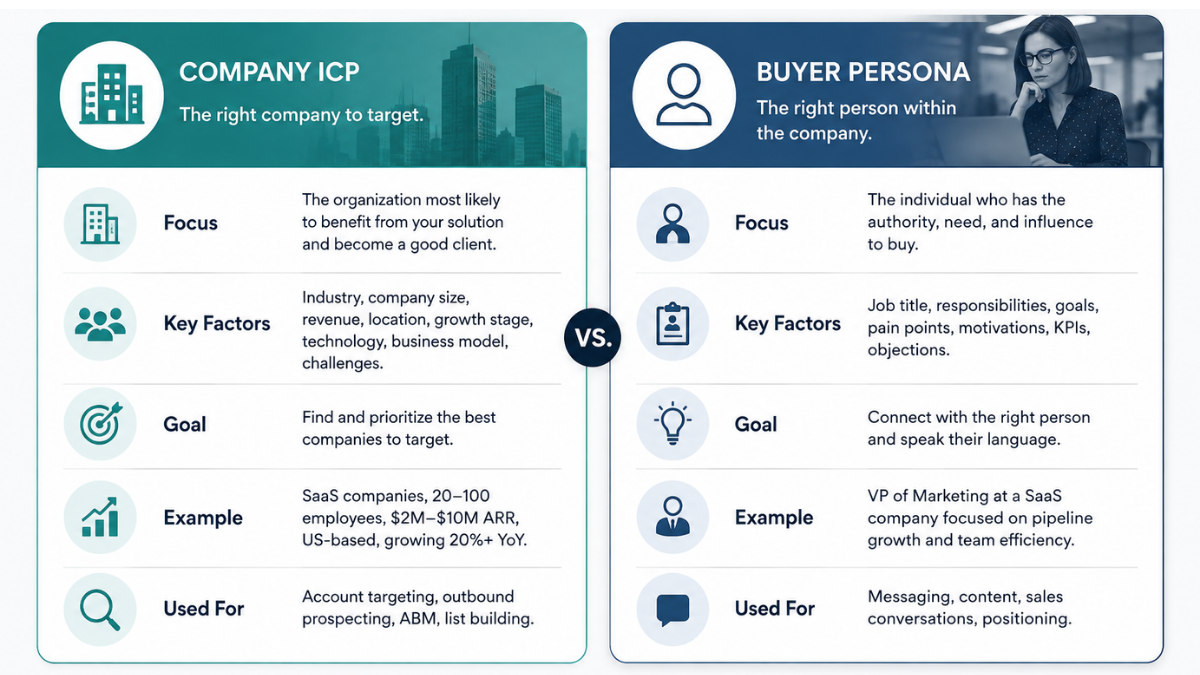
Before choosing post ideas, I always start with the audience. In B2B LinkedIn marketing, the ideal customer profile and buyer persona are related, but they are not the same thing.
The ideal customer profile describes the kind of company the business wants to attract. That might include industry, team size, revenue stage, location, service need, or growth situation. The buyer persona describes the person inside that company who feels the problem, researches solutions, influences the decision, or signs off on the investment.
For example, a company may want to reach growing service businesses with five to twenty team members. But the actual reader on LinkedIn may be the founder, marketing director, operations lead, or executive assistant helping research support options. Those people do not respond to the exact same message. The founder may care about growth and time. The marketing lead may care about execution. The operations lead may care about consistency and handoff.
That is why audience work matters. Without it, LinkedIn content becomes too broad. It sounds polished, but it does not make the right person feel seen.
What Goals Should a B2B LinkedIn Content Strategy Actually Target?
A B2B LinkedIn strategy should have a clear goal before content ideas are chosen. Otherwise, every metric starts to look equally important, and that is how teams end up chasing likes instead of business movement.
The most common goals I see are brand awareness, authority-building, relationship-building, lead pipeline support, recruitment visibility, and community engagement. Each one needs a slightly different content approach.
If the goal is brand awareness, the content needs to repeat the company message clearly and consistently. If the goal is authority, the content should explain how the team thinks, solves problems, and makes decisions. If the goal is lead pipeline, the content needs to create a natural path from post engagement to profile visit, message, website click, or discovery call.
This is also where a B2B LinkedIn strategy should connect to the buyer journey. Awareness content helps the audience name the problem. Consideration content helps them compare approaches. Decision-stage content helps them understand why the company is a credible option.
What Does a Strong LinkedIn Content Mix Look Like?
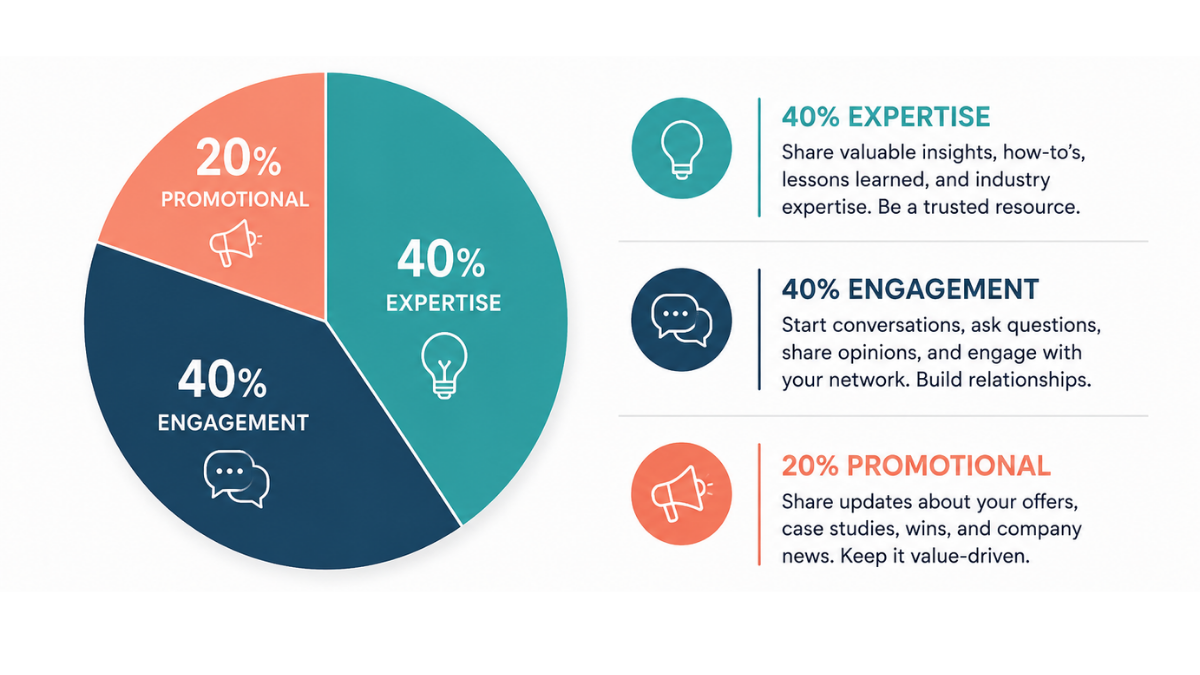
A strong LinkedIn content mix usually includes three types of posts: expertise content, engagement content, and promotional content. I like using a 40/40/20 balance as a starting point, then adjusting based on performance and business goals.
| Content Type | Suggested Share | Purpose | Examples |
|---|---|---|---|
| Expertise and value content | 40% | Build trust by teaching how the business thinks. | Lessons, frameworks, mistakes to avoid, practical tips. |
| Engagement and conversation content | 40% | Start useful conversations with the right audience. | Questions, opinions, short stories, industry observations. |
| Promotional content | 20% | Make the offer clear without turning the feed into a sales page. | Service posts, proof points, calls to book, lead magnets. |
The reason this works is simple. If every post is promotional, the audience learns to scroll past. If every post is educational with no offer, the audience may trust the brand but never understand how to take the next step. The content mix has to build trust and create a path.
For B2B businesses managing several channels at once, this is where clear planning supports stronger brand consistency. A LinkedIn content strategy should not feel disconnected from email, blogs, sales conversations, or the website. The same core message should support a multi-channel brand awareness strategy instead of showing up differently everywhere.
What Types of LinkedIn Content Perform Best for B2B Brands?
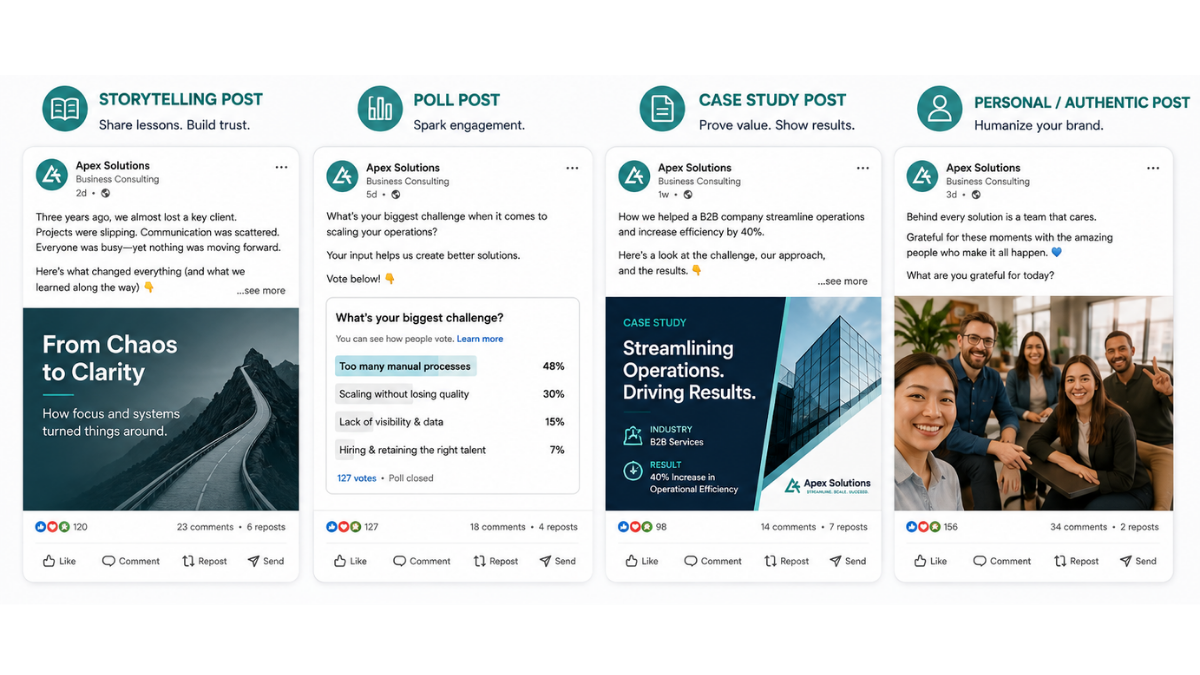
The best LinkedIn formats depend on the audience and the goal, but there are a few formats I use often because they help B2B brands explain value without sounding stiff.
Story-based posts that show a real problem, decision, lesson, or shift.
Thought-leadership posts that explain a clear point of view.
Case-study style posts that show the before, the change, and the outcome.
Educational posts that break down a process, mistake, or framework.
Founder or team posts that make the business feel more human.
Question posts that start relevant conversations with the right people.
A simple example structure I use for B2B service content is: start with the problem the buyer already feels, explain why it happens, share what usually fixes it, then connect that insight to the service without pushing too hard. For example, instead of posting "We offer LinkedIn management," I would frame the post around the problem: "Posting three times a week does not help much if every post is speaking to a different buyer." Then I would explain why audience clarity, message consistency, and review workflows matter.
That kind of post is more useful because it teaches and positions the business at the same time.
For smaller teams, the same idea applies beyond LinkedIn. A simple social media workflow for small businesses helps keep content practical instead of scattered across too many disconnected ideas.
How Often Should You Post, and What Formatting Actually Gets Read?
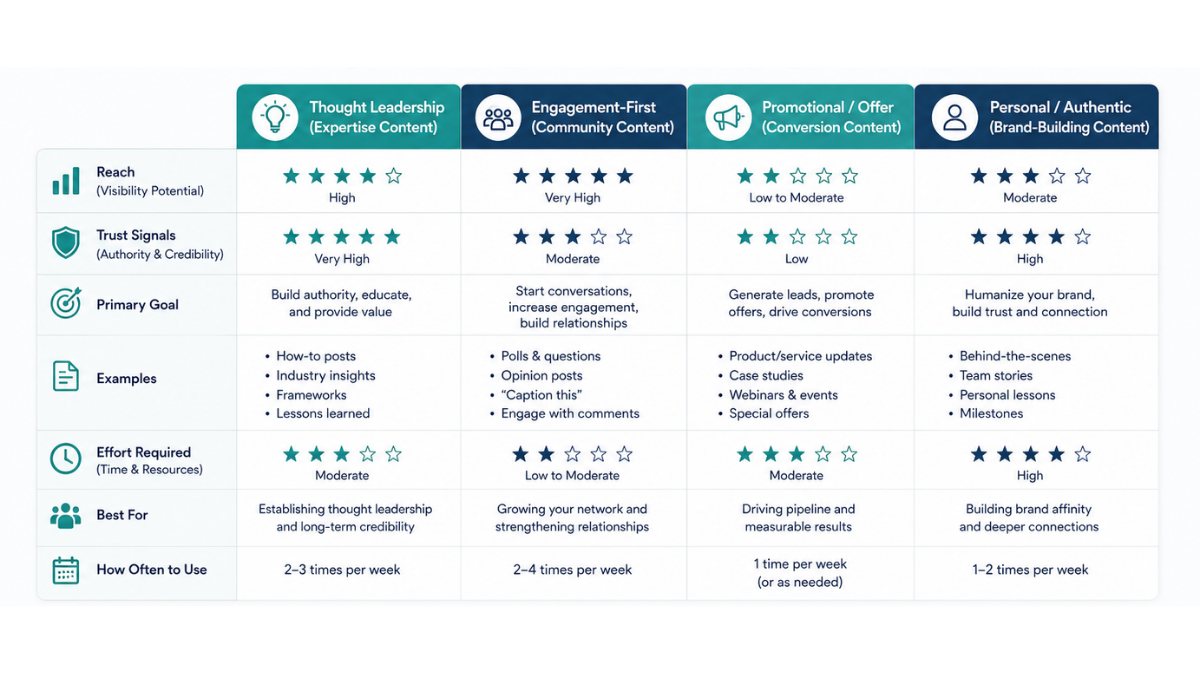
I do not like giving a rigid posting rule because the right cadence depends on capacity, audience, and content quality. A small B2B business posting two strong posts per week with a clear point of view is usually better than posting daily just to stay visible.
What matters most is a rhythm the team can actually maintain. This is also where social media management best practices matter: planning ahead, using repeatable content themes, and reviewing what the audience responds to instead of starting from zero every week.
Formatting matters too. LinkedIn is a scrolling platform, so dense paragraphs are easy to ignore. I usually keep hooks clear, paragraphs short, and the post focused on one main idea. A strong post does not need to explain everything. It needs to make one useful point well enough that the right person stops, reads, and remembers it.
Should You Post as a Company Page, a Personal Profile, or Both?
For most B2B businesses, I prefer using both the company page and selected personal profiles. They serve different roles.
The company page is the brand home. It keeps the business visible, supports credibility, gives prospects somewhere to check the company, and can carry service content, team updates, case examples, and thought leadership. LinkedIn Page best practices also point to using the Page for community-building, visitor insights, targeting organic posts, and tracking button clicks and visitor activity.
Personal profiles are where trust often feels more direct. A founder, executive, or specialist can explain the thinking behind the work in a way that feels less formal than a company post. For B2B, that matters because people often trust people before they trust a page.
The best setup is not either-or. The company page should stay consistent while personal profiles add perspective, stories, and expertise. That is also why LinkedIn content planning needs a workflow that protects the founder voice rather than replacing it.
How Do You Turn LinkedIn Content into Actual Leads, Not Just Engagement?
LinkedIn content turns into leads through a path, not a single post. The path usually looks like this: someone sees a post, recognizes a problem, visits the profile or company page, sees more useful content, engages with a comment, clicks to the website, sends a message, or books a call later.
That is why I never treat likes as the whole story. Likes can show visibility, but comments, profile views, website clicks, direct messages, and discovery-call conversations tell me more about whether the content is attracting the right people.
A strong LinkedIn marketing strategy also makes the next step easy. The profile should explain who the business helps. The company page should be updated. The website should match the message. The call to action should feel natural, not desperate.
At Smart VAs, this is where a coordinated workflow matters. A LinkedIn Specialist can help plan posts, prepare captions, schedule content, monitor routine engagement, and track what is creating conversations, while the business owner stays involved in the ideas and perspective that only they can provide.
Which Metrics Actually Prove a LinkedIn Content Strategy Is Working?
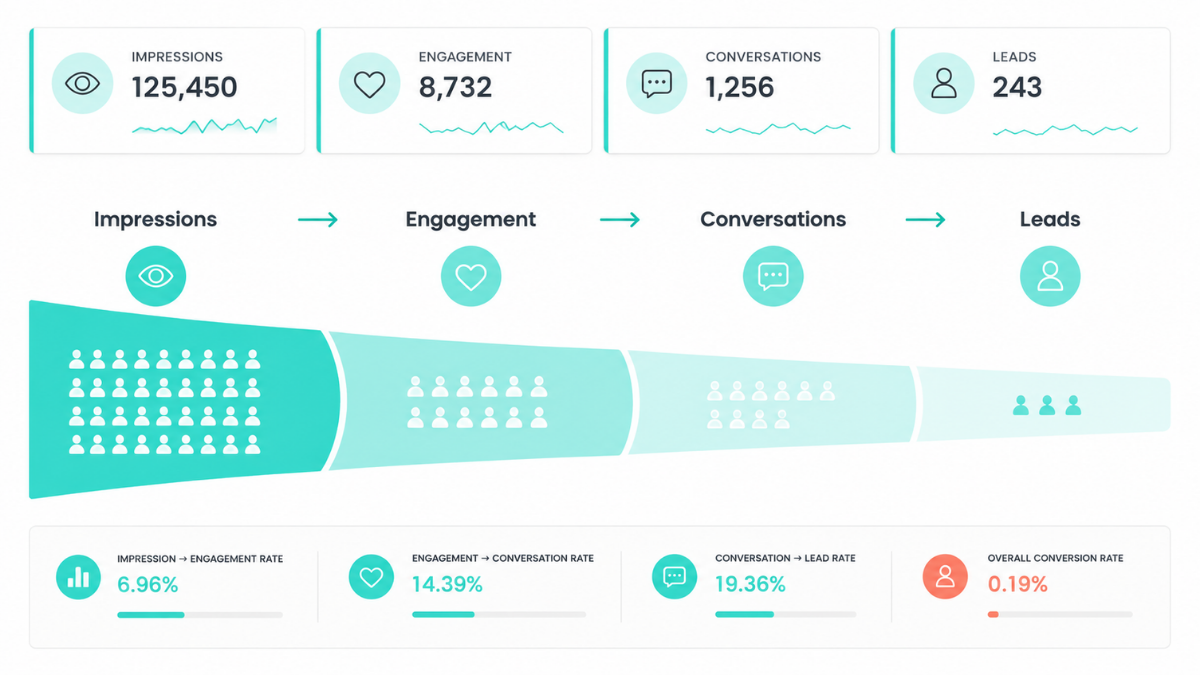
The right metrics depend on the goal, but I usually look beyond surface-level engagement. LinkedIn Page analytics can show content highlights, impressions, engagement rate, clicks, follower activity, and other admin-level performance indicators. Those are useful, but they need context.
| Metric | What It Tells You | How I Use It |
|---|---|---|
| Impressions | How many times content appeared in feeds. | Useful for visibility, but not enough by itself. |
| Engagement rate | How often people react, comment, share, or click compared with impressions. | Helps spot topics that connect with the audience. |
| Follower growth | Whether the page is attracting more of the right audience. | Best reviewed alongside audience quality. |
| Profile views | Whether content is making people curious enough to check the person behind it. | Important for founder or specialist-led content. |
| Clicks | Whether content is moving people toward the website or offer. | Useful for lead path and content-to-site behavior. |
| Conversations started | Whether content is creating useful business conversations. | Often the strongest signal for B2B content quality. |
A single sale usually cannot be traced honestly to one LinkedIn post. B2B buying is more layered than that. I would rather ask better questions: Are more of the right people noticing the business? Are decision-makers engaging? Are posts creating conversations? Are website visits or call bookings increasing after consistent content?
How Do You Keep This Consistent Without It Becoming a Full-Time Job?
This is the part where many B2B teams get stuck. The strategy makes sense, but the execution becomes too much. Someone has to turn ideas into posts, keep the content calendar moving, format the captions, prepare visuals, schedule content, check comments, track performance, and keep the message consistent.
That is where Smart VAs support can make the strategy easier to sustain. Businesses can use a fully managed team of specialists to support recurring marketing work without forcing the owner to personally manage every moving piece.
For LinkedIn specifically, a LinkedIn Specialist can support company-page content planning, post preparation, publishing, routine engagement support, and reporting. When the strategy includes broader channels, social media management support can help keep content calendars, visual consistency, platform scheduling, and engagement workflows moving together.
I see this in client feedback too. Business owners often talk about the relief of having steady support across social media, content, websites, technical tasks, and operations without chasing every moving part themselves. That same relief matters on LinkedIn because the strategy only compounds when the content is planned, prepared, reviewed, posted, and measured consistently.
Building a LinkedIn Presence That Actually Compounds
A strong B2B LinkedIn strategy is not built by posting random updates and hoping the right person notices. It is built by knowing who you want to reach, what you want to be known for, which content mix supports that goal, and how every post connects back to real conversations.
Strategy without execution stalls. Execution without strategy wastes effort. The best results come when both work together.
If LinkedIn is becoming one more marketing task your team knows matters but cannot keep up with, Smart VAs can help you build a more consistent workflow around planning, publishing, engagement, and reporting. Book a discovery call and let us look at where support would make the biggest difference.
Smart Virtual Assistant
👍🤵
Smart Virtual Assistant 👍🤵
What if you could reclaim 40 hours this month?Why does call tracking matter for PPC lead generation?
Find out inside this free guide.
Frequently Asked Questions
-
A B2B company should post as often as it can maintain quality and consistency. For many smaller teams, two to four strong posts per week is more realistic than daily posting. The better question is whether each post supports a clear audience, message, and business goal.
-
Most B2B businesses benefit from using both. The company page supports brand credibility and consistency, while personal profiles often create more direct trust and conversation. The best approach is to let the company page carry the brand and let founders or specialists add perspective.
-
A good starting mix is 40% expertise content, 40% engagement content, and 20% promotional content. That balance keeps the feed useful without hiding the offer completely. Over time, the mix should be adjusted based on audience response, conversations started, and business goals.
-
Do not measure only likes and views. Track profile views, company page visits, clicks, comments from relevant people, direct messages, referral traffic, discovery calls, and CRM notes. LinkedIn leads often happen through a sequence of small touches rather than one obvious conversion moment.
-
Yes, but LinkedIn content should usually be part of a larger relationship-building system. A small B2B business can generate leads when the content is specific, consistent, and connected to a clear next step. Content works best when profiles, pages, website messaging, and follow-up are aligned.
About the Author:
Ferjo, LinkedIn Specialist, SmartVAs

Ferjo is a LinkedIn Specialist at Smart VAs who works with Smart VAs clients to strengthen their LinkedIn presence and support their marketing and lead-generation efforts. He specializes in LinkedIn management, email copywriting, and creating and optimizing LinkedIn outreach and email marketing campaigns.
He has experience managing LinkedIn accounts and email campaigns across platforms such as Sales Navigator, Expandi, and Instantly. With a focus on personalized outreach and high-quality copy, Ferjo helps clients generate qualified leads, support prospecting efforts, and improve overall marketing performance.