How to Build Brand Awareness with Multi-Channel Marketing
Key Takeaways
Brand awareness is not just visibility. It is recognition, recall, and trust built through repeated, consistent touchpoints.
A multi-channel strategy works best when every channel carries the same core message, even when the format changes.
Growing businesses should usually focus on 3 to 4 strong channels before trying to show up everywhere.
Social media, content, email, SEO, and paid campaigns can support each other when the message and measurement are aligned.
The biggest challenge is not choosing channels. It is executing consistently without overloading the owner or internal team.

ARE YOU STILL TRYING TO DO IT ALL?
Discover the SMART way to delegate without losing control—and finally free up your time.
If your business is posting online, sending emails, and updating the website but still does not feel known, the problem is usually not effort. It is consistency. Brand awareness strategies work when the same audience sees a clear, memorable message across the right channels often enough to recognize and trust it.
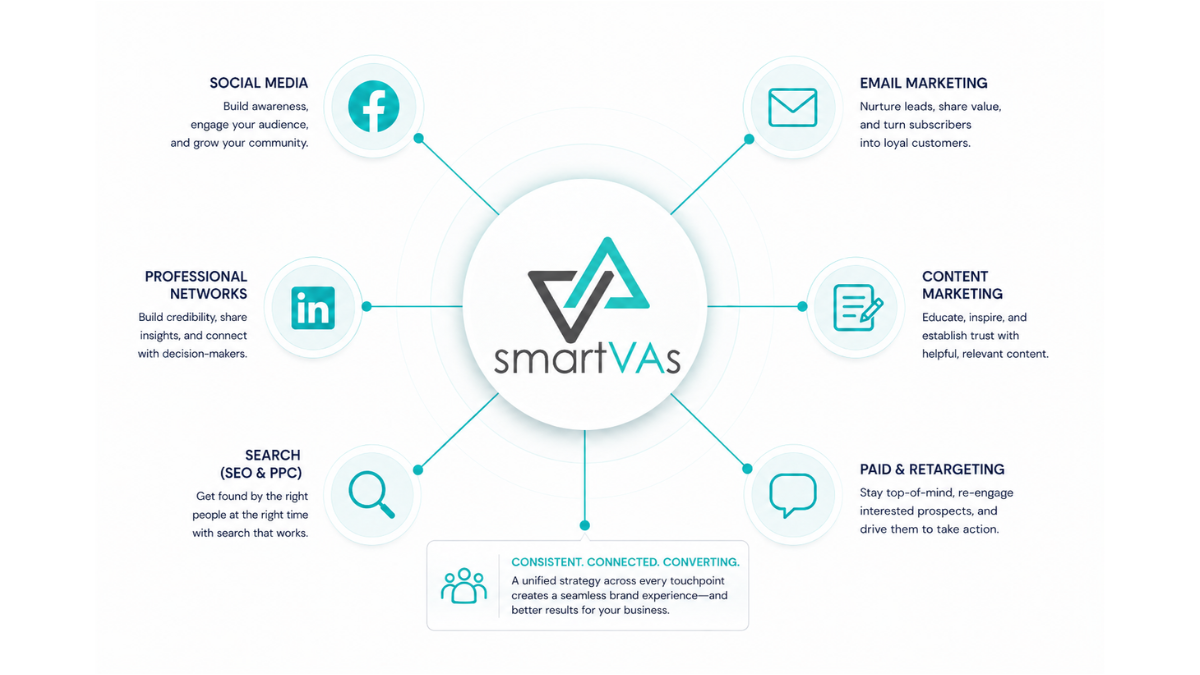
I see this often with growing businesses. They are active, but their marketing feels scattered. One week the focus is social media. The next week it is email. Then the website sits untouched, or the blog becomes quiet. The business is visible in pieces, but the brand does not feel connected.
In this guide, I’ll walk through how I think about brand awareness, how multi-channel marketing works, how to choose the right channels, and how to keep everything consistent without burning out your team.
What Is Brand Awareness and Why Does It Matter for Growing Businesses?
Brand awareness is how easily people recognize, remember, and understand your business before they are ready to buy. For growing businesses, it matters because trust often starts long before a sales call, website visit, or proposal request.
I do not look at brand awareness as “getting seen once.” I look at it as building memory. When someone keeps seeing your message in the right places, your business becomes familiar before they need you.
That matters because most buyers do not make a decision the first time they see a company. They notice, compare, leave, return, ask questions, and look for proof. Brand awareness helps your business stay part of that process.
Founder Perspective
At Smart VAs, I think of brand awareness as the trust layer before conversion. A good lead generation system is important, but people are more likely to respond when they already recognize your name, your message, and the kind of problem you solve.
What Is a Multi-Channel Marketing Strategy and How Is It Different from Omnichannel?
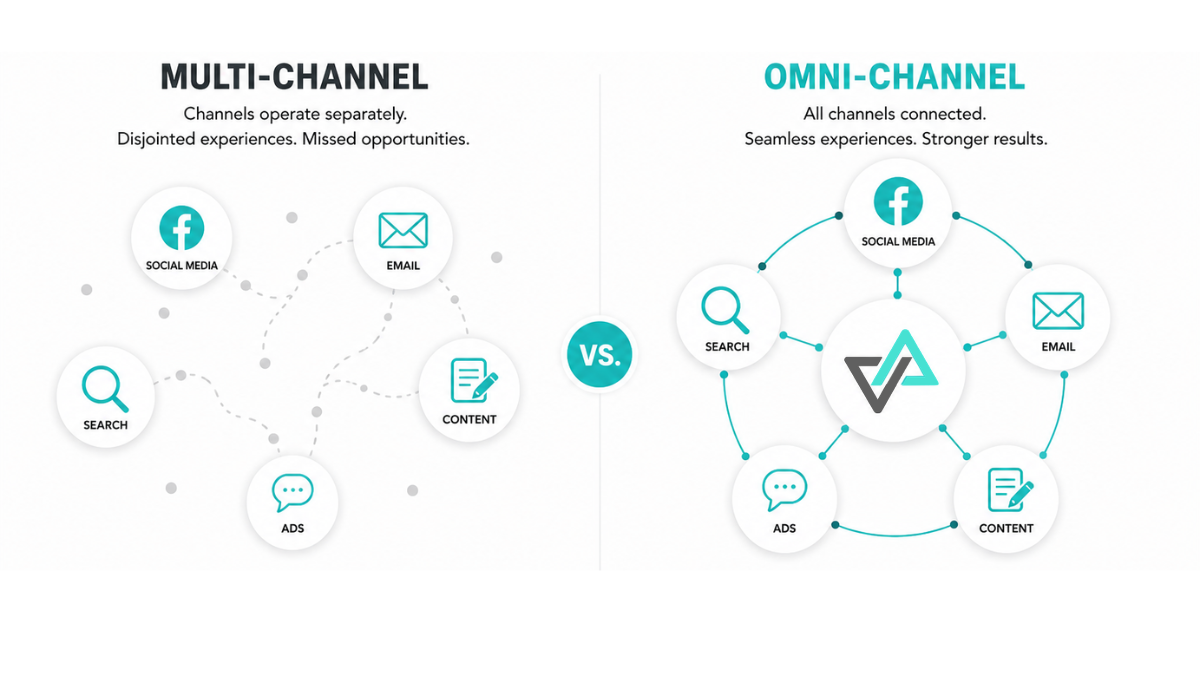
A multi-channel marketing strategy means using several channels to reach your audience, such as social media, email, SEO, paid ads, and blog content. Omnichannel marketing goes further by connecting those channels into one unified customer experience.
For most growing businesses, I recommend starting with multi-channel before trying to build a full omnichannel system. Multi-channel gives you focus. Omnichannel requires deeper systems, data, tools, and operational maturity.
Salesforce explains the difference clearly: multi-channel uses multiple channels, while omnichannel connects them into a single customer view and experience. For a growing business, the practical first step is usually to choose the right channels, align the message, and execute consistently before building advanced integrations.
Inside Smart VAs, this is why I care so much about coordination. If one person handles social, another handles blog uploads, and another helps with design, the work still needs one shared message. Otherwise, every channel starts sounding like a different company.
How Do You Define Your Target Audience Before Choosing Channels?
You define your target audience by identifying who you want to reach, what they are trying to solve, where they spend time, and what kind of message will feel relevant to them. Channel selection without audience clarity usually wastes time and budget.
Before I think about platforms, I ask a simpler question: who are we trying to become familiar to? A business owner, a marketing manager, a healthcare clinic, a real estate team, and a digital agency may all need support, but they do not always spend time in the same places.
| Audience Question | Why It Matters |
|---|---|
| Who are we trying to reach? | This keeps the campaign from becoming too broad or generic. |
| What problem are they already aware of? | This helps decide whether the message should educate, reassure, or invite action. |
| Where do they look for answers? | This guides the channel mix, such as search, LinkedIn, email, or local listings. |
| What proof do they need before trusting us? | This shapes content, case examples, reviews, and service explanations. |
At Smart VAs, we usually make this practical. We do not need a 40-page audience document to start. We need clear enough direction so the content, visuals, captions, emails, and landing pages all speak to the same person.
How Do You Craft a Brand Message That Stays Consistent Across Every Channel?
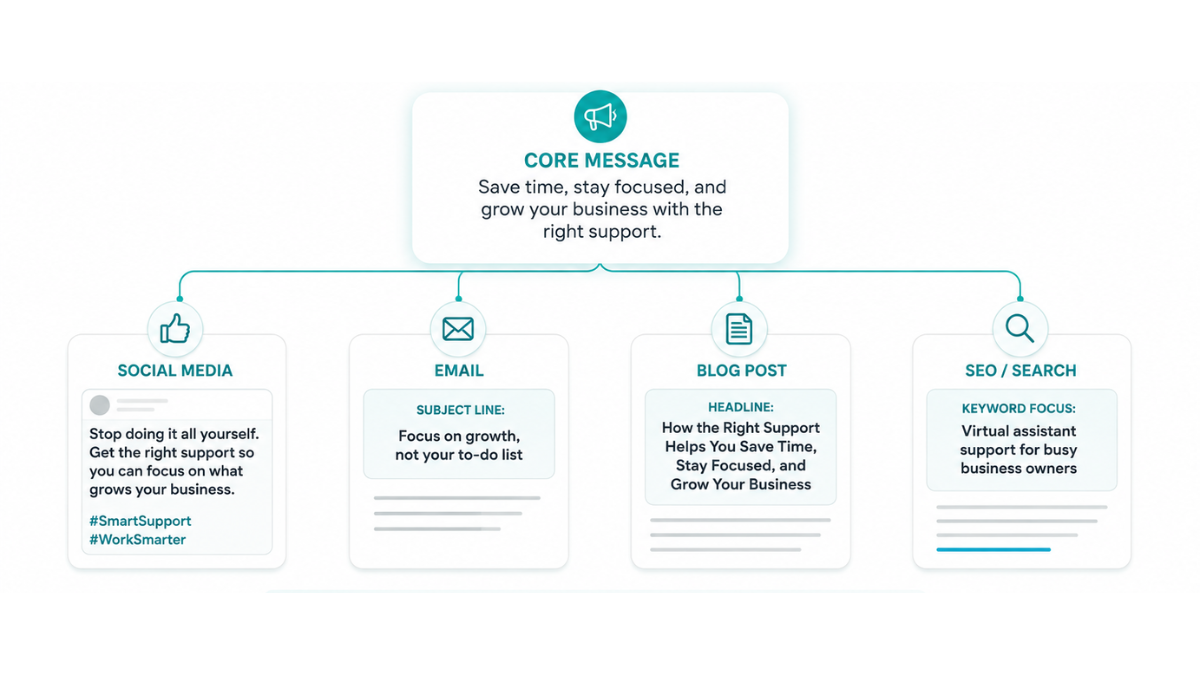
A consistent brand message starts with one clear promise, then adapts that promise to each channel without changing its meaning. Your website, email, social posts, ads, and blog content should feel like different conversations from the same business.
This is where many teams struggle. They think consistency means posting the exact same words everywhere. That is not the goal. LinkedIn may sound more thoughtful. Instagram may be more visual. Email may feel more personal. But the core message should still match.
For Smart VAs, that message often comes back to giving business owners access to a managed remote team of specialists so they can stop carrying every operational and marketing task alone. That idea can show up as a founder post, a blog intro, a website section, a client email, or a paid ad, but the meaning stays consistent.
The more consistent your message becomes, the easier it is for people to understand what you do and remember why it matters.
Which Marketing Channels Should You Combine for Maximum Brand Awareness?
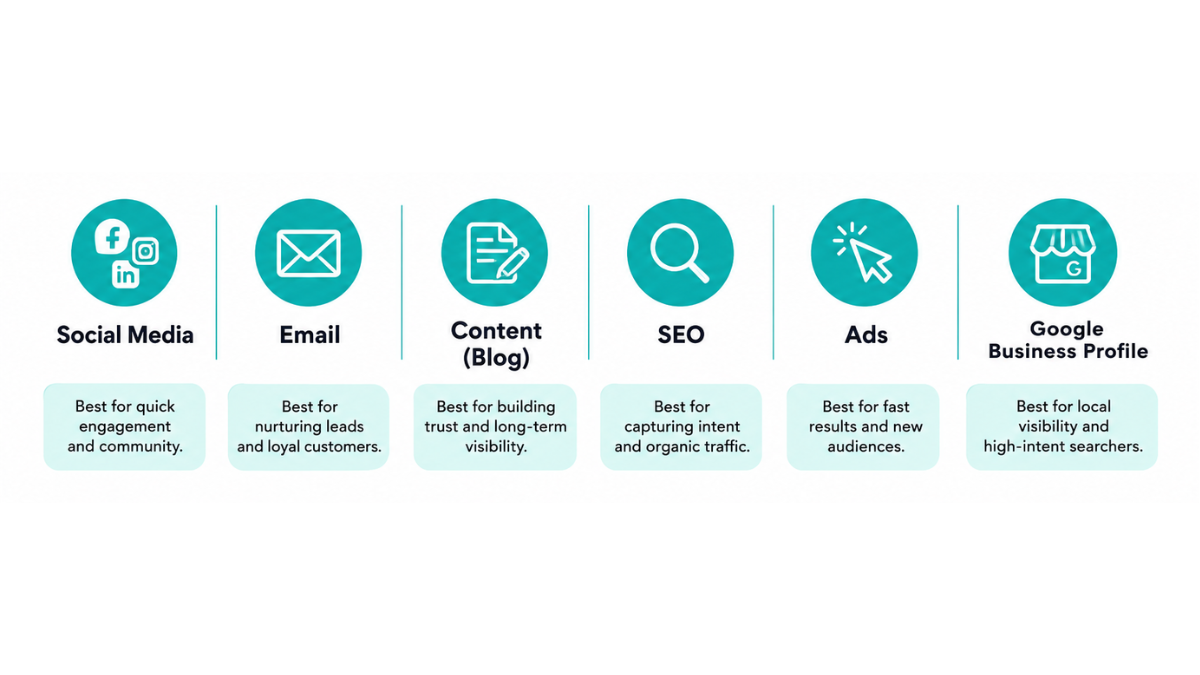
The best channels for brand awareness are the ones your audience already uses and your team can manage consistently. Most growing businesses do not need to be everywhere. They need 3 to 4 strong channels that work together.
A practical mix usually includes one discovery channel, one trust-building channel, one nurture channel, and one conversion channel. The exact mix depends on your audience and offer.
| Channel | Best Role in Brand Awareness | Smart VAs Execution View |
|---|---|---|
| Social Media | Keeps the brand visible and familiar through recurring content. | Use it for consistency, community, short-form education, and personality. |
| Blog Content | Builds search visibility and authority around problems your audience is researching. | Use it to answer real questions and support SEO. |
| Creates repeat exposure with people who already raised their hand. | Use it to nurture trust without depending on algorithms. | |
| SEO | Helps people find your business when they search for solutions. | Use it to make content and service pages easier to discover. |
| Paid Ads | Adds controlled visibility for campaigns, offers, launches, or retargeting. | Use it when the offer, landing page, and tracking are ready. |
| Local Search | Supports discovery for businesses with location-based demand. | Use it when reviews, services, and business profile details matter. |
When we support multi-channel execution, it often connects several specialties. A content plan may need professional blog writers, search visibility may need professional SEO experts, and campaigns may need a Google Ads Specialist when paid visibility becomes part of the mix.
How Do You Run a Social Media Campaign That Builds Brand Awareness?
A social media campaign builds brand awareness when it repeats a clear message through consistent posts, visuals, captions, engagement, and short-form content. The goal is not only reach. The goal is to make the right people recognize the brand faster.
Social media is often the easiest place to become visible, but it is also one of the easiest places to become inconsistent. That happens when posts are created randomly, visuals change every week, or the brand voice depends on whoever had time to write the caption.
This is why I like building social campaigns around themes. A theme gives the team a clear lane: pain point posts, proof posts, educational posts, founder perspective, behind-the-scenes moments, and simple calls to action. Our social media management specialist support is built around that kind of consistency, not just posting for the sake of posting.
A good awareness campaign should make someone say, “I keep seeing this company talk about the exact problem I have.” That is when visibility begins turning into recognition.
Can Content and Email Work Together to Reinforce Brand Recognition?
Content and email work well together because content helps people discover your thinking, while email keeps that thinking in front of people who already showed interest. Together, they create repeated exposure without relying on one platform.
A blog post should not live once and disappear. One article can become an email topic, several social posts, a short video script, a sales enablement asset, and a resource link for follow-up conversations.
This is where brand awareness through digital marketing becomes more practical. Instead of constantly inventing new ideas, the team can repurpose one strong message across channels.
At Smart VAs, I see this as a workflow problem as much as a marketing problem. A founder may have the ideas, but the business still needs someone to format the blog, schedule the email, coordinate the graphic, and adapt the message for different platforms.
What Are the Challenges of Managing a Multi-Channel Brand Awareness Strategy?
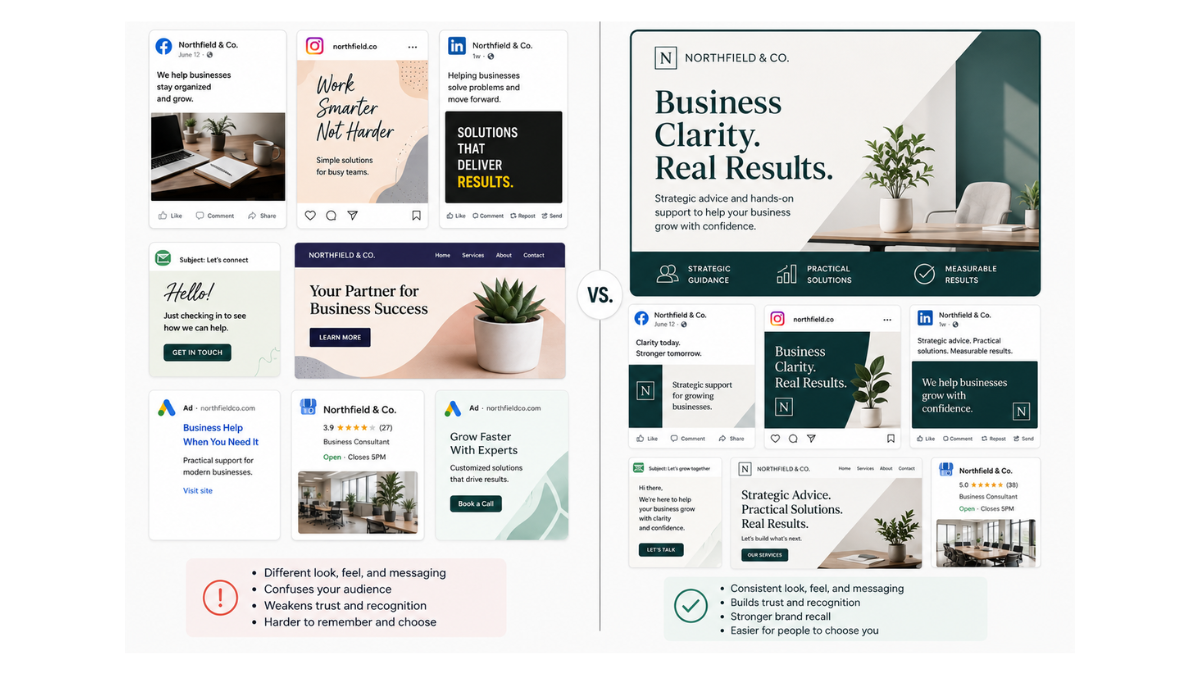
The biggest challenge of multi-channel marketing is not knowing what to do. It is keeping every channel consistent, active, and aligned without overloading the founder or internal team. More channels can create more confusion if no one owns the system.
I have seen businesses add channels too quickly because they feel pressure to be everywhere. Then the blog gets delayed, social posts become rushed, email becomes inconsistent, and no one checks whether the message still matches the offer.
That is why a marketing team without full-time hires can make sense for growing businesses. You may not need five employees. You may need the right specialists coordinated around one plan.
| Challenge | What It Looks Like | What Helps |
|---|---|---|
| Too Many Channels | The business is active everywhere but consistent nowhere. | Choose fewer channels and execute them well. |
| Message Drift | Each platform sounds like a different company. | Create one core message and adapt the format only. |
| Asset Overload | Every channel needs graphics, captions, emails, and links. | Batch content and repurpose from strong core pieces. |
| No Clear Owner | Tasks sit between marketing, admin, and leadership. | Assign ownership for calendar, approvals, publishing, and reporting. |
How Do You Measure Whether Your Brand Awareness Strategy Is Actually Working?
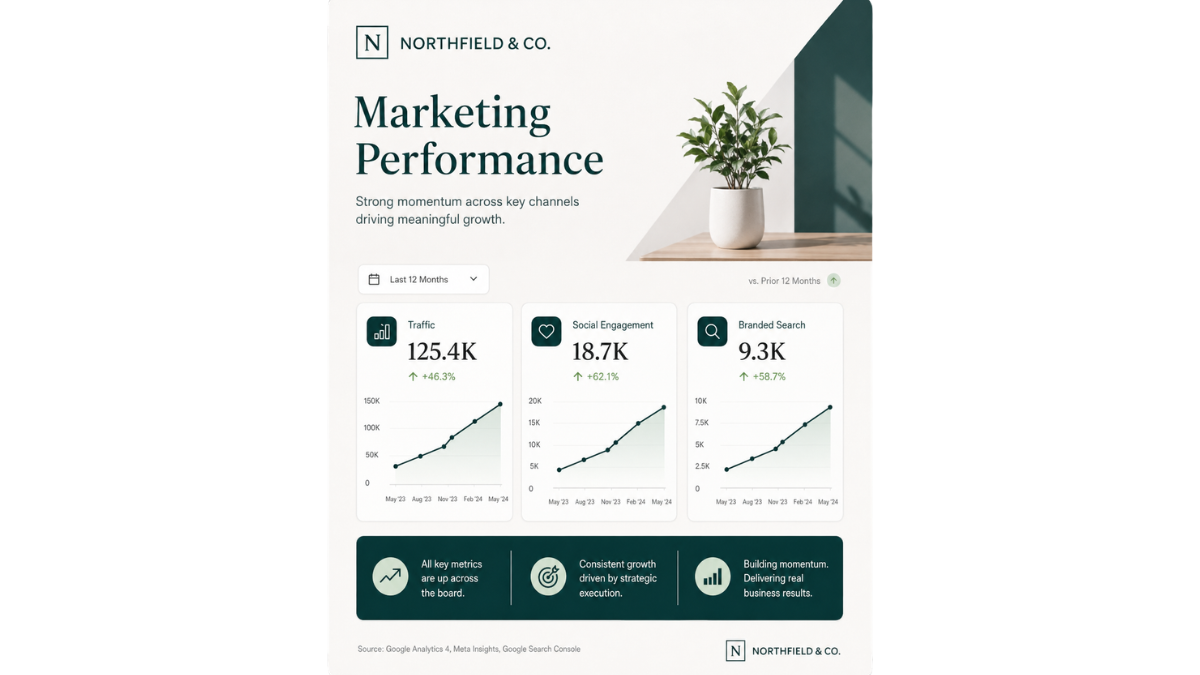
You measure brand awareness by looking at signals that show more people are recognizing, searching for, engaging with, and returning to your brand. Awareness is not always measured by leads alone because many people need repeated exposure before they act.
For awareness campaigns, Google recommends setting clear branding goals and measuring performance through impressions, conversions, and other campaign statistics. Google also provides reach and frequency metrics to understand how many people saw a message and how often they saw it.
Google Ads brand awareness measurement and reach and frequency reporting are useful reminders that awareness needs its own measurement lens.
In practice, I would look at a mix of numbers and behavior:
Branded search growth: more people searching your company name or service name.
Direct and returning website traffic: more people coming back after first exposure.
Social engagement quality: comments, saves, replies, shares, and profile visits.
Email growth and engagement: more people staying connected after discovering you.
Lead source notes: more prospects saying they saw you on LinkedIn, email, Google, or a podcast.
The goal is not to chase every metric at once. It is to build a simple dashboard that tells you whether your social media marketing efficiently and broader content efforts are creating real recognition over time.
How Do You Keep a Multi-Channel Strategy Consistent Without Losing Your Mind?
You keep a multi-channel strategy consistent by turning the message, calendar, assets, approvals, and reporting into a repeatable workflow. Without that structure, the owner usually becomes the person holding every channel together.
This is where I believe execution support matters most. Strategy is important, but brand awareness is built through repetition. If nobody is consistently creating, adapting, publishing, reviewing, and improving the work, the strategy stays on paper.
One example I keep in mind is Gabe Gibitz of Blue Guru Marketing. His business needed support across technical project management, social media, and marketing execution. What stands out to me is not just that tasks were delegated. It is that the support became coordinated enough for him to focus more on scaling the business instead of personally carrying every moving part.
For many founders, this is also where signs to outsource marketing start showing up. The issue is not a lack of ideas. The issue is that every channel needs follow-through.
At Smart VAs, we support this through a managed structure. A Client Success Partner helps coordinate the work, while the right specialists support social media, content, design, SEO, website updates, email, or campaign tasks depending on what the business needs.
This is why I often describe Smart VAs as a middle path between doing everything in-house and handing everything to a traditional agency. For growing businesses comparing in-house vs outsourced marketing ROI, the question is not only cost. It is whether the structure can stay consistent as the business grows.
Ready to Build Brand Awareness Without Managing Every Channel Yourself?
If your business is active but still not recognizable, the next step is not always adding more channels. Sometimes the next step is creating a better execution structure around the channels you already have. Smart VAs helps growing businesses turn marketing plans into consistent execution through social media, blog content, SEO support, design coordination, email support, and campaign assistance. If you need a clearer structure for marketing and brand awareness, explore our managed services for growing businessesorbook a discovery call so we can talk through what kind of support fits your stage. Delegation is not just a task. It is a strategy.
Smart Virtual Assistant
👍🤵
Smart Virtual Assistant 👍🤵
What if you could reclaim 40 hours this month?
Find out inside this free guide.
Frequently Asked Question
-
Multi-channel marketing means using several platforms to reach your audience, such as social media, email, SEO, and paid ads. Omnichannel marketing connects those platforms into one unified customer experience. Most growing businesses should start with consistent multi-channel execution before trying to build a fully integrated omnichannel system.
-
Most small businesses should start with three to four channels they can manage consistently. A practical mix may include social media, blog content or SEO, email, and one paid or local channel. The right number depends on your audience, budget, team capacity, and ability to publish consistently.
-
Brand awareness usually builds over months, not days, because it depends on repeated exposure and recognition. A business may see early signs through engagement, website traffic, branded searches, or direct inquiries, but stronger awareness comes from showing up consistently with the same message across the right channels.
-
Social media can build awareness, but it is stronger when supported by content, email, SEO, and a clear website experience. Social platforms help people discover and remember the brand, while other channels reinforce trust, answer deeper questions, and help interested prospects take the next step.
-
You can measure brand awareness through branded search volume, direct traffic, returning website visitors, social engagement, email list growth, audience surveys, and lead source notes. These signals show whether more people recognize your business, remember your message, and return to your brand before they are ready to buy.
About the Author :
Kristy Yoder, Founder

Kristy Yoder is the Founder of Smart VAs, a virtual assistant agency that helps entrepreneurs grow through reliable administrative and digital marketing support. With extensive experience building and managing remote teams, she specializes in delegation, operational efficiency, and scalable business growth.
Passionate about helping business owners reclaim their time, Kristy leads Smart VAs in connecting entrepreneurs with skilled virtual professionals who provide dependable support and contribute to long-term success.