Outsourcing Video Editing Services: What Businesses Should Look for in a Video Editing Partner
Key Takeaways
The best video editing partner is not simply the cheapest or fastest. Businesses should compare quality, brand fit, communication, workflow, reliability, and the ability to handle the actual content mix.
A strong editor understands what the video needs to accomplish, not just which effects or transitions to add.
Clear briefs, reference videos, brand rules, centralized feedback, and version control reduce unnecessary revision cycles.
A paid pilot project is one of the most practical ways to test editing quality, communication, brand alignment, and turnaround before committing long term.
Freelancers, agencies, and managed specialist teams can all work. The right model depends on volume, management capacity, continuity needs, and budget.
Outsourcing works best when it gives the business reliable creative capacity while the owner or internal team keeps control of brand direction and approvals.

DELEGATE SMART. SCALE FAST.
The step-by-step guide to reclaim your time and grow with confidence.
In my work as a Video Editing Specialist at Smart VAs, I have learned that outsourcing video editing services works best when the editor understands more than editing software. Before I touch a timeline, I want to know five things: what the video needs to accomplish, who it is for, how the brand should feel, where the video will be published, and how the client wants the review process to work. A polished portfolio matters, but I pay just as much attention to reliability, communication, revisions, and business fit. The goal is not simply to hand off editing. It is to build a production process that gives the business more capacity without losing control of the content.
I see the same pattern with businesses again and again: the footage is already recorded, but publishing keeps slipping because editing sits behind client work, sales, operations, and everything else that feels more urgent. By the time someone finally opens the project, the content may already be late. That is why I look at the editing partner as part of the content workflow, not just the person who makes the final cut.
What Should Businesses Know Before Outsourcing Video Editing Services?
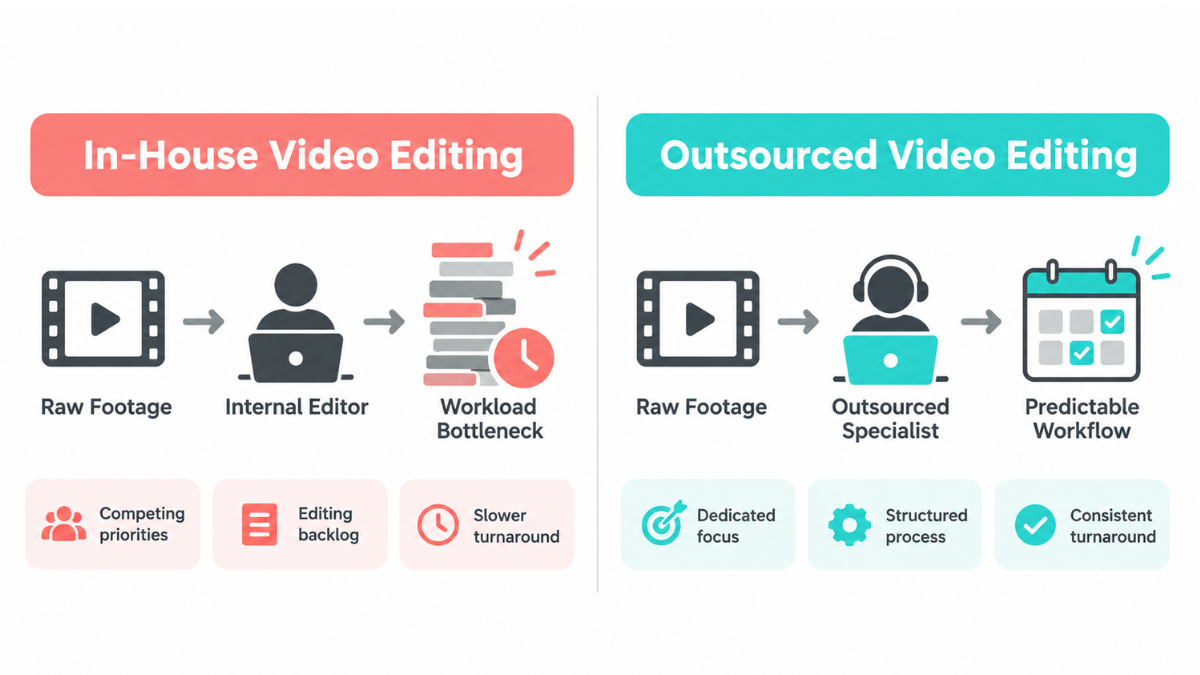
Outsourcing video editing means delegating post-production to an external professional, freelancer, agency, or managed specialist team. The scope can be as simple as trimming and captions or as involved as long-form editing, audio cleanup, color work, motion graphics, branded templates, repurposing, and platform-specific exports.
When a client sends me a project, I do not start by asking which effects they want. I start with the purpose. A sales video, educational YouTube episode, testimonial, podcast clip, course lesson, and short-form Reel all need different choices around pacing, structure, graphics, audio, and calls to action. If I do not understand what the video is supposed to do, I can make it look polished and still make the wrong editing decisions.
That is also why I would not choose a partner based only on hourly price. I would compare quality, reliability, communication, scalability, and how easily that person or team can fit into the way the business already creates and approves content.
The three common models are straightforward: a freelancer gives you a direct relationship with one editor; an editing agency gives you broader production capacity; and a managed specialist model gives you an editor plus a layer of coordination and ongoing support. None is automatically right for every business.
Why Are Businesses Outsourcing Video Editing Instead of Handling It In-House?
Does outsourcing actually save businesses time?
Video editing is rarely one task. A single finished video can involve organizing footage, selecting takes, cleaning audio, cutting pauses, adding B-roll, creating captions, applying brand elements, exporting different formats, uploading review files, handling revisions, and creating platform-specific versions. Even rendering and file management take time that is easy to underestimate.
At Smart VAs, when I take editing off a business owner or marketing team, I do not see the value as simply moving clips around a timeline for them. The real value is giving that team back the hours spent organizing footage, cleaning audio, reviewing cuts, exporting versions, and chasing revisions so they can focus on strategy, clients, recording, sales, and the work that actually requires their attention
Can outsourcing reduce the cost of video production?
It can, but I would not claim that outsourcing is always cheaper. The real comparison is cost relative to output and management overhead. A full-time hire includes recruiting, onboarding, salary, equipment, software, management time, and the question of whether there is enough editing work every week to justify the role. Outsourcing can make sense when the business needs ongoing creative capacity without building an internal editing department.
Does outsourcing make it easier to scale video production?
Scaling usually becomes difficult when the number of deliverables grows faster than the editing process. One webinar may need a full replay, five short clips, a teaser, captions, a thumbnail frame, and versions for different channels. A launch may create a temporary spike in production that an internal team cannot absorb comfortably.
In recurring client work, I can tell the workflow is getting stronger when each new project requires less explaining. Once I know the brand, file structure, pacing preferences, review process, and export requirements, I can move faster without guessing. That is the kind of consistency we try to build at Smart VAs, because scaling video production is much easier when the process improves from one project to the next instead of restarting every time.
Smart Virtual Assistants
👍🤵
Smart Virtual Assistants 👍🤵
What Types of Video Editing Services Can Businesses Outsource?
Businesses can outsource almost any recurring post-production work, but I recommend choosing a partner based on the formats you actually publish. Common projects include:
YouTube videos and interviews
Instagram Reels, TikTok videos, and YouTube Shorts
Podcast video episodes and clips
Social media content and campaign videos
Product demos and promotional videos
Training, webinar, and course videos
Corporate and internal communication videos
Customer testimonials and case-study videos
Video ads
Long-form-to-short-form content repurposing
For example, when a business wants one long recording turned into a steady stream of short clips, the editing work often connects directly with publishing and channel management. In that kind of workflow, a social media management specialist can help make sure the finished assets are used consistently instead of sitting in a folder after approval.
Podcast video is another example where editing affects more than appearance. Clean post-production supports the way a business presents its expertise over time, which is why podcast production can support brand authority when the recording, editing, and publishing process stays consistent.
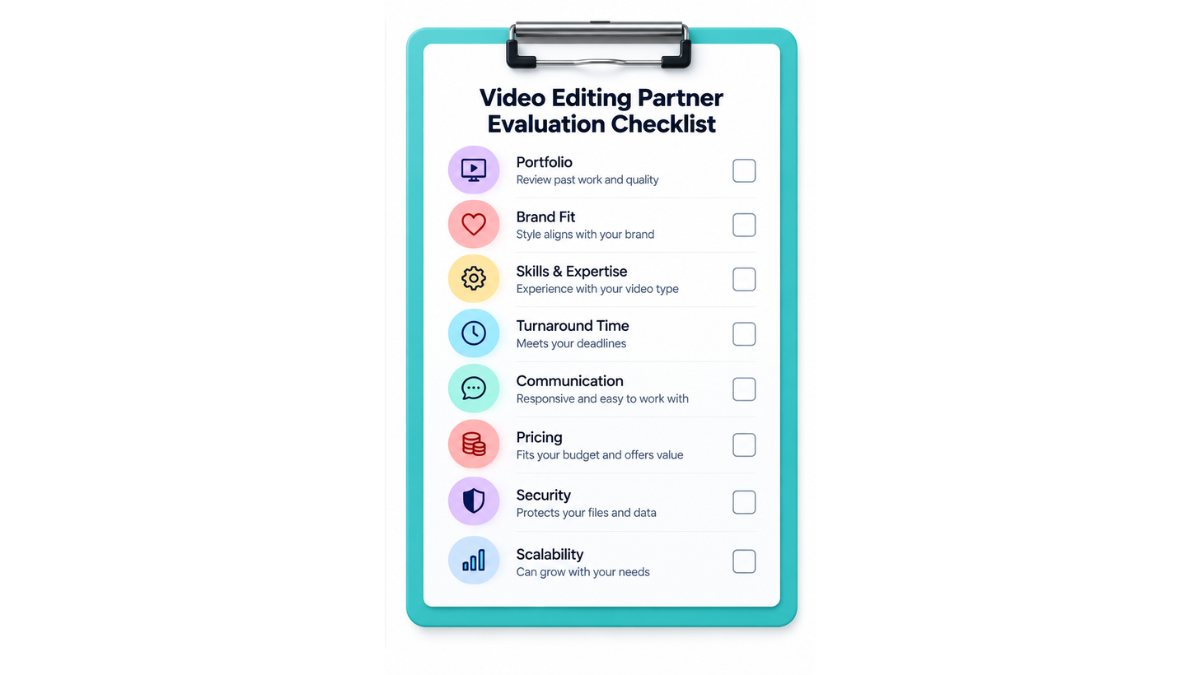
What Should You Look for in an Outsourced Video Editing Partner?
Does the video editing partner have relevant portfolio experience?
When I review whether an editor is a good fit for a business, I do not get distracted by one flashy showreel. I would rather see three relevant examples that prove the editor can handle the kind of content the business actually publishes. I look at format, audience, platform, pacing, storytelling, and whether the quality stays consistent across more than one project.
I also look beyond software knowledge. The strongest skills for a freelance video editor include storytelling judgment, audio awareness, attention to detail, project organization, communication, and the ability to adapt feedback without losing consistency.
Can the editor match your brand's visual identity?
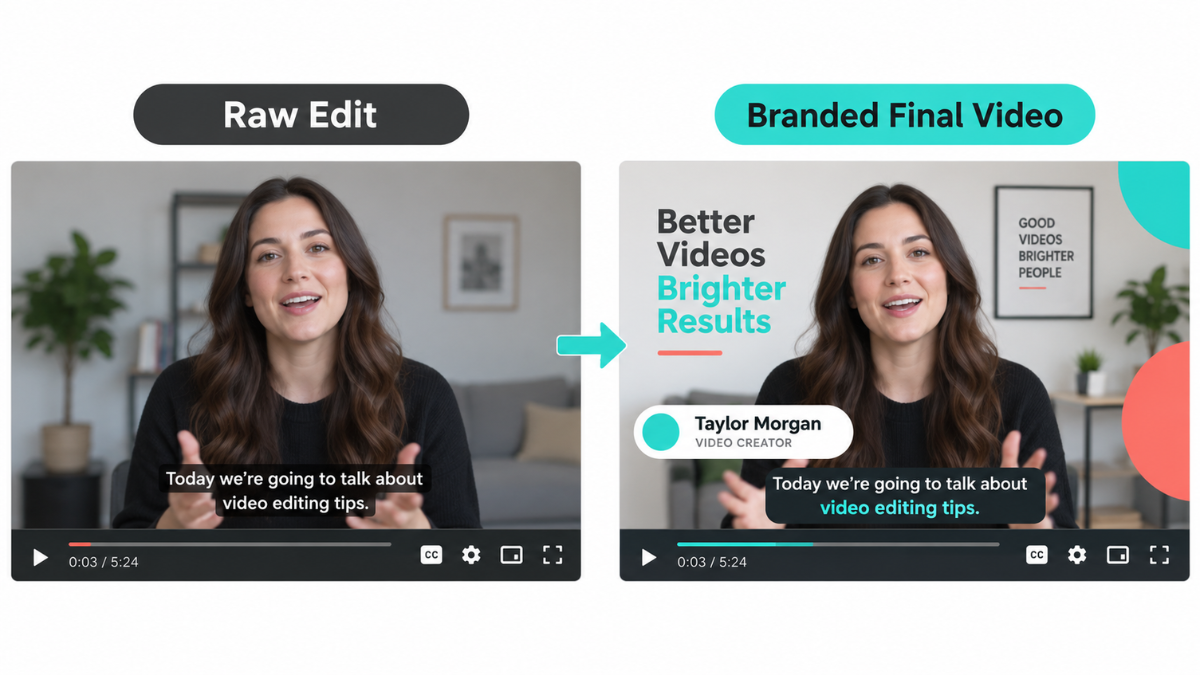
One of the first things I ask for is approved brand material. I want to see the fonts, colors, logo treatment, caption style, motion graphics, music choices, transitions, pacing, framing, and on-screen text that already feel right to the client. In my experience, a few strong reference videos are often more useful than a vague instruction like 'make it professional' because they show me what the client means by professional.
A practical handoff includes brand guidelines, logo files, fonts, color values, intro and outro assets, lower thirds, caption preferences, music guidance, and examples of edits the business likes or dislikes. That turns subjective feedback into something repeatable.
Does the provider understand your video's marketing objective?
Before I decide what to cut, emphasize, or move earlier in the video, I want to know what the viewer should think, feel, or do after watching. Is the goal awareness, education, lead generation, a sales conversation, product sales, authority, or engagement? That answer changes the edit. It tells me which moments need more space, which parts can be tightened, where B-roll helps, and where a CTA needs room to land.
A technically clean edit can still miss the point if it treats every video the same way. A strong partner should understand why the content exists before deciding how to shape it.
What editing capabilities should a professional partner offer?
The exact scope varies, but businesses commonly need cutting and sequencing, audio cleanup, color correction, captions, B-roll, motion graphics, transitions, on-screen text, title screens, platform-specific formatting, and content repurposing. I would verify which of these are included rather than assuming every editor offers the same level of post-production.
Platform requirements matter too. For example, YouTube's official upload guidance covers recommended encoding, frame rate, audio, resolution, and aspect-ratio considerations. A business should expect its editor to understand the delivery requirements for the channels it actually uses, not export one generic file for everything.
How Should You Evaluate the Video Editing Workflow Before Hiring?
How will you submit raw footage and creative instructions?
At Smart VAs, I consider the first draft to start before I open the editing software. A cleaner handoff gives me a better chance of getting the edit right sooner. I want the footage organized, deliverables named clearly, deadline confirmed, brand assets available, and the brief specific enough that I know what the finished piece is supposed to accomplish.
For recurring clients, I prefer a repeatable request format that includes the project name, target platform, final length, aspect ratio, CTA, required graphics, reference videos, and any moments that must stay in the edit. We try to turn those details into a standard workflow because the less I have to guess, the more time I can spend improving the edit itself.
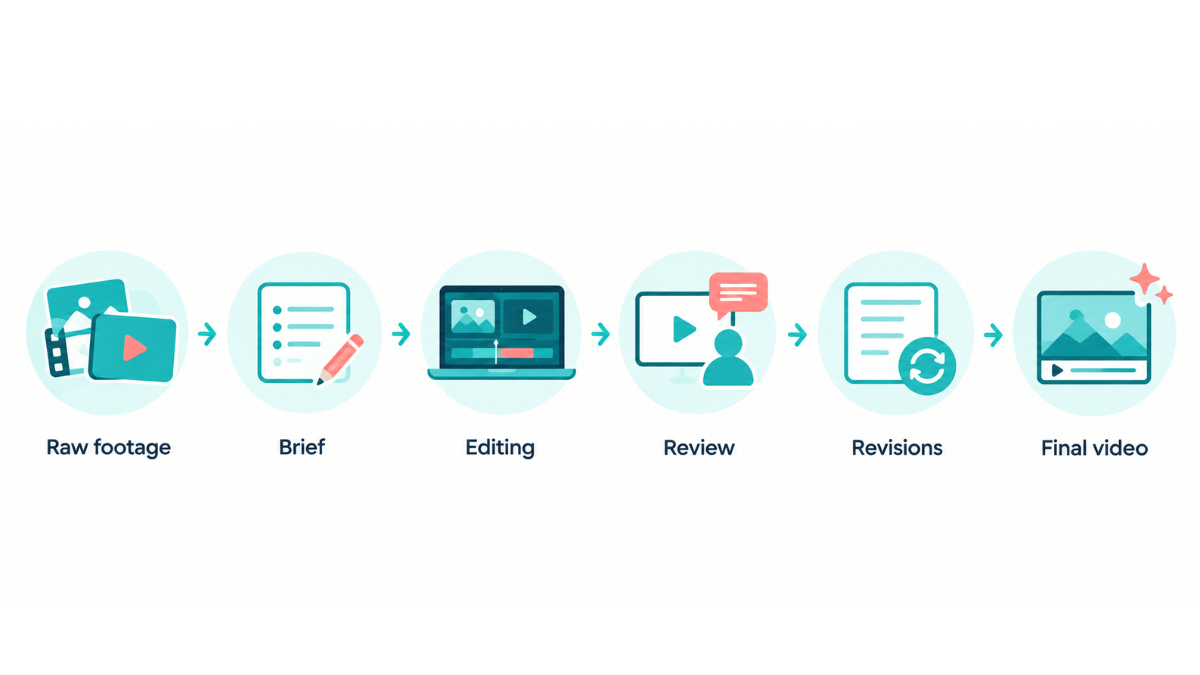
How will you review drafts and provide feedback?
One of the fastest ways to slow an editing project down is to scatter feedback across email, chat, voice notes, and separate documents. When I am working through revisions, I need one review location and, whenever possible, one clear decision-maker. Timestamped notes are especially useful because I can go straight to the exact moment, make the change, and keep version history clean.
Frame.io's current commenting guidance shows how review comments can be attached to a specific frame or range of a video. Whether a business uses Frame.io or another review tool, the principle is the same: feedback should be precise, centralized, and easy to trace from one version to the next.
Who manages the project?
This is one of the areas where the Smart VAs model feels different from being handed a freelancer and told to manage everything yourself. I still own the creative and technical editing work, but the client also has a Client Success Partner helping coordinate priorities, communication, workload, and ongoing support. That extra layer can matter when the business has recurring deadlines or several types of content moving at once.
Neither arrangement is automatically better, but the business should know which responsibility it is taking on before signing an agreement.
What Should You Ask About Turnaround Time and Revisions?
What is a realistic turnaround time for video editing?
When clients ask me how fast a video can be finished, I always want to see the scope first. A 45-second talking-head clip and a 45-minute interview with multiple cameras, B-roll, graphics, audio cleanup, and captions are completely different jobs. I estimate turnaround around raw footage volume, final length, complexity, number of deliverables, and revision rounds rather than pretending every video should fit the same deadline.
Fast delivery is helpful only if the workflow can still protect quality. I would rather have a realistic schedule that the editor can consistently meet than a headline promise that falls apart as soon as the project becomes more involved.
How many revision rounds are included?
Unlimited revisions can sound attractive, but it does not solve a poor briefing process. What matters more is a clear revision policy, defined scope, centralized feedback, and enough iterations to reach the agreed result. Businesses should also ask what counts as a revision versus a new request or change in direction.
What happens when you need an urgent video?
If your content calendar includes launches, events, announcements, or client deadlines, ask how rush work is handled. Does the provider have capacity to absorb urgent requests? Is there backup coverage? Is rush pricing different? A good answer should be specific enough that you know what will happen before the emergency arrives.
How Does Video Editing Pricing Work When You Outsource?
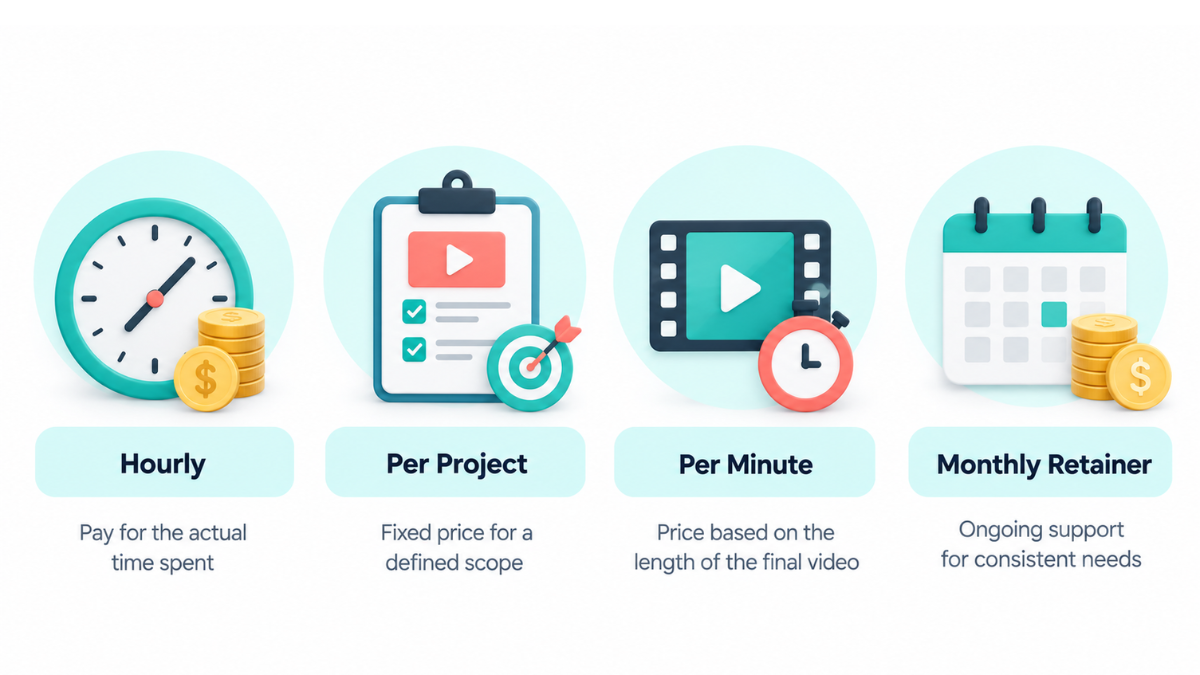
Do video editors charge hourly, per project, per minute, or monthly?
| Pricing model | Best suited for |
|---|---|
| Hourly | Variable or occasional editing where scope changes frequently |
| Per project | Defined deliverables with a clear brief and finish line |
| Per finished minute | Standardized production where the editing scope is consistent |
| Monthly retainer | Recurring content with predictable volume |
| Dedicated hours | Ongoing editing capacity across changing tasks |
When I scope a project, I look beyond the headline rate. I want the client to know what is actually included: revisions, captions, motion graphics, stock assets, music licensing, resizing, source files, rush work, and delivery of project files. Two quotes can look similar until those details are compared, and those details are usually where misunderstandings start.
If pricing is a major part of the decision, comparing video editor rates across freelancers and agencies can help clarify why hourly price alone does not show the total management or production cost.
What factors affect outsourced video editing costs?
The main cost drivers are usually final video length, raw footage volume, number of cameras, editing complexity, motion graphics, audio work, captions, number of platforms, revision volume, turnaround expectations, and how much original creative direction the editor needs to provide.
Should you choose the cheapest video editing service?
From the editing side, I would not choose the cheapest provider automatically. A low rate can be a great fit for simple work when the editor is reliable. The problem starts when low price comes with unclear communication, repeated revisions, missed deadlines, or inconsistent quality. I have seen how much extra time a team can lose when it has to keep correcting the same issues, and at that point the cheaper option is no longer really saving the business time.
How Can You Protect Your Video Files and Intellectual Property When Outsourcing?
Before sharing raw footage, a business should understand how files will be accessed, stored, retained, and removed. The agreement should also make ownership clear for final deliverables, raw footage, licensed assets, and editable project files where those are part of the scope.
Before I download client footage, I want the access and ownership expectations to be clear. I would ask about NDAs where appropriate, file-sharing methods, permissions, retention periods, third-party access, ownership of final files and project files, and what happens during offboarding. For sensitive client footage or internal recordings, those are workflow questions, not paperwork to think about after the project is finished.
I would also avoid assuming that any provider follows a particular security process unless it is documented in the agreement or service policy. Security expectations should be explicit.
How Can Businesses Maintain Brand Consistency With an Outsourced Video Editor?
What should you include in a video editing style guide?
Brand colors and fonts
Logo placement and safe areas
Caption style and on-screen text rules
Intro, outro, and lower-third formats
Music and sound preferences
Animation and transition style
B-roll preferences
Approved reference videos
Platform-specific versions and aspect ratios
In practice, a useful video style guide is not about creating a huge brand document. It is about documenting the choices I have to make repeatedly while editing. If I already know the approved caption treatment, intro, lower thirds, music direction, B-roll style, and export formats, I can stay consistent without asking the client to re-approve the same decisions every week.
Should you provide reference videos?
Yes. When a client tells me, “I like the pacing in this example, the caption style in that one, and the way this brand uses B-roll,” I can translate those references into editing decisions. “Make it engaging” is subjective. A reference gives us something concrete to calibrate against.
How can templates improve consistency?
Reusable caption templates, intros, outros, lower thirds, transition rules, title cards, and export presets reduce repeated decisions. They also make it easier to bring backup support into the workflow because the brand system is documented rather than living only in one editor’s head.
How Can You Tell Whether a Video Editing Partner Is Reliable?
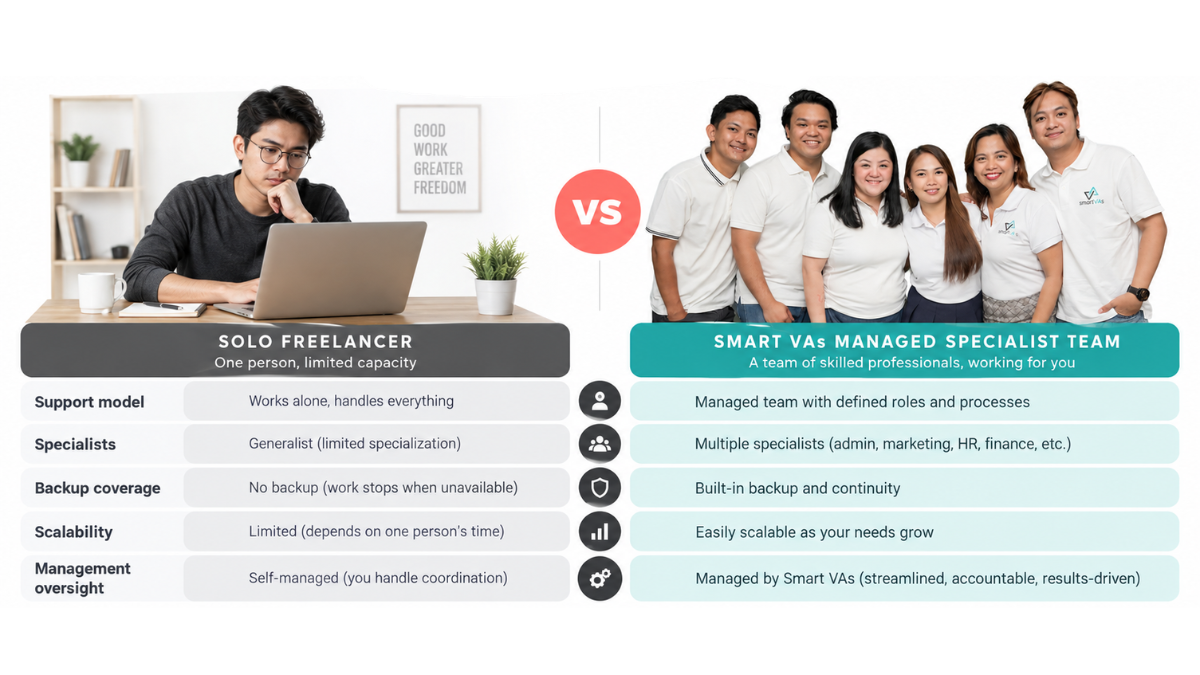
When I think about reliability, I look far beyond portfolio quality. For ongoing business content, I pay attention to whether deadlines are realistic, communication is clear, files are organized, revisions are tracked, and the editor takes ownership when something needs to be fixed. At Smart VAs, continuity also matters because recurring content should not stop just because one person becomes unavailable.
Is hiring one freelancer enough for ongoing business video production?
Sometimes, yes. A skilled freelancer can be an excellent fit for predictable volume and a business that is comfortable managing the relationship directly. The trade-off is dependence on one person. If that editor becomes unavailable during a launch or busy period, the production queue can pause.
A managed team or agency may cost more, but it can provide greater capacity, coordination, and continuity. The right decision depends on how important publishing deadlines are and how much management the internal team wants to own.
This is also why I would look at the hiring process, not just the portfolio. A business deciding how to hire a video editor online should assess communication, workflow, role fit, and business context before committing to recurring production.
How Can Businesses Test a Video Editing Partner Before Committing Long Term?
When a business is considering ongoing editing support, I like the idea of a paid pilot because it shows much more than a portfolio can. Use a real project with the same type of footage, deadline, brand requirements, and feedback process the editor would receive after onboarding. That gives both sides a realistic picture of what working together will actually feel like.
During the pilot, evaluate:
1. Brief comprehension
2. Editing quality
3. Brand alignment
4. Turnaround reliability
5. Communication
6. Revision handling
7. Final file quality
8. File organization
9. Overall ease of working together
What I watch during a pilot is not whether the first draft is magically perfect. I watch how the editor interprets the brief, makes creative decisions, asks questions, responds to feedback, organizes the files, and improves the second version. That tells me much more about long-term fit than one polished sample created without real client pressure.
What Red Flags Should You Watch for When Outsourcing Video Editing Services?
No relevant portfolio
An editor does not need to have worked in your exact industry, but there should be enough relevant work to judge whether the style and format are a realistic fit.
Vague pricing
If you cannot tell what is included, how revisions work, or what creates an extra charge, it becomes difficult to compare providers fairly.
Poor communication
Slow or unclear communication during the sales process can become a larger problem once deadlines and revisions begin.
Unclear revision policies
The business should know how feedback is submitted, how many rounds are included, and what counts as a change in scope.
Promises of extremely fast delivery for every project
Speed should reflect the complexity of the work. A provider should be able to explain how turnaround is estimated.
No documented workflow
If the provider cannot explain how footage moves from upload to draft, review, revision, approval, and final delivery, ongoing production may become messy.
No continuity plan for high-volume work
For businesses with strict publishing schedules, dependence on one unavailable editor can become a real operational risk.
Is Outsourcing Video Editing Right for Your Business?
Outsourcing may make sense when editing consumes significant internal time, publishing is frequent, specialized skills are needed, the internal team lacks capacity, multiple formats are required, or existing long-form content needs to be repurposed consistently.
Keeping editing in-house may make more sense when video volume is very low, editing is a core competitive capability, the content requires highly specialized internal knowledge, or the business already has an effective production team with enough capacity.
When I talk with a client about whether outsourcing makes sense, I do not assume the answer is always yes. I ask where editing currently sits in the business and what it is costing in time, delays, quality, and management attention. The right setup is the one that gives the business the best balance of quality, control, capacity, and cost, whether that is in-house, freelance, or managed support.
What Makes Smart VAs Different From a Traditional Video Editing Freelancer?
As a Video Editing Specialist at Smart VAs, I do not work as an isolated editor waiting for random files to appear. The goal is to become part of the client's repeatable content workflow. I handle the creative and technical execution, while the managed structure around me helps keep priorities, communication, workload, and expectations organized so the client is not building the entire support system around one person.
Our video editing specialists can support short-form and long-form editing, YouTube, Reels, TikTok, testimonials, courses, podcast video, captions, audio cleanup, motion graphics, color work, platform resizing, and content repurposing. The exact mix depends on what the business is producing.
The broader managed specialist team model also matters when the work expands beyond editing. A business may eventually need design, social media, podcast support, website updates, or other execution around the same content.
A good example is Gabe Gibitz, who runs Blue Guru Marketing. His Smart VAs support includes content creation, video editing, podcast support, social media management, email marketing, and website updates. The useful lesson is not that one service does everything. It is that recurring creative work becomes easier to sustain when the business has reliable support across the workflow instead of carrying every production task internally.
That is how I approach recurring client work: learn the brand well enough that I am not guessing, understand what each video needs to accomplish, make the feedback loop easier, and keep improving the workflow over time. A good editing relationship should require less management as it matures, not more.
What Questions Should You Ask Before Choosing an Outsourced Video Editing Service?
1. Can I see portfolio examples that match the type of content we actually produce?
2. Who will actually edit my videos?
3. What types of videos do you specialize in?
4. How do you estimate turnaround time?
5. How many revision rounds are included?
6. What does the quoted price include?
7. Which items can create additional charges?
8. How do you learn and document our brand guidelines?
9. How do I submit footage and project instructions?
10. How will feedback and version control be handled?
11. Who is my main point of contact?
12. What happens if my primary editor is unavailable?
13. How is footage stored, shared, and removed?
14. Who owns the final files and editable project files?
15. Can you handle increased video volume when campaigns or launches get busy?
If a provider can answer those questions clearly, it becomes much easier to compare fit beyond a demo reel or hourly rate.
What Is the Best Way to Start Outsourcing Video Editing Services?
1. Define the types of videos and platforms you actually need.
2. Establish your expected monthly volume, deadlines, and budget.
3. Shortlist providers with relevant work, not just attractive showreels.
4. Compare communication, workflow, revisions, pricing, and continuity.
5. Run a paid pilot using a real project.
6. Document your visual and editing style.
7. Create a repeatable request, review, and approval process.
8. Review the relationship after the first few projects and refine the workflow.
In my experience, the best outsourcing relationship is one where each project gets easier because the editor keeps learning the brand, the client gets better at briefing and feedback, and the process becomes more predictable. That is when video editing stops feeling like another vendor task and starts functioning as reliable production capacity for the business.
If your footage is piling up because editing keeps losing to more urgent work, a Video Editing Specialist can help turn that backlog into a repeatable content workflow without asking you to manage every cut, export, and revision yourself.
What if you could reclaim 40 hours this month?
Find out inside this free guide.
Frequently Asked Question
-
Costs vary based on video length, raw footage, complexity, graphics, audio work, captions, revisions, turnaround, and volume. Compare what each quote includes instead of relying on one generic rate. The right pricing model may be hourly, per project, per finished minute, monthly, or dedicated hours.
-
It can be, especially when a business does not need a full-time editor, but it is not automatically cheaper. Compare total output, recruiting and management overhead, software and equipment needs, continuity, and how much internal time each option requires.
-
Businesses can outsource YouTube videos, social clips, podcast video, product demos, testimonials, courses, webinars, corporate content, video ads, promotional videos, and long-form-to-short-form repurposing. The best partner should have experience with the formats you publish most often.
-
Review relevant portfolio work, communication, turnaround process, revision policy, brand-fit process, file workflow, continuity plan, and client proof. A paid pilot can help you evaluate how the editor performs with your real content before making a long-term commitment.
-
Turnaround depends on final length, raw footage volume, number of cameras, motion graphics, audio work, captions, number of deliverables, and revisions. Ask the provider how they estimate delivery instead of assuming one turnaround standard applies to every video.
-
There is no universal ideal number. What matters is a clear scope, a defined review process, centralized feedback, and enough revision rounds to reach the agreed result. Ask what counts as a revision and what would be treated as a new request.
-
Provide brand guidelines, approved videos, fonts, colors, logo files, caption rules, intro and outro assets, music guidance, and reusable templates. Consistency improves when the editor has concrete references instead of relying on vague directions.
-
Neither is always better. A freelancer can offer a direct relationship and potentially lower cost, while an agency or managed team may offer more capacity, continuity, and coordination. Choose based on your volume, deadlines, budget, and how much management you want to handle internally.
-
Use an approved file-sharing method, limit access to what the editor needs, define storage and deletion expectations, and clarify ownership of raw footage, final files, and project files. Sensitive content may also require NDAs or other contractual safeguards.
-
Yes, if the provider has the capacity and a repeatable workflow. Ongoing production works best when briefs, brand rules, feedback, file organization, deadlines, and backup coverage are documented so each project does not have to be rebuilt from scratch.
A-marc | Video Editor Graphics, Smart VAs

A-Marc is one of our seasoned Graphics Designer and Video Editor who continues to work with multiple SMART VAs clients. He has been receiving good feedback for the work that he does. He has done multiple videos for different platforms for multiple clients. The flexibility he offers in terms of tools he can use to wok on creatives is definitely a plus.