In-House vs Managed Customer Support Services: Which Is Right for Your Business?
Key Takeaways
Customer support is not only a cost center. It directly affects trust, retention, referrals, and repeat sales.
In-house support gives the most direct control, but it also requires hiring, training, management, tools, and coverage planning.
Traditional outsourcing can help with volume, but it can break down when accountability, reporting, and escalation rules are unclear.
A managed customer support model gives growing businesses a structured middle path: specialist support, clear workflows, backup coverage, and oversight.
The right model depends on ticket volume, support complexity, response expectations, budget predictability, and how much time leadership can spend managing support.

ARE YOU STILL TRYING TO DO IT ALL?
Discover the SMART way to delegate without losing control—and finally free up your time.
Customer support services help businesses respond to questions, solve issues, manage follow-ups, and protect the customer experience. The right model is not always the cheapest one. It is the structure that gives your customers consistent care while giving you enough time, visibility, and confidence to keep growing.
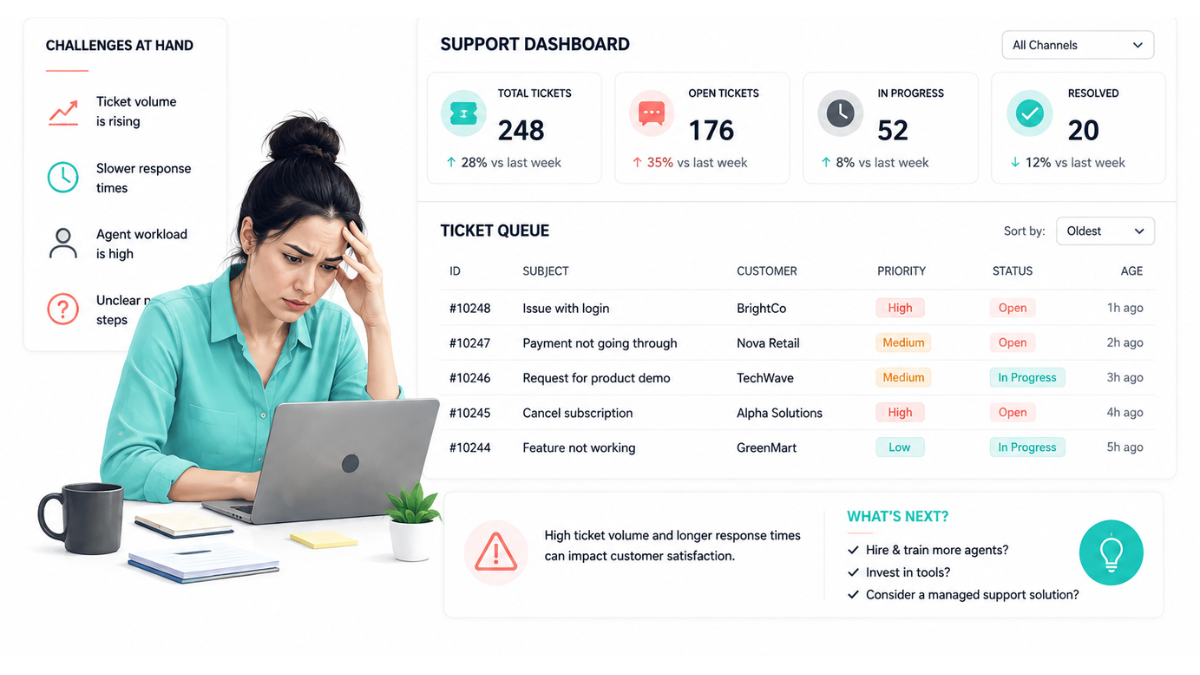
I have seen growing businesses reach this decision point when tickets start piling up, escalations become more frequent, and the owner realizes customer support cannot stay informal anymore. At that stage, the question is not just, “Should we hire?” It is, “What support structure can actually keep up with the business?”
Some businesses need an in-house department. Some need outsourced customer support services for overflow. Others need a managed customer support team that sits between those two models. Inside Smart VAs, I think about this as a structure decision, not just a staffing decision. We help business owners build a fully managed team of specialists so support does not depend on one overwhelmed person.
What’s the Difference Between In-House, Outsourced, and Managed Customer Support?
In-house, outsourced, and managed support differ by who owns people, process, and accountability. In-house means you hire and manage support directly. Outsourced means you send defined tasks to an outside provider. Managed support adds structure, reporting, escalation rules, and specialist coverage so customers are supported without you building a full department.
I like to explain it this way: customer support is not only answering messages. It is a repeatable customer experience system. Someone has to own response standards, brand voice, CRM updates, escalation paths, and customer follow-through.
In-house support gives you direct control, but you also own hiring, training, turnover, coverage gaps, and quality management.
Outsourced support can help with defined tasks, but the relationship can become unclear when expectations and escalation rules are not documented.
Managed support works best when a growing business needs a dedicated customer service specialist, but also wants structure, oversight, and flexibility around that Specialist.
At Smart VAs, we do not treat customer support as “just inbox help.” We look at how customers contact the business, what issues repeat, how information moves through the CRM, and where the owner is still being pulled back into daily support decisions.
How Do In-House, Outsourced, and Managed Support Actually Compare Side by Side?
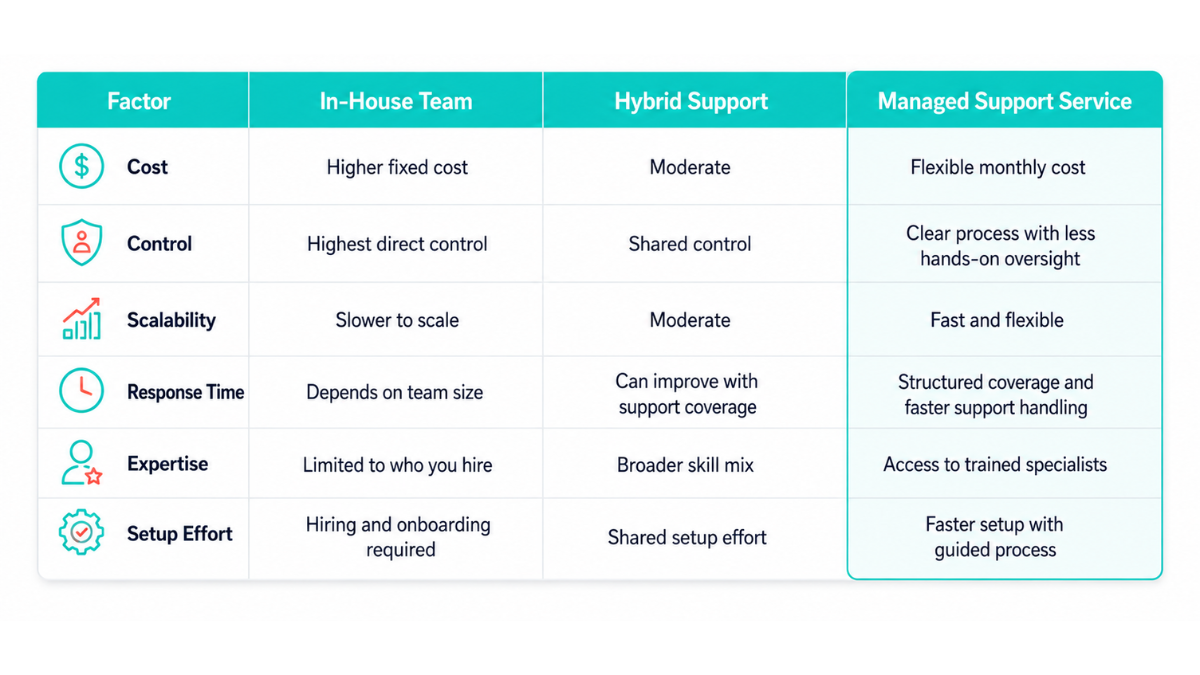
The biggest difference is not location. It is operating structure. In-house support gives control, outsourced support can give relief, and managed support gives a coordinated system. The best choice depends on how complex your customer questions are and how much management time you can realistically give.
Here is a practical comparison business owners can use before deciding.
The U.S. Bureau of Labor Statistics describes customer service representatives as professionals who handle complaints, process orders, answer questions, and support customers through channels including phone, email, text, live chat, and social media. That range matters because support now touches more channels than many small teams are prepared to manage well. BLS customer service data
When Does In-House Customer Support Make the Most Sense?
In-house support makes the most sense when your product is complex, your customer relationships are highly sensitive, or your support team needs deep access to internal decisions every day. It can work very well, but only when the business can properly fund and manage the function.
I would consider in-house support first if your business needs constant collaboration with product, sales, compliance, or account management. This is common in enterprise software, regulated services, and high-touch client relationships.
The risk is underfunding it. One internal hire may look like enough at first, but customer support often requires evenings, weekends, documentation, quality checks, CRM updates, and backup coverage. If that role is treated as a catch-all, the customer experience quietly suffers.
At Smart VAs, we often see owners realize this when they still have to step in for escalations, missed replies, or customer follow-ups. When support starts pulling leadership away from growth work, the structure needs to change.
When Does Outsourcing Make Sense — and Where Does It Typically Go Wrong?
Outsourcing can make sense when support tasks are clear, repeatable, and easy to document. It often works for overflow inbox support, order updates, appointment confirmations, or Tier 1 triage. It goes wrong when the provider is chosen on price alone and no one owns quality, reporting, or escalation.
Outsourced customer support services can be useful when the problem is volume. But if the real problem is inconsistent process, unclear brand voice, or messy customer data, simply moving tasks outside the business will not fix the root issue.
The common failure points are usually predictable:
No clear response standards or service expectations.
No documented escalation path for angry, confused, or high-value customers.
No shared source of truth for customer records.
No reporting cadence that shows what customers are asking about most.
No process for reviewing quality before problems become complaints.
This is where organized CRM systems become important. If customer records are incomplete or scattered across tools, even a strong support person will struggle to give consistent answers.
When Does a Managed Support Model Make the Most Sense?
A managed support model makes the most sense when ticket volume is growing faster than your hiring capacity, but you still need quality, accountability, and visibility. It gives you support coverage without forcing you to build a full department before the business is ready.
For me, the biggest advantage is structured accountability. A managed model should not feel like throwing tasks over a wall. It should feel like building a support rhythm that includes documentation, response standards, escalation rules, and regular check-ins.
Inside Smart VAs, that means we look at the role beyond the inbox. A Specialist may help respond to customer questions, update records, track common issues, flag escalations, and work with an administrative support specialist or CRM Specialist when the customer experience depends on clean operations behind the scenes.
I have seen this with Gabe Gibitz, founder of Blue Guru Marketing. As his business grew, he needed more than task help. He needed support around client communication, operations, and delivery so work would not bottleneck with him. That is the difference between filling a seat and creating a support structure.
What Are the Most Common Mistakes Businesses Make When Choosing a Support Model?
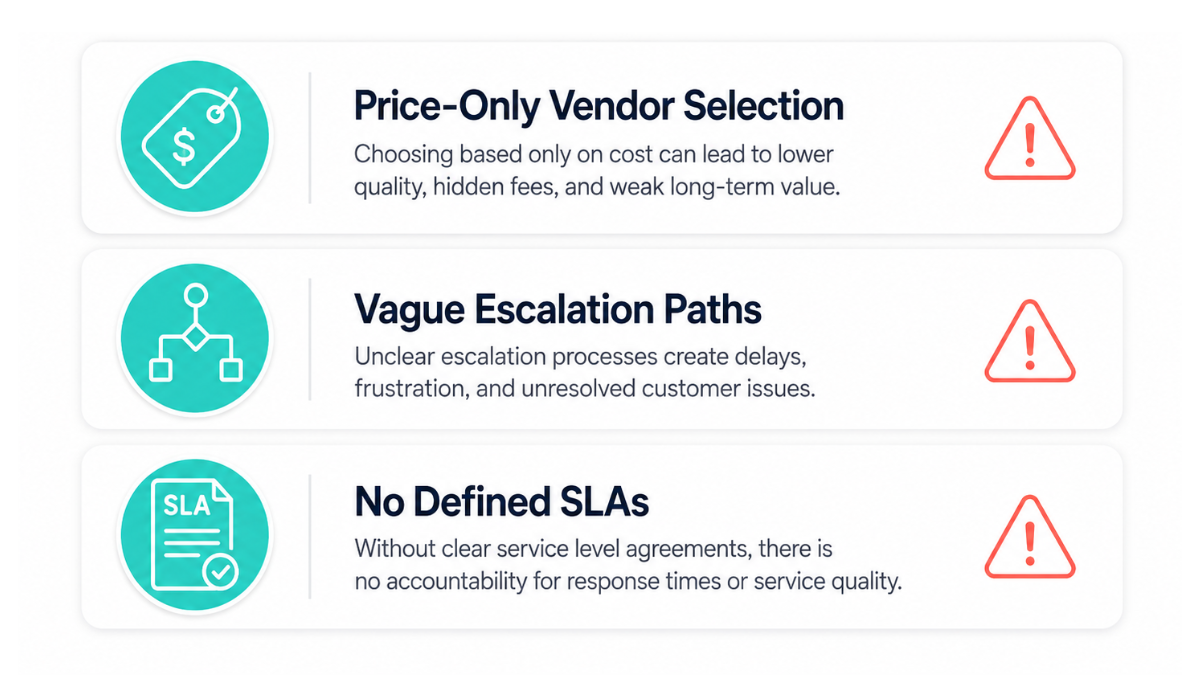
The most common mistake is choosing a support model based only on habit or price. A business may default to in-house because that feels safer, or choose the cheapest outside option because the inbox feels urgent. Neither choice works well if the structure does not match the workload.
Here are the mistakes I would watch for:
Waiting until a missed message or frustrated customer forces the decision.
Hiring one person without documenting what “good support” means.
Choosing a provider without asking how quality will be measured.
Ignoring ticket patterns that could reveal product, process, or communication problems.
Assuming speed alone equals good support.
How Does Response Time and Service Quality Compare Across These Models?
Response time matters, but consistency matters more. A fast answer that is incomplete, cold, or disconnected from the customer’s history can still damage trust. The strongest support model gives customers timely replies, accurate answers, and a clear path when the issue needs escalation.
Zendesk’s 2026 CX Trends research reports that many consumers now expect 24/7 availability and faster response times than they did a year earlier. That does not mean every small business needs a giant support center. It means response expectations are rising, and businesses need a realistic plan for coverage. Zendesk CX Trends 2026
Here is how I think about support quality:
Speed answers, “How quickly did we respond?”
Accuracy answers, “Did we solve the right issue?”
Tone answers, “Did the customer feel respected?”
Continuity answers, “Did the next person understand the history?”
Reporting answers, “Are we learning from support patterns?”
A managed customer support team should help with all five. That is why I care so much about documentation, escalation rules, and reporting cadence when we help a business build support.
Can a Managed Support Model Scale With You as Your Business Grows?
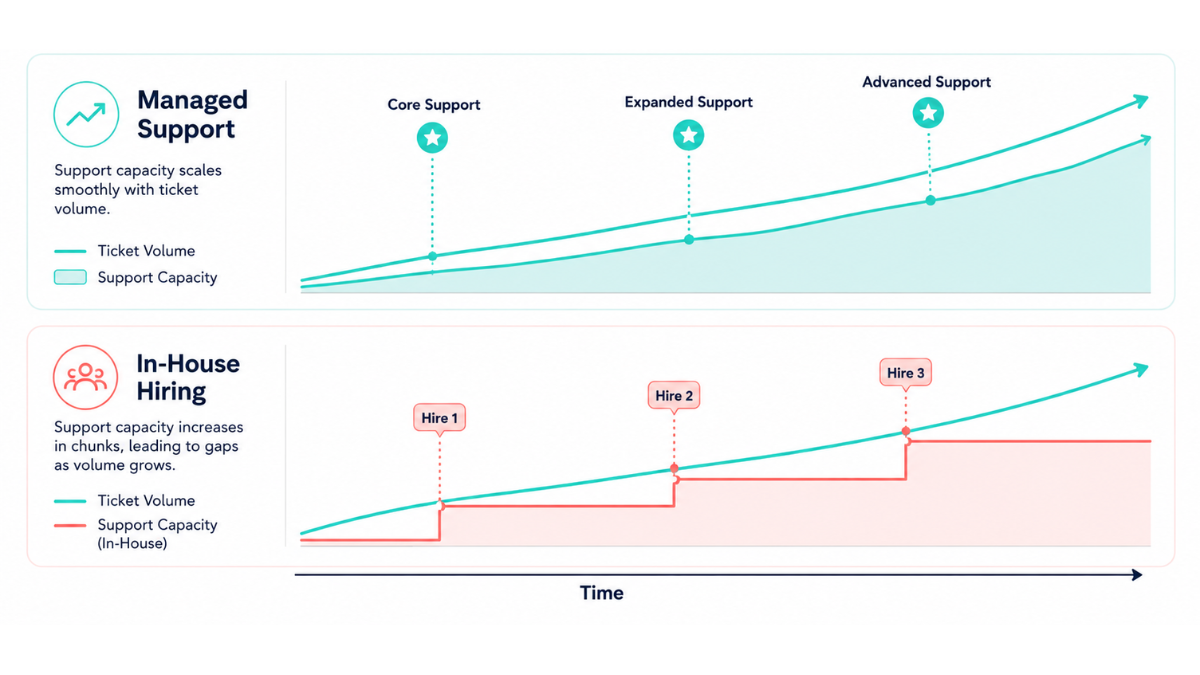
A managed support model can scale when the service agreement is built around workload, coverage, and outcomes instead of a single fixed role. As ticket volume grows, support can expand through clearer workflows, additional coverage, or adjacent Specialists without requiring a full rehiring cycle.
Scaling support should not mean starting from scratch every time volume increases. It should mean the current system becomes easier to expand because the knowledge base, CRM notes, standard replies, and escalation paths are already documented.
This is where managed remote assistant services for scaling connect naturally to customer support. A growing business often starts by asking for inbox relief, then realizes customer support touches operations, CRM, billing, fulfillment, and client communication. The support structure has to grow with that reality.
At Smart VAs, we help clients think through what support should look like now and what it may need to become next quarter. That keeps the business from outgrowing the system too quickly.
What Should You Look For When Evaluating a Managed Support Partner?
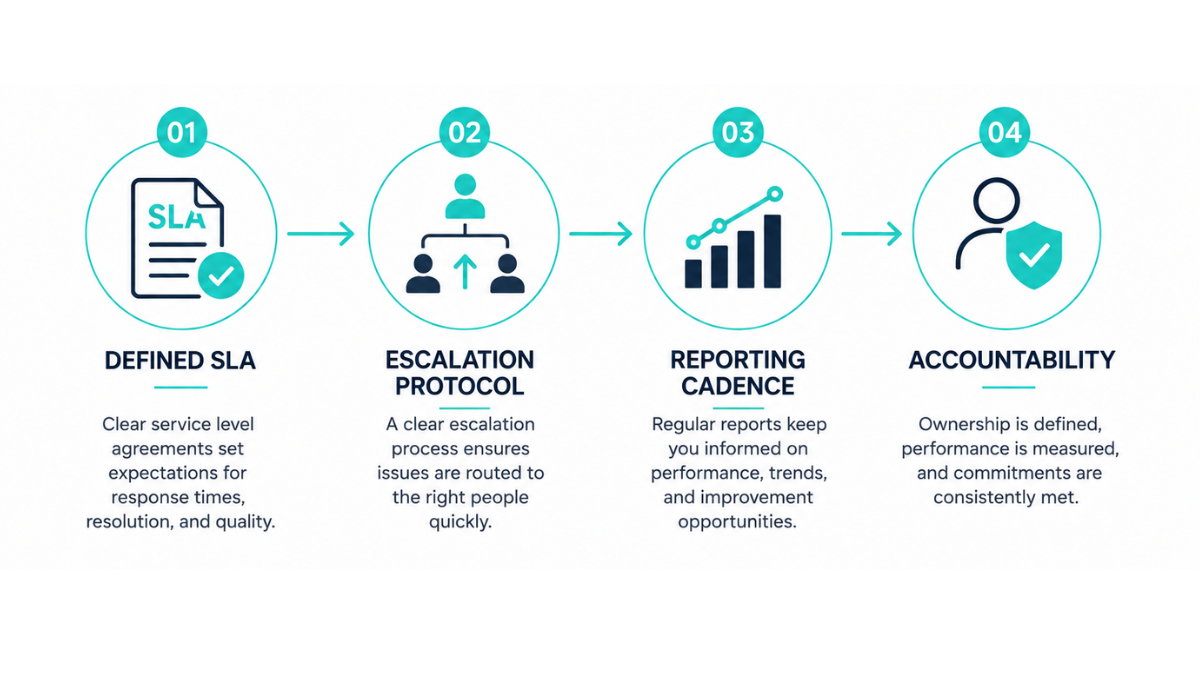
A managed support partner should give you clarity before you commit. You should understand who handles communication, how support quality is measured, how escalations work, and how reporting is shared. If those details are vague, the partnership may create more management work instead of less.
Before signing, I would ask:
What channels can the Specialist support: email, chat, phone, social, or help desk?
How are response standards and escalation rules documented?
Who reviews quality and checks for recurring customer issues?
How often will I receive updates or reports?
What happens if ticket volume suddenly increases?
How are customer records, passwords, and sensitive information protected?
Can the support structure adjust as the business grows?
I would also look at customer service rates with context. Price matters, but it should never be the only decision point. Poor support can cost more through refunds, churn, bad reviews, and lost trust.
How Do You Decide Which Customer Support Model Is Right for Your Business Right Now?
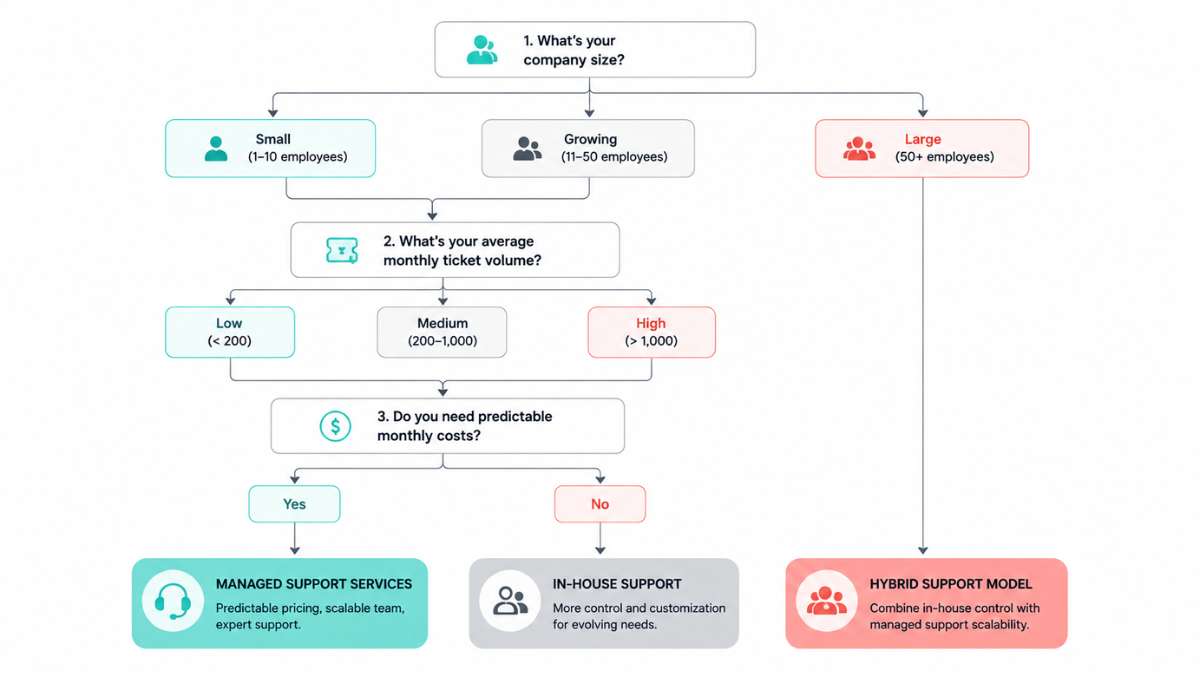
The right model depends on your support complexity, ticket volume, budget, and leadership bandwidth. If your business needs deep internal knowledge and can manage the function well, in-house may fit. If volume is rising and leadership is stretched, managed support may be the stronger middle path.
Use this quick framework:
| Choose This Model | Best Fit | Be Careful If |
|---|---|---|
| In-House Support | You need deep product knowledge, sensitive client handling, or full internal control. | You cannot provide training, coverage, tools, and supervision consistently. |
| Traditional Outsourced Support | You need help with clear, repeatable, high-volume tasks. | You do not have documentation, escalation rules, or quality checks. |
| Managed Customer Support Team | You need consistent support, scalable capacity, reporting, and structured accountability. | Your goals, channels, and support expectations are not yet clear. |
My practical advice is to look at the work honestly. If support is simple and occasional, you may not need a managed model yet. If customer communication is becoming a daily strain and missed replies could hurt trust, it is time to build something more dependable.
How Can a Managed Specialist Team Solve This Without a Full Hiring Cycle?
A Managed Specialist Team helps growing businesses add support structure without going through a long hiring cycle. Instead of building a department from scratch, you can bring in trained support, guided onboarding, clear communication, and a Client Success Partner who helps keep the work aligned.
This is the middle path I often recommend when the owner needs relief but still cares deeply about customer experience. You do not have to choose between doing everything in-house and handing customer care to a disconnected provider.
Smart VAs can help with customer inquiries, complaint handling, order follow-ups, CRM updates, customer feedback, and support documentation. We also help owners think through what should be answered directly, what should be escalated, and what patterns should be reported back to leadership.
The goal is not only to clear tickets. The goal is to protect trust while buying back your time.
Conclusion
In-house, outsourced, and managed customer support can all work. The wrong choice is the one that ignores your current growth stage, ticket volume, and ability to manage the work well. Customer support should make your business feel more stable, not more stretched.
If your customers are waiting too long, your team is constantly reacting, or support keeps landing back on your desk, the structure may need to change. A managed model can give you the consistency, visibility, and support coverage you need without building a full department before you are ready.
Smart Virtual Assistant
👍🤵
Smart Virtual Assistant 👍🤵
What if you could reclaim 40 hours this month?
Find out inside this free guide.
Frequently Asked Questions
-
Managed customer support can be more cost-efficient than hiring in-house when you factor in salary, onboarding, tools, training, benefits, supervision, and coverage gaps. It is not always the cheapest option upfront, but it can reduce fixed overhead while giving a growing business more structured support.
-
Outsourced support usually means sending defined tasks to an outside provider. Managed customer support adds more structure, including documented workflows, quality checks, escalation rules, reporting, and oversight. The managed model is often better when customer experience needs consistency, not just extra hands.
-
There is no universal ticket number. The stronger signal is whether support is affecting response time, customer satisfaction, leadership focus, or team capacity. If support is consistently delayed, poorly tracked, or dependent on the owner, it may be time to consider a managed support model.
-
Many small businesses can afford managed customer support when they start with the right scope. The goal is not to overbuild. It is to identify the channels, tasks, and coverage gaps causing the most pressure, then create a support structure that can grow as demand increases.
-
Quality control starts with clear documentation, response standards, escalation rules, and regular reporting. A strong managed support partner should understand your brand voice, keep customer records updated, review common issues, and give you visibility into what customers are asking for most often.
About the Author:
Kristy Yoder, Founder

Kristy Yoder is the Founder of Smart VAs, a virtual assistant agency that helps entrepreneurs grow through reliable administrative and digital marketing support. With extensive experience building and managing remote teams, she specializes in delegation, operational efficiency, and scalable business growth.
Passionate about helping business owners reclaim their time, Kristy leads Smart VAs in connecting entrepreneurs with skilled virtual professionals who provide dependable support and contribute to long-term success.