How to Optimize Google Ads Campaigns for Better ROI: A Strategic Guide for Growing Businesses
Key Takeaways
Google Ads optimization is a continuous system, not a one-time campaign setup.
ROI improves when keywords, search terms, bidding, audiences, ad copy, assets, landing pages, and conversion signals work together.
Clicks and impressions are not enough. Growing businesses should track cost per acquisition, conversion rate, return on ad spend, and qualified lead quality.
Google AI tools can speed up analysis and recommendations, but they still need human oversight and clean business context.
A dedicated Google Ads Specialist can help protect budget, catch performance drops early, and keep optimization consistent.

ARE YOU STILL TRYING TO DO IT ALL?
Discover the SMART way to delegate without losing control—and finally free up your time.
Optimizing Google Ads campaigns for better ROI means refining keywords, bids, budgets, audiences, ad copy, landing pages, and conversion tracking so your ad spend produces more qualified leads and fewer wasted clicks.
If you are wondering how to optimize Google Ads, the most important thing to know is this: optimization is not one task. It is an ongoing system.
I have seen growing businesses launch campaigns with good intentions, then feel frustrated when clicks come in but the sales conversations do not. That is painful because every click costs money, whether the visitor becomes a customer or leaves after a few seconds.
This guide walks through the practical parts of Google Ads optimization: keyword control, Quality Score, bidding, audiences, metrics, ad assets, landing pages, and AI tools. It also shows when it makes sense to manage campaigns internally and when a dedicated Specialist can help you buy back your time and protect your budget.
What Is Google Ads Optimization?
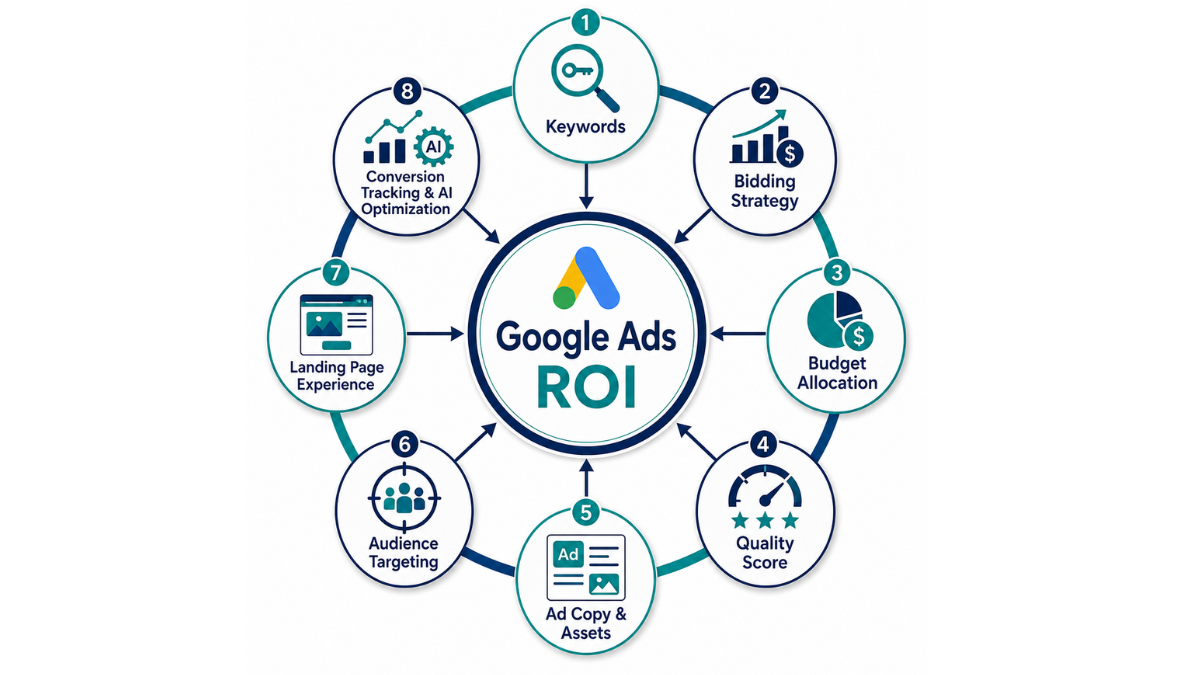
Google Ads optimization is the process of improving an active campaign so it spends budget on the right searches, audiences, ads, and landing pages. It includes both small tactical checks and bigger strategic decisions that connect ad spend to business results.
A strong Google Ads strategy does not stop after launch. Search behavior changes, competitors adjust bids, landing pages age, and conversion quality shifts. A campaign that worked last quarter can quietly become expensive if no one reviews the data.
In practice, optimization touches several levers at once:
Keyword selection and search term cleanup
Negative keyword lists
Bidding strategy and budget allocation
Quality Score signals
Ad copy and ad assets
Campaign and ad group structure
Audience targeting and remarketing
Landing page message match and speed
Conversion tracking and reporting
AI-generated recommendations and human review
For example, a keyword may start with a healthy cost per lead, then become too expensive after new competitors enter the auction. Without regular review, the campaign keeps spending even after the economics stop making sense.
Why Do Google Ads Campaigns Lose ROI Over Time?
Google Ads campaigns lose ROI when costs rise, search intent changes, competitors become more aggressive, or the campaign keeps paying for clicks that do not convert. Because every click can cost money, poor targeting and weak landing pages can burn budget quickly.
This is why Google Ads ROI depends on more than a good setup. It depends on continuous control. If search terms drift, broad matches expand too far, or conversion tracking gets messy, Smart Bidding may start learning from the wrong signals.
The benefits of Google Ads come from control. You can reach people who are already searching, but the account still needs clean targeting, strong pages, and regular review.
Common reasons performance declines include:
New competitors increase auction pressure.
Search terms become less relevant over time.
The landing page no longer matches the ad promise.
Budget shifts toward low-quality traffic.
Conversion tracking includes too many weak actions.
Ad copy stops standing out in the search results.
Mobile page speed or user experience gets worse.
Kristy’s note
The hardest part for many founders is not understanding that ads need optimization. It is finding the time to check campaigns deeply enough to know what should change next.
How Often Should You Optimize Google Ads for Better Results
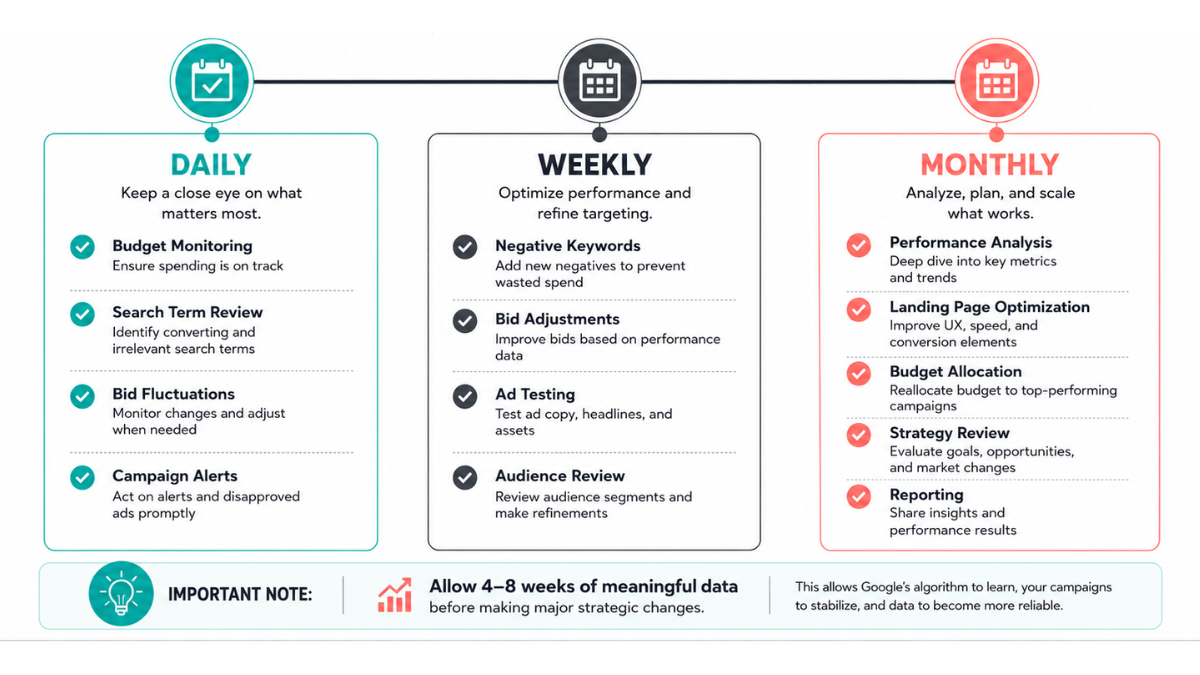
Google Ads should be checked weekly for budget, search terms, conversion issues, and obvious performance drops. Deeper strategic reviews usually need enough data to avoid overreacting, which often means looking at patterns over several weeks rather than judging one slow day.
The right cadence depends on budget, traffic volume, and competition. A high-spend campaign may need daily checks. A small local campaign may not have enough data to justify major changes every morning.
A practical optimization rhythm looks like this:
Daily: watch for tracking errors, budget overspend, disapproved ads, and sudden conversion drops.
Weekly: review search terms, negative keywords, landing page behavior, and campaign-level spend.
Monthly: review bidding strategy, audience performance, lead quality, landing pages, and conversion value.
Quarterly: revisit offer positioning, campaign structure, competitor messaging, and broader business goals.
The mistake I see most often is changing too many variables too quickly. If you adjust bids, keywords, landing pages, and conversion goals all at once, it becomes harder to know what actually improved performance.
How Do You Optimize Keywords and Search Terms in Google Ads?
You optimize Google Ads keywords by reviewing which searches trigger your ads, removing irrelevant traffic, and expanding into higher-intent phrases. The goal is not more traffic. The goal is more qualified traffic that is more likely to convert.
The search terms report is one of the first places I would look when reviewing an account. It shows the actual phrases people typed before clicking your ads. That is where wasted spend often reveals itself.
Negative keywords are critical because they tell Google what not to show your ads for. Google explains that negative keywords help exclude search terms and focus spend on the keywords that matter to your customers.
Use account-level negatives for terms that should never trigger ads across the account.
Use campaign-level negatives when one campaign should avoid a specific theme.
Use ad group-level negatives to keep intent clean between closely related groups.
Build long-tail keyword groups around specific buying intent.
Review exact and phrase match performance before expanding broadly.
Look for search terms that generate clicks but no qualified leads.
People still search for AdWords optimization and AdWords optimize because the old name stuck. The platform has changed, but the principle is the same: control what you pay for, and avoid paying for searches that do not match your offer.
How Can You Improve Your Google Ads Quality Score?

You improve Quality Score by making the keyword, ad, and landing page feel highly relevant to the same search intent. Google describes Quality Score as a diagnostic tool based on expected clickthrough rate, ad relevance, and landing page experience.
Quality Score is not the only measure of success, and Google says it is not a key performance indicator by itself. Still, it is useful because it points to relevance problems that can hurt campaign efficiency.
Here is how to read the three main inputs:
| Quality Score Input | What It Means | How to Improve It |
|---|---|---|
| Expected CTR | How likely your ad is to be clicked when shown for the keyword. | Write clearer headlines, match search intent, and test stronger offers. |
| Ad Relevance | How closely your ad matches the intent behind the search. | Keep ad groups focused and mirror the searcher's need in the ad copy. |
| Landing Page Experience | How useful and relevant the destination page is after the click. | Improve message match, page speed, mobile usability, and conversion paths. |
The fix is usually alignment. If someone searches for “emergency plumbing repair,” the ad and landing page should not speak broadly about “home services.” The tighter the path from search to ad to page, the stronger the experience feels.
What Is the Best Way to Optimize Google Ads Bidding and Budget?
The best bidding strategy depends on your business goal, conversion volume, and data quality. Google Smart Bidding uses AI to optimize for conversions or conversion value, but it works best when the campaign feeds it clean and meaningful conversion signals.
Google lists Target CPA, Target ROAS, Maximize Conversions, and Maximize Conversion Value as Smart Bidding strategies. In June 2026, Google also updated how bidding strategies are labeled, while keeping the underlying bidding behavior the same.
The important part is not simply turning on automation. It is choosing what the automation should learn from.
Use Maximize Conversions when volume matters and conversion tracking is clean.
Use Target CPA when you need to hold cost per acquisition near a defined goal.
Use Maximize Conversion Value when different leads, purchases, or actions have different value.
Use Target ROAS when revenue or lead value is tracked reliably.
Avoid feeding Smart Bidding too many weak conversion actions.
This last point matters. If newsletter signups, page views, form starts, and qualified sales calls all count the same, the algorithm may optimize toward easy actions instead of valuable ones. That is conversion signal hygiene, and it can make or break Google Ads conversion rate optimization.
How Do You Use Audience Targeting to Improve Google Ads ROI?
Audience targeting improves Google Ads ROI by helping campaigns prioritize people who are more likely to buy, return, or convert. Keywords show intent, but audience layers can add context such as location, demographics, previous site visits, or in-market behavior. The goal is to target the right audience instead of simply increasing traffic, ensuring your budget reaches people with genuine buying intent.
For growing businesses, targeting is often where small changes make a big difference. Two people may search the same phrase, but one is researching casually while another is ready to book a call.
Useful audience layers include:
Remarketing lists for people who visited your site but did not convert.
Customer match lists when you have compliant first-party data.
In-market segments that show active purchase behavior.
Geographic targeting for service areas, locations, and delivery zones.
Demographic layers when age, household status, or income bands affect fit.
Device and schedule data to see when conversions actually happen.
The goal is not to overcomplicate the campaign. The goal is to understand where strong intent is already showing up, then spend more carefully around those patterns.
Which Metrics Actually Determine Google Ads ROI?
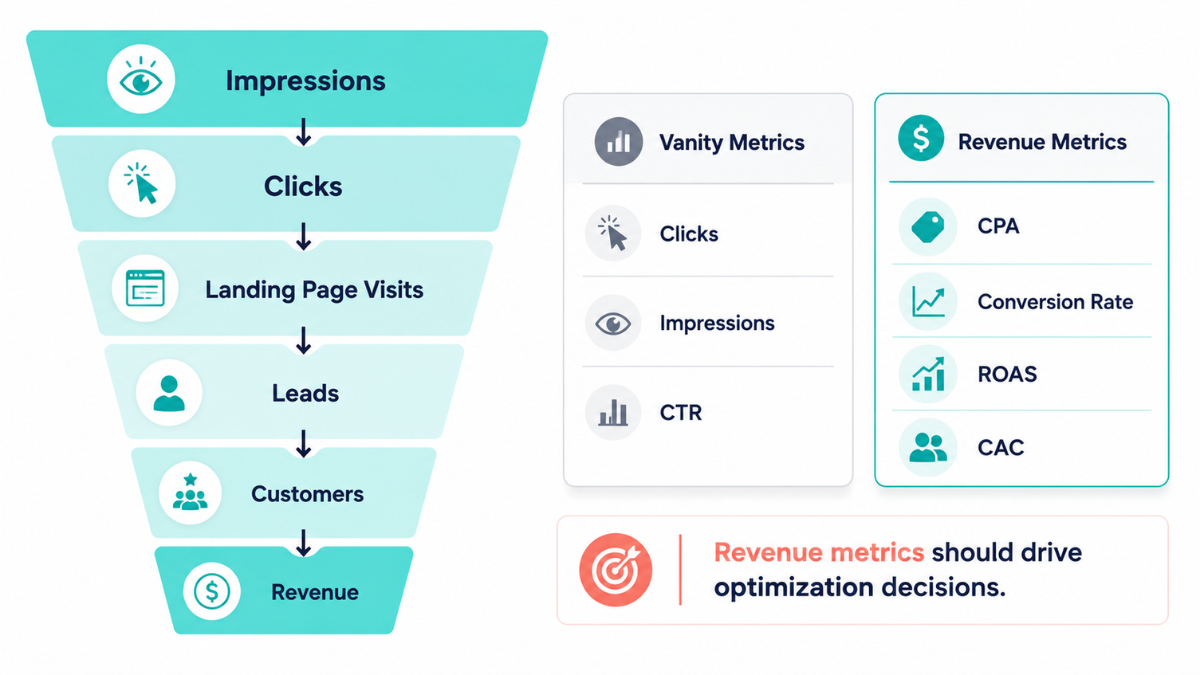
The metrics that determine Google Ads ROI are the ones tied to business outcomes: conversions, cost per acquisition, conversion rate, return on ad spend, and qualified lead quality. Clicks and impressions matter, but they do not prove that the campaign is profitable.
This is one of the biggest mindset shifts I encourage business owners to make. A campaign can look busy without being useful. It can also have a lower click volume and still perform better if those clicks turn into better leads.
Use this quick glossary to keep reporting focused:
| Metric | What It Tells You | Why It Matters |
|---|---|---|
| Clicks | How many people clicked the ad. | Useful for measuring traffic, but not enough to determine ROI. |
| CTR | How often people clicked after seeing the ad. | Helps evaluate ad relevance, messaging, and copy strength. |
| Conversion Rate | The percentage of visitors who completed the desired action. | Shows whether your ads and landing pages are working together effectively. |
| CPA | The average cost to generate one conversion. | Helps determine whether customer acquisition is financially sustainable. |
| ROAS | Revenue returned for every dollar spent on advertising. | Most valuable when revenue or lead value is accurately tracked. |
| CAC | Total customer acquisition cost. | Connects advertising spend to the true cost of acquiring a customer. |
| Qualified Leads | Leads that match your sales criteria. | Prevents campaigns from optimizing for volume instead of lead quality. |
Micro-conversions can still be useful. Button clicks, form starts, pricing page views, and booked-call page visits can help diagnose the funnel. They should not replace the main action you truly want the campaign to optimize for.
How Do Ad Copy and Assets Improve Google Ads Performance?
Ad copy and assets improve Google Ads performance by making the ad more useful, specific, and credible before someone clicks. Strong creative helps the right person choose your ad while discouraging poor-fit clicks that waste budget.
Google now refers to many former ad extensions as assets. These can include sitelinks, call assets, location assets, price assets, image assets, and other helpful additions that give searchers more context.
Ad copy should not simply describe the service. It should answer the searcher’s next question.
Use specific headlines instead of generic claims.
Match the promise in the ad to the landing page content.
Use sitelinks to send users to high-intent pages.
Use call assets when phone leads matter.
Use location assets for local intent.
Test offers, proof points, and calls to action over time.
Avoid changing every ad at once, or the test becomes difficult to read.
A helpful framework is the 4U test: make the message useful, urgent, unique, and ultra-specific. That does not mean every ad needs hype. It means the searcher should quickly see why your result is worth their click.
How Does Your Website Affect Google Ads Conversion Rate?
Your website affects Google Ads conversion rate because the click is only the first step. If the landing page loads slowly, feels disconnected from the ad, or makes the next action unclear, the campaign can lose money after doing its job.
This is where many campaigns quietly fail. The ad gets the visitor to the page, but the page does not finish the conversation. Google has reported that 53% of visits are likely to be abandoned if mobile pages take longer than three seconds to load.
Good landing pages usually include:
A headline that matches the ad promise.
A clear next step above the fold.
Fast mobile loading and compressed images.
Simple forms that ask only for necessary information.
Trust signals such as reviews, case studies, certifications, or proof points.
A layout that answers objections before the visitor leaves.
Tracking that shows which page and campaign produced the lead.
Google Ads conversion rate optimization is not only about campaign settings. It is also about what happens after the click.
Can AI Tools Replace Manual Google Ads Optimization?
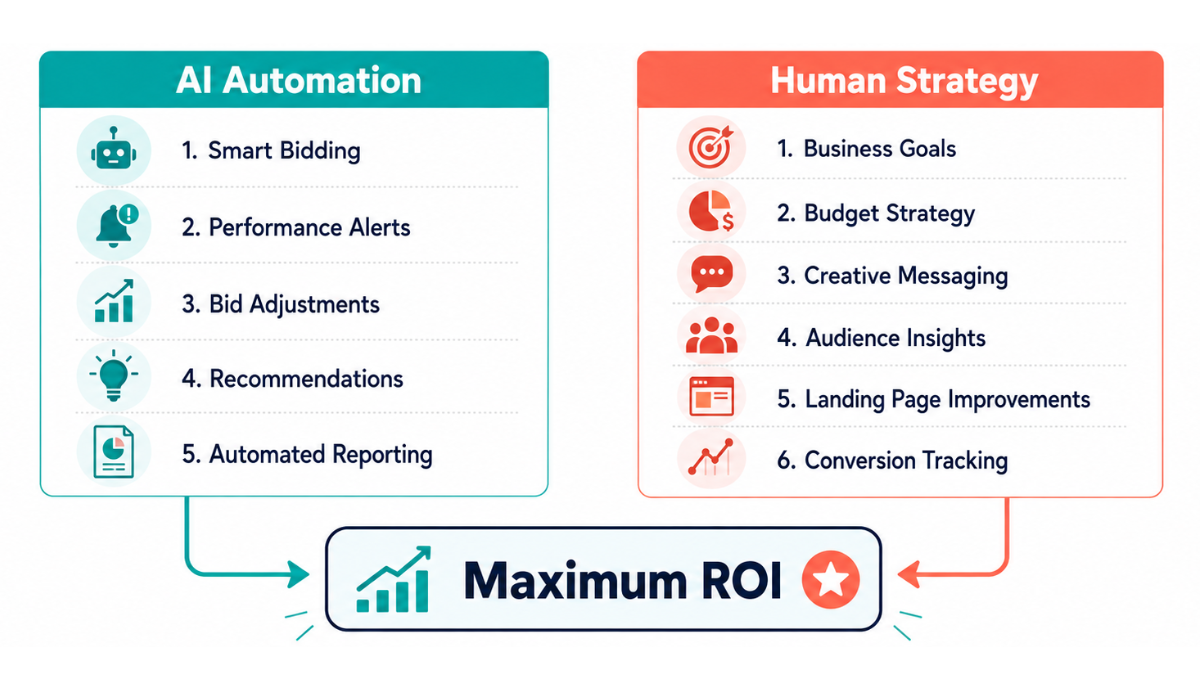
AI tools can support Google Ads optimization, but they do not replace strategic human review. Google’s newer advisor tools can surface recommendations, explain performance, and assist with campaign work, but they still need clean data and business context.
Google announced Ads Advisor and Analytics Advisor as Gemini-powered tools designed to help advertisers find insights and manage campaigns. Google also describes Ask Advisor as an AI-powered collaborator that works across Google marketing products.
That is useful, but it does not remove the need for judgment. AI can flag a campaign drop, but a human still needs to ask better business questions.
Is this conversion action actually valuable?
Is this lead type worth paying for?
Does the landing page match what sales hears from customers?
Should we follow this recommendation or dismiss it?
Is the campaign optimizing toward the right stage of the funnel?
Automation raises the floor. Strategy raises the ceiling. For most growing businesses, the safest approach is AI-assisted execution with human oversight from someone who understands paid search, reporting, and the business model.
Should You Optimize Google Ads Yourself or Work With a Specialist?
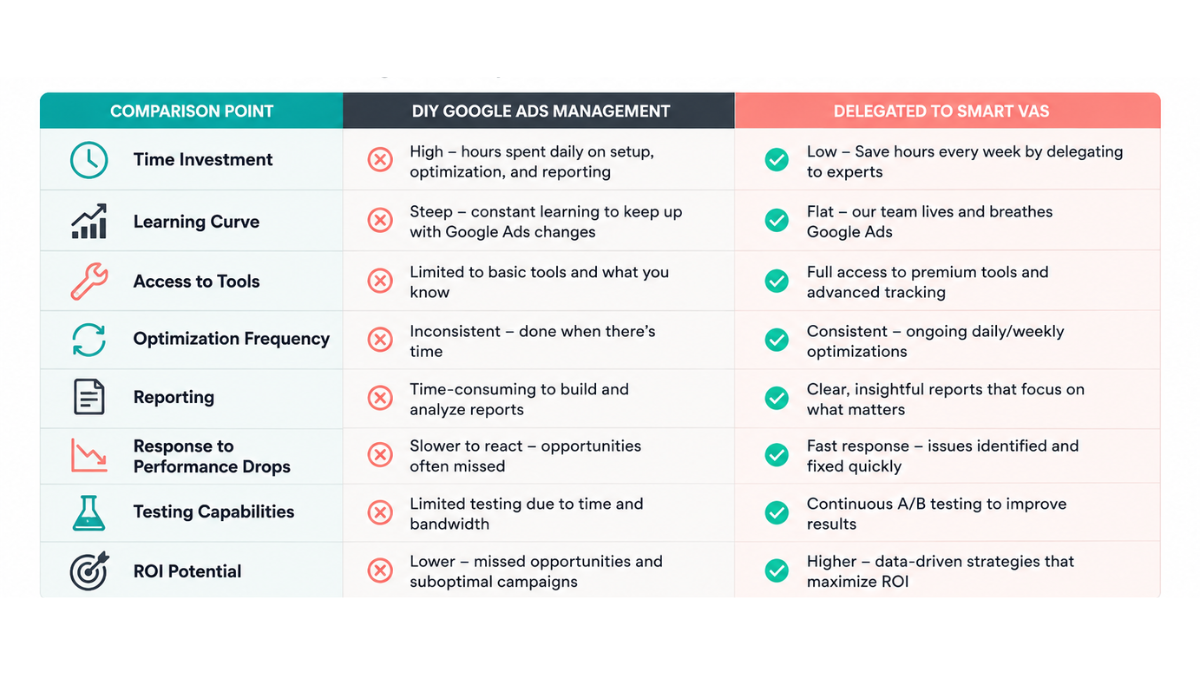
You can optimize Google Ads yourself if you have the time, data discipline, and confidence to manage keywords, bidding, audiences, ad testing, tracking, and landing page performance. A Specialist is usually a better fit when ad spend is growing or mistakes are becoming expensive.
There is nothing wrong with learning the platform internally. I just do not want business owners to underestimate the workload. Google Ads optimization sits at the intersection of analytics, copywriting, audience research, technical tracking, and budget management.
I have seen this with growing businesses that come to Smart VAs after trying to manage digital marketing execution on top of everything else. The issue is rarely that they do not care about results. It is that Google Ads requires constant attention, clean data, strong landing pages, and fast decision-making. On the Smart VAs reviews page, clients describe getting support with content creation, social media management, email marketing, website updates, and other marketing work. That kind of consistent execution is the same operational foundation paid search needs when a business wants better ROI without adding more work to the founder's plate.
Smart VAs supports growing businesses with a Google Ads Specialist as part of a Managed Specialist Team. The goal is not to take control away from you. It is to help you drive a consistent pipeline with certified paid search experts while staying focused on high-level growth.
Google Ads rarely works in isolation. Paid search often depends on landing page performance, SEO insights, CRM cleanup, and blog writing support when campaigns need stronger pages, clearer reporting, and better follow-through.
That is why Smart VAs is built around a fully managed team of specialists and broader managed marketing support, not one disconnected task owner.
When business owners ask how a Google Ads Specialist can improve ROI, I usually point back to the same pattern: cleaner signals, better testing, stronger landing pages, and less inconsistent optimization.
This is where delegation becomes strategic. Delegation is not just a task - it is a STRATEGY.
Ready to Make Your Ads Work Harder?
If your campaign is generating clicks but not enough qualified leads, Smart VAs can help you review the account structure, strengthen conversion signals, and build a more consistent optimization process. Schedule a discovery call to see whether managed Google Ads support fits your next stage of growth
What Is the Bigger Lesson for Better Google Ads ROI?
The bigger lesson is that Google Ads ROI improves when optimization is treated as a system. Keywords, bids, audiences, ad copy, landing pages, conversion tracking, and AI recommendations must work together instead of being managed in separate pieces.
A campaign can have the right keywords and still underperform because the landing page is weak. It can have strong ad copy and still waste money because conversion tracking is diluted. It can have good AI recommendations and still need a human to reject changes that do not match the business goal.
For growing businesses, the win is not constant tweaking. The win is a steady optimization rhythm that protects budget, improves lead quality, and gives leadership the confidence to make better decisions.
Smart Virtual Assistant
👍🤵
Smart Virtual Assistant 👍🤵
Frequently Asked Questions:
-
Most campaigns should be checked weekly for search terms, budgets, conversions, and tracking issues. Larger campaigns may need daily monitoring. Bigger strategy changes should usually wait until there is enough data to see a pattern, not just one unusual day.
-
This usually means the campaign is attracting the wrong traffic, the landing page does not match the ad promise, or the conversion path is unclear. Review search terms, negative keywords, landing page messaging, mobile speed, form friction, and whether the main conversion action is easy to complete.
-
Yes. Smaller budgets need optimization even more because there is less room for wasted clicks. Careful keyword selection, negative keywords, location targeting, clear conversion tracking, and landing page improvements help every dollar work toward qualified leads instead of broad traffic.
-
Some fixes, such as negative keywords or broken tracking repairs, can improve clarity quickly. Larger performance shifts often need several weeks of data. Many campaigns need around three months to mature, while full profitability can take longer depending on market, budget, and sales cycle.
-
Yes, when the campaign is optimized around stronger intent and cleaner conversion signals. Better search terms, tighter ad relevance, stronger landing pages, smarter bidding, and improved audience targeting can reduce wasted spend and help lower the cost of generating qualified leads.
-
There is no universal monthly cost because Google Ads spend depends on industry, location, competition, keywords, and goals. Google lets advertisers set an average daily budget and adjust it over time. The safer question is what budget can generate enough data to learn profitably.
-
AI tools can help analyze performance, surface recommendations, and speed up campaign work, but they still need human oversight. A person should confirm whether suggestions match the business goal, whether conversion data is clean, and whether the campaign is optimizing for valuable leads.
-
Quality Score is a diagnostic tool that estimates keyword-level relevance using expected CTR, ad relevance, and landing page experience. Ad Rank determines whether and where an ad appears in the auction. Quality Score is useful for diagnosis, but it is not the same as Ad Rank.
About the Author:
Kristy Yoder, Founder

Kristy Yoder is the Founder of Smart VAs, a virtual assistant agency that helps entrepreneurs grow through reliable administrative and digital marketing support. With extensive experience building and managing remote teams, she specializes in delegation, operational efficiency, and scalable business growth.
Passionate about helping business owners reclaim their time, Kristy leads Smart VAs in connecting entrepreneurs with skilled virtual professionals who provide dependable support and contribute to long-term success.